
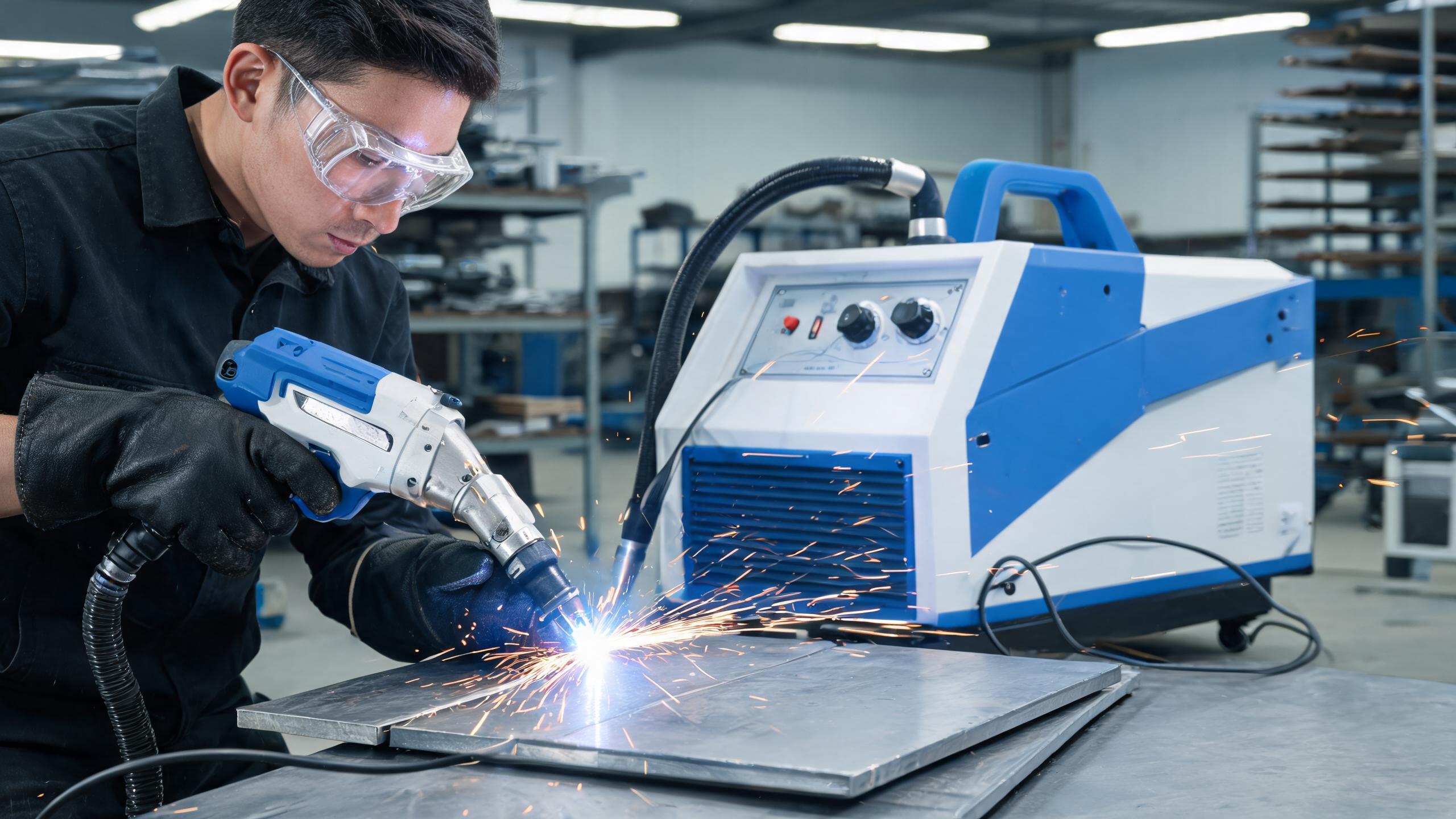
A practical analysis of handheld laser welding machine advantages, material and thickness limits, application scenarios, and safety considerations for B2B buyers - based on real 1,000W and 1,500W welder specifications.
Why Handheld Laser Welding Is Replacing Traditional Methods
Walk into a sheet metal fabrication shop today and you'll likely see a handheld laser welding machine in use - something that would have been rare just five years ago. The shift is driven by a simple reality: handheld laser welders deliver cleaner welds, faster cycle times, and lower post-weld processing costs than TIG or MIG welding for thin-to-medium gauge metals.
For B2B buyers evaluating portable laser welding equipment, the question is whether the technology fits your specific materials, production volume, and operator skill level. This article breaks down the real advantages, practical limitations, and application scenarios based on actual machine specifications.
How Handheld Laser Welding Works
A handheld fiber laser welding machine directs a high-energy laser beam through a flexible optical fiber to a handheld welding gun. The beam melts the base metal (and filler wire, if used) at the joint, creating a weld bead. Unlike traditional arc welding, the heat input is highly concentrated - the heat-affected zone (HAZ) is significantly narrower, which means less thermal distortion and less discoloration around the weld.
The welding gun itself is lightweight - typically around 1.8 kg - and connected to the main unit via an armored fiber cable. The operator guides the gun along the joint, and the machine maintains a consistent beam output regardless of hand speed variations within the effective range.
Practical Advantages Over TIG and MIG Welding
1. Speed
Handheld laser welding typically runs 2 to 4 times faster than TIG welding on the same joint. A 1,500W handheld welder can produce a 3 mm penetration weld on stainless steel in a single pass - a task that would require multiple passes with TIG and significantly more time.
2. Minimal Post-Weld Finishing
The concentrated heat input produces a narrow, clean weld bead with minimal oxidation (when using shielding gas). For stainless steel applications like kitchen equipment, elevator panels, and medical device housings, this often eliminates the need for grinding or polishing after welding - a major labor saving.
3. Low Thermal Distortion
Because the HAZ is narrow (typically 0.5–1.5 mm compared to 3–5 mm for TIG), thin-gauge materials (0.5–2 mm) stay flat. This is critical for applications where dimensional accuracy matters - enclosures, doors, and visible seams in consumer-facing products.
4. No Consumables for Autogenous Welds
When the joint design allows for autogenous welding (melting the base metal without filler), there's no wire to feed and no tungsten electrode to replace. The main consumable is shielding gas (argon or nitrogen), which is far cheaper than continuous TIG consumables.
What You Can Actually Weld: Material and Thickness Limits
Based on real machine specifications, here's what 1,000W and 1,500W handheld welders handle:
| Material | 1,000W Max Thickness | 1,500W Max Thickness |
|---|---|---|
| Stainless Steel | 2.0 mm | 3.0 mm |
| Carbon Steel | 2.5 mm | 3.0 mm |
| Aluminum | 1.5 mm | 3.0 mm |
For thicker materials (4 mm+), a fixed or automated laser welding system is more appropriate. Handheld welders are designed for thin-to-medium gauge work - pushing them beyond their rated capacity produces inconsistent penetration and risks damaging the optics.
Welding Gun Profiles and Flexibility
One of the underrated features of modern handheld laser welders is the welding waveform library. A 1,500W machine typically includes 50+ preset welding profiles - different beam patterns (spot, line, circle, spiral) optimized for different joint types, materials, and thicknesses. This means an operator can switch between welding a thin stainless sheet and a thicker carbon steel bracket by simply selecting a different profile on the touchscreen - no equipment changeover required.