
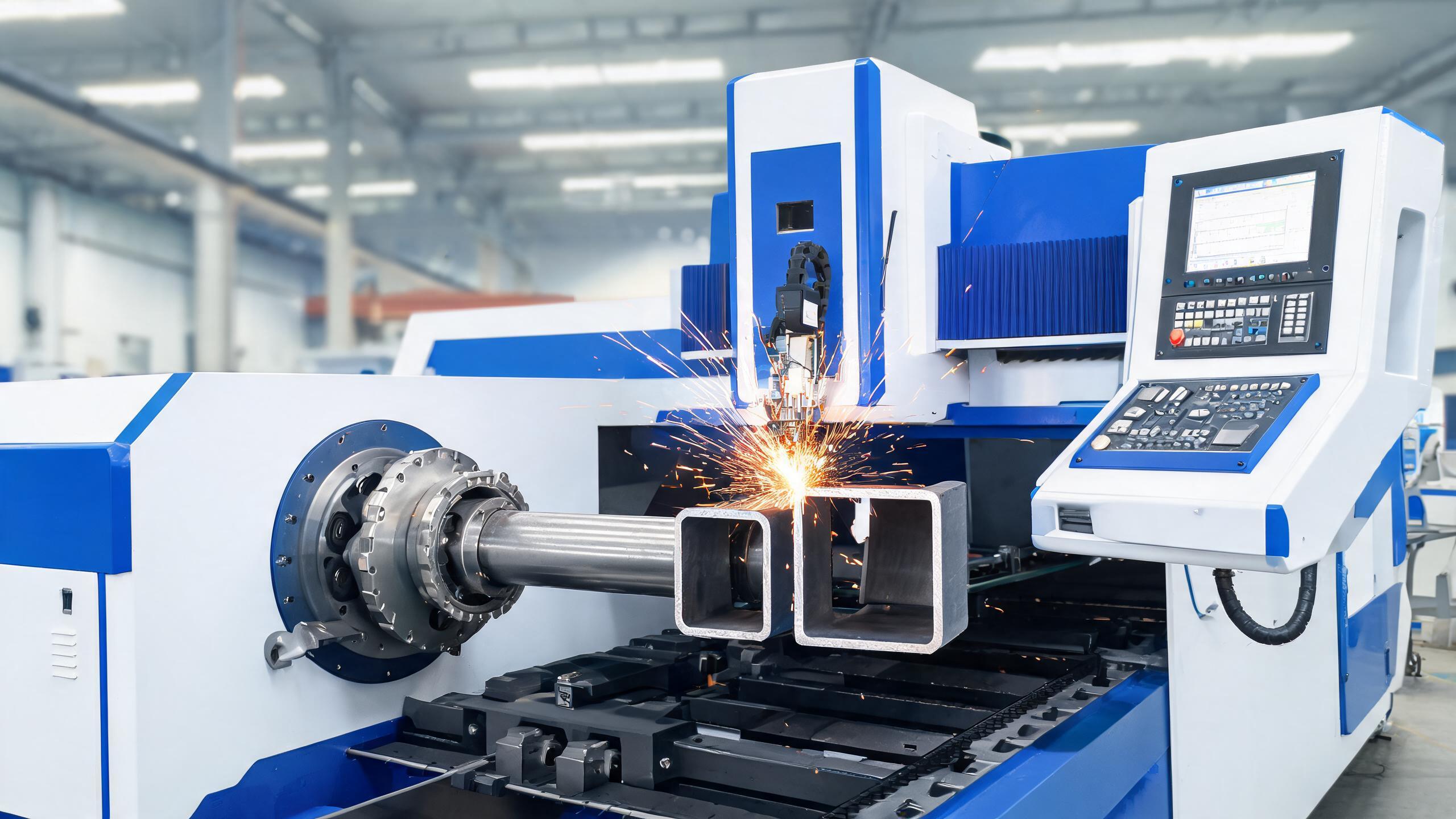
A technical analysis of tube laser cutting machines covering how the technology works, precision on round and square tubes, material capabilities, automation tiers, software requirements, and integration considerations for B2B fabricators.
Tube Laser Cutting: The Technology Reshaping Pipe Fabrication
If your workshop still cuts tubes and pipes with band saws, abrasive wheels, and manual drilling jigs, you're losing time on every single piece. Tube laser cutting machines eliminate multiple processing steps - cutting, hole-making, beveling, and marking - in a single setup, on a single machine. For B2B fabricators processing structural tubing, round pipes, or square profiles, this technology has moved from luxury to competitive necessity.
This article breaks down how tube laser cutting works, what precision and efficiency gains it delivers, and what to evaluate when considering a CNC tube cutting system for your operation.
How Tube Laser Cutting Works
A tube laser cutting machine combines a fiber laser source with a rotary axis (or chuck system) that rotates the tube while the laser head moves along its length. The laser beam cuts through the tube wall as it rotates, enabling complex cuts - straight cuts, miters, holes, slots, and intricate profiles - without changing tools.
Key components include:
- Fiber laser source - Typically 1,000W to 6,000W depending on tube wall thickness. The same RAYCUS, IPG, and GW sources used in flat-sheet cutters power tube systems.
- Rotary chuck or drive system - Secures and rotates the tube with precise angular positioning. Dual-chuck systems support longer tubes and allow continuous loading.
- Automatic feeding system - Loads raw tube lengths (typically 3–6 meters) into the cutting zone, sometimes with bundle-loading capability for unattended operation.
- CNC control system - Programs the cut path, rotary speed, and laser parameters. Systems like CypCut support tube-specific programming with 3D simulation.
Cut Quality and Precision on Round and Square Tubes
The precision expectations for tube laser cutting are similar to flat-sheet systems - positioning accuracy in the ±0.03 mm range is standard for quality machines. But tube cutting adds a rotational dimension, which introduces different variables:
- Rotary positioning accuracy: The chuck must maintain angular precision as the tube rotates. Any backlash or slippage translates directly to cut error.
- Tube straightness and ovality: No tube is perfectly round or straight. Quality machines compensate for tube deviations through software, but severely out-of-spec tubing will produce inconsistent results regardless of machine precision.
- Wall thickness variation: Laser power must adjust for variations in wall thickness along the tube length, especially on welded tubing.
For square and rectangular profiles, the machine cuts each flat face in sequence as the chuck rotates 90 degrees between faces. Corner quality depends on laser power control and cutting speed at the transition points.
What a Tube Laser Replaces
Consider a typical structural tube fabrication job: cutting a square tube to length, drilling two mounting holes, and adding a 45-degree miter cut at one end. With conventional methods, this involves:
- Cutting to length on a band saw
- Transferring to a drill press for holes
- Transferring to a miter saw or angle grinder for the bevel
- Deburring all cut edges by hand
A tube laser cutting machine completes all four operations in a single cycle, typically in under a minute for a standard 40×40 mm square tube. The elimination of material handling between stations is where the real time savings compound - not just in labor, but in reduced work-in-process inventory and floor space.
Material and Thickness Capabilities
Tube laser cutting machines handle the same material range as flat-sheet fiber lasers:
- Carbon steel tubes: Up to 8 mm wall thickness with a 3,000W source; up to 12 mm with a 6,000W source
- Stainless steel tubes: Up to 6 mm with a 3,000W source
- Aluminum tubes: Up to 4 mm with a 3,000W source
- Galvanized tubes: Clean cuts with minimal dross when using nitrogen assist gas
Round tubes up to 220 mm diameter and square/rectangular profiles up to 200×200 mm are within the typical capacity range. Maximum tube length is usually 6,000 mm with optional extensions to 9,000 mm for structural applications.
Automation Tiers: From Manual to Fully Automated
Tube laser cutting systems come in three automation tiers, each suited to different production volumes:
Entry-Level: Manual Loading
The operator manually loads each tube into the chuck, positions it, and starts the cut cycle. Suitable for low-volume, high-mix shops processing 20–50 tubes per shift. Cycle time includes significant loading overhead, but the machine cost is lower.
Mid-Range: Semi-Automatic Loading
A powered roller conveyor or magazine feeds tubes to the chuck automatically, but the operator still monitors and triggers each load. Throughput increases to 80–150 tubes per shift. This tier is the sweet spot for most fabrication shops.
High-End: Fully Automated Bundle Loading
A bundle loader handles 10–20 tubes at once, feeding them continuously with automatic measurement and alignment. Unattended operation is possible for extended periods. Throughput can exceed 300 tubes per shift. This tier justifies its cost when production volume exceeds 5,000 tubes per month.
Software and Programming
Modern tube laser machines use specialized CAM software that handles tube-specific operations:
- 3D simulation - Visualize the cut path on the actual tube profile before cutting
- Parametric library - Pre-programmed cut shapes (holes, slots, miters, branches) that can be parameterized by dimension
- Nesting optimization - Maximize material utilization by optimizing cut placement along the tube length
- Common cut-line - Share a single cut line between adjacent parts to reduce cycle time and material waste
CypCut and TubePro are common software platforms bundled with Chinese-manufactured tube laser systems. They support DXF, DWG, and IGES import formats, making it straightforward to integrate with existing CAD workflows.
Key Specifications to Evaluate
When comparing tube laser cutting machines, focus on these specifications:
- Laser power: 1,000W–3,000W for thin-wall tubes; 6,000W for thick-wall structural tubes
- Tube diameter range: Ensure the chuck system accommodates your typical tube sizes
- Maximum tube length: 6,000 mm standard; longer for structural work
- Number of chucks: Dual-chuck systems provide better support for long tubes and enable continuous cutting
- Positioning accuracy: ±0.03 mm is standard for quality machines
- Automation level: Match the loading system to your production volume
Integration Considerations
Adding a tube laser cutting machine to your facility requires planning beyond the machine itself:
- Floor space: Tube lasers are longer than sheet lasers due to the feeding system. Plan for at least 12–15 meters of linear space including loading and unloading zones.
- Power and gas supply: A 3,000W system typically requires 3-phase 380V power and compressed air or nitrogen at 1.5–2.5 MPa.
- Exhaust and filtration: Cutting galvanized or painted tubes generates fumes that require extraction. Ensure your dust collector is rated for metal dust with appropriate filter media.
- Operator training: While the CNC interface simplifies operation, programming complex tube cuts requires training. Factor in 2–4 weeks of operator onboarding.
Conclusion
Tube laser cutting machines deliver measurable productivity gains for fabricators processing round, square, and rectangular tubes. The ability to cut, drill, bevel, and mark in a single setup eliminates material handling bottlenecks and reduces labor costs. When evaluating systems, match the laser power, chuck capacity, and automation tier to your specific material range and production volume - and verify that the software supports your CAD workflow.