
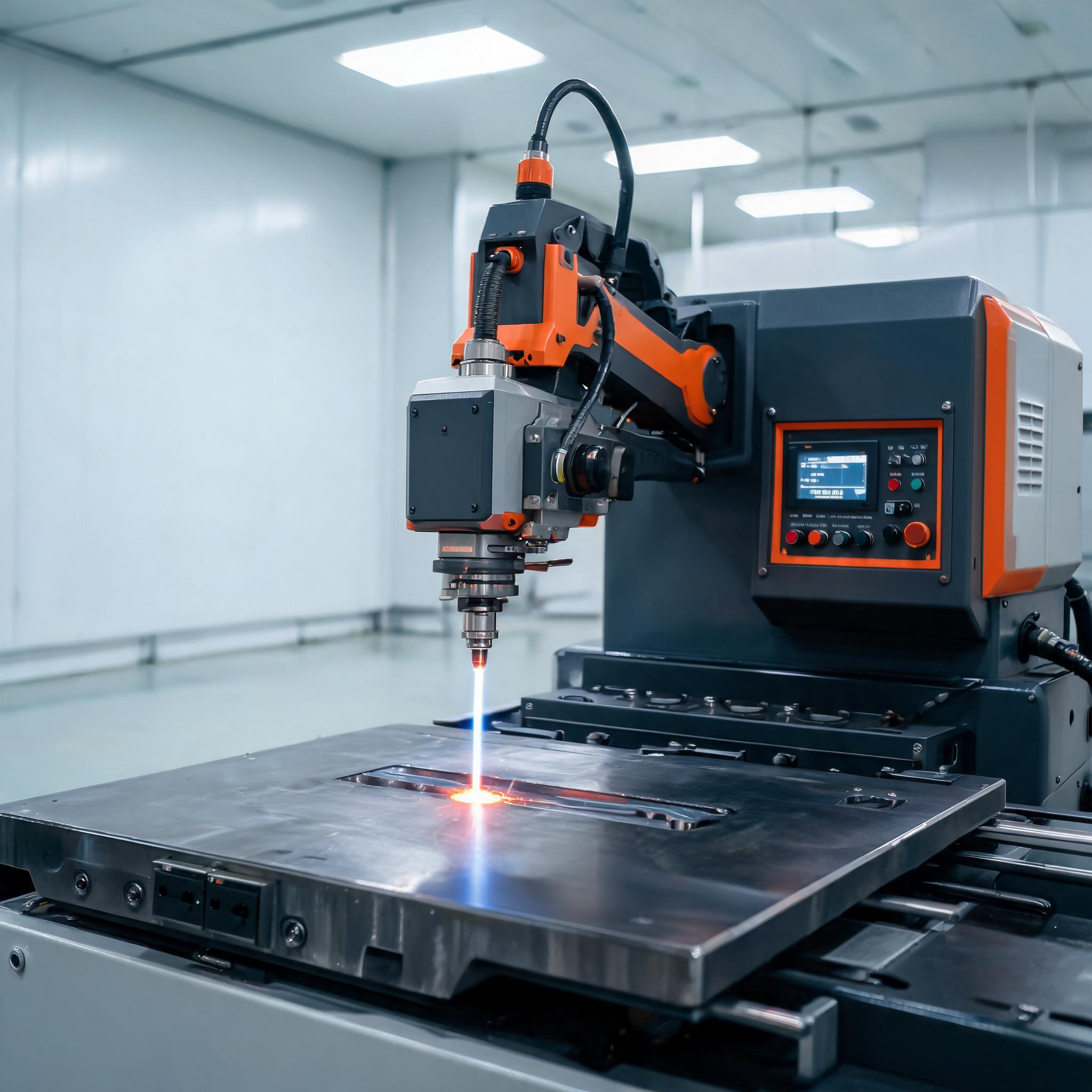
A practical breakdown of 5-axis CNC machine costs by type and configuration, plus a head-to-head comparison with fiber laser cutting to help you choose the right technology for your shop.
BUYER GUIDE
If you're searching "how much does a 5 axis cnc machine cost," you're likely evaluating a major capital investment. The short answer: a new 5-axis CNC machine typically ranges from $90,000 to $500,000+, depending on configuration, size, and brand. But the real question isn't just the sticker price—it's whether 5-axis machining or fiber laser cutting is the right technology for your production mix. This guide breaks down the price ranges, the key differences, and how to make a cost-effective decision.
- Entry-level 5-axis CNC machines start around $90,000; production-grade models typically run $150,000–$400,000; large-format and high-precision machines can exceed $500,000.
- 5-axis CNC is for complex 3D geometries, tight tolerances, and multi-sided machining in one setup—ideal for aerospace, medical, and mold & die.
- Fiber laser cutting is for flat sheet metal profiling—fast, low per-part cost, but limited to 2D cutting (with some 3D tube/pipe options).
- Total cost of ownership (TCO) matters more than purchase price: tooling, maintenance, floor space, and labor all differ significantly.
- Your decision should be driven by part geometry, material, tolerance, and production volume—not by which machine is cheaper upfront.
What Drives 5-Axis CNC Price?
5-axis CNC price varies widely because the machines are built to different scales and precision levels. Here are the main factors that push the price up or down:
- Machine size (travel): A compact unit with 400×400×300 mm travel costs far less than a gantry machine with 2000×2000×800 mm travel.
- Spindle power and speed: Higher RPM spindles (15,000–30,000 RPM) and higher torque for hard metals increase cost.
- Rotary table design: Trunnion tables are common and cost-effective; swivel-rotary heads (for larger parts) are pricier.
- Control system and software: Advanced CAM software, probing, and automation add to the package.
- Brand and build quality: European and Japanese machines often command a premium; Taiwanese and Chinese machines offer lower entry points.
- Options: Automatic tool changers, chip conveyors, high-pressure coolant, and thermal compensation systems all add cost.
5-Axis CNC Price Ranges by Type
To give you a realistic picture, here are typical price bands for new 5-axis CNC machines (in USD, as of 2024–2025). These are estimates—actual quotes depend on configuration and supplier.
| Machine Type | Typical Price Range (USD) | Typical Applications |
|---|---|---|
| Compact / entry-level 5-axis (trunnion) | $90,000 – $180,000 | Prototyping, small molds, education, light production |
| Mid-range production 5-axis (vertical) | $180,000 – $350,000 | Aerospace brackets, medical implants, die/mold components |
| Large-format / gantry 5-axis | $350,000 – $600,000+ | Large aerospace structures, automotive body dies, energy components |
| 5-axis horizontal machining centers | $400,000 – $800,000+ | High-volume precision parts, automotive, heavy industry |
Note: Used 5-axis machines can be found from $40,000, but factor in retrofitting, maintenance, and potential downtime.
5-Axis vs. Laser Cutting: Not the Same Tool
Comparing 5-axis CNC machining to fiber laser cutting is like comparing a milling machine to a pair of scissors—they solve different problems. Here's a side-by-side look at what each does best.
| Criteria | 5-Axis CNC Machining | Fiber Laser Cutting |
|---|---|---|
| Process | Subtractive (milling/drilling) with multi-axis movement | Thermal cutting with a focused laser beam |
| Part geometry | Complex 3D shapes, contours, undercuts, deep cavities | Primarily 2D flat sheet profiles; some 3D tube/pipe cutting |
| Materials | Metals (steel, aluminum, titanium), plastics, composites | Sheet metal: steel, stainless, aluminum, copper, brass |
| Thickness capability | Solid blocks up to several inches (depends on machine) | Sheet up to ~1 inch for steel (thinner for reflective metals) |
| Tolerances | ±0.005 mm to ±0.025 mm typical | ±0.1 mm to ±0.2 mm typical (kerf width matters) |
| Surface finish | Excellent—can achieve mirror finishes with proper tooling | Good—but leaves a heat-affected zone (HAZ) and dross |
| Setup time | Longer—requires CAM programming, tooling, and workholding | Short—once the file is prepared, cutting can start quickly |
| Per-part cost (high volume) | Higher—tool wear, longer cycle times | Lower—fast cutting, minimal tooling |
| Typical purchase price | $90,000 – $500,000+ | $30,000 – $200,000 (fiber lasers for sheet metal) |
When to Choose 5-Axis CNC
Investing in a 5-axis CNC machine makes sense when your parts have one or more of these characteristics:
- Complex 3D geometry: Impellers, turbine blades, medical implants, mold cores—features that cannot be produced on a 3-axis or with a laser.
- Multi-sided machining: You need to machine five or six faces without re-fixturing, which reduces setup errors and lead time.
- Tight tolerances: If you need ±0.01 mm or better, 5-axis milling is the way to go.
- Hard materials: Machining hardened steels, titanium, or Inconel requires the rigidity and spindle power of a milling machine.
- Low-to-medium volumes with high complexity: For prototypes and small batches of intricate parts, 5-axis is cost-effective compared to multiple setups.
When to Choose Fiber Laser Cutting
Fiber laser cutting is the better choice for:
- Flat sheet metal parts: Brackets, enclosures, chassis, panels—anything that can be cut from a flat sheet.
- High-volume production: Laser cutting is extremely fast, especially for thin to medium thickness steel.
- Simple geometries with tight deadlines: If you need quick turnaround on 2D profiles, lasers are hard to beat.
- Lower initial investment: A fiber laser machine is often half the price of a 5-axis CNC, making it accessible for smaller shops.
Cost of Ownership: Beyond the Purchase Price
When comparing 5-axis CNC price to a fiber laser, don't stop at the machine cost. Consider the full picture:
- Tooling: 5-axis machining requires end mills, drills, and holders—ongoing costs. Lasers use no physical tools, but require gas (nitrogen/oxygen) and lenses.
- Maintenance: CNC machines have moving parts, spindles, and hydraulics that need regular service. Lasers have optics and resonators that degrade over time.
- Floor space: 5-axis machines are large and heavy; lasers are more compact but need a fume extraction system.
- Labor: Skilled CNC programmers are harder to find and cost more than laser operators. 5-axis programming requires advanced CAM skills.
- Utilities: Lasers consume significant electricity (often 10–20 kW), while CNC machines use less but require coolant and air compressors.
How to Get an Accurate 5-Axis CNC Price Quote
To get a meaningful quote, prepare these details before contacting suppliers:
- Part drawings or CAD files: Provide a sample part with critical dimensions and tolerances.
- Material and hardness: Specify the material you'll be machining (e.g., 6061-T6 aluminum, P20 tool steel).
- Production volume: Annual or monthly quantity—this determines whether you need a high-speed or heavy-duty machine.
- Required accuracy: Be honest about your tolerance needs; tighter tolerances cost more.
- Future flexibility: Do you plan to machine larger parts or different materials later? Choose a machine that can grow with you.
Ask suppliers for a total package quote that includes installation, training, and warranty. Some suppliers offer financing or leasing options, which can ease the upfront burden.
Frequently Asked Questions
Is a 5-axis CNC machine worth the cost for a small shop?
It depends. If you regularly produce complex parts that currently require multiple setups on a 3-axis machine, a 5-axis can pay for itself in reduced labor and scrap. For simple flat parts, a 3-axis or a laser is more cost-effective.
Can a fiber laser cut 3D shapes?
Most fiber lasers are 2D or 2.5D (with a Z-axis for focus). Some specialized 3D laser cutting systems exist for tube and pipe, but they cannot match the complexity of 5-axis milling.
What is the typical lead time for a 5-axis CNC machine?
Lead times vary from 2 to 6 months depending on the manufacturer and customization level. Used machines may be available immediately, but require inspection.
Are there cheaper alternatives to full 5-axis?
Yes—3+2 machining (positioning a tilting head) can handle many 5-sided parts at a lower cost. True simultaneous 5-axis is only needed for complex contours.
Final Thoughts
Choosing between a 5-axis CNC machine and a fiber laser cutter is not about which is "better"—it's about which technology matches your parts and production goals. If you're machining complex 3D components with tight tolerances, a 5-axis CNC is the right investment, and the 5-axis CNC price is justified by the value it adds. If you're cutting flat sheet metal in high volumes, a fiber laser offers faster payback.
Before making a decision, talk to multiple suppliers, request sample cuts or test parts, and calculate your total cost of ownership. And remember: the cheapest machine is not always the most profitable one—look for the one that gives you the best return on your specific work.
Need help evaluating a 5-axis CNC machine for your shop? Contact our team for a consultation—we'll help you compare specifications and pricing based on your actual parts.