
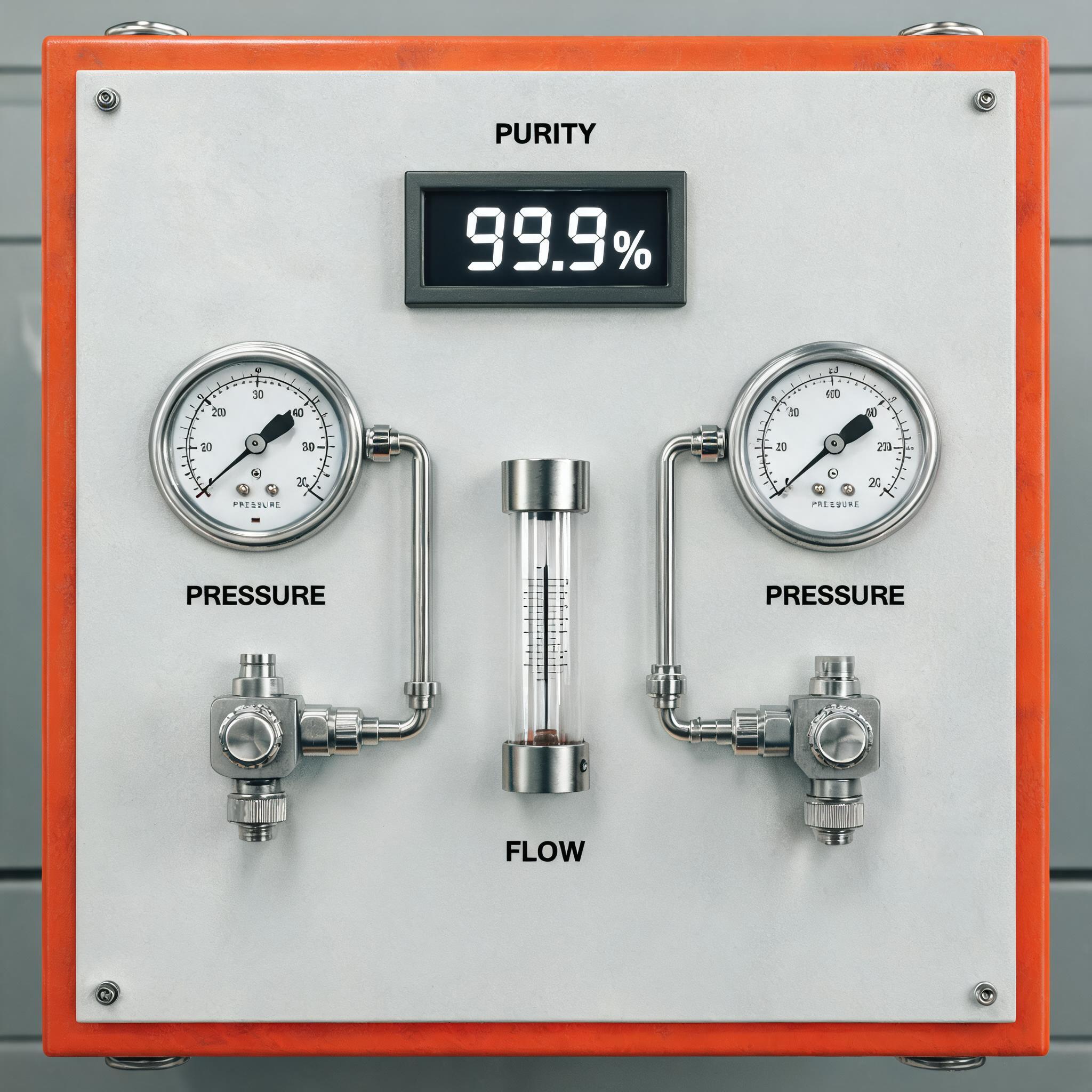
A PSA nitrogen generator's price tag reflects the purity and flow you specify, the air compressor and dryer that must feed it, filtration consumables, long-term sieve replacement, and installation. This breakdown explains each cost driver in plain terms and shows how the 6–12 month payback versus bottled nitrogen is calculated—plus what to include in a quote request.
Cost Breakdown
When you request a quote for a PSA nitrogen generator, the number that comes back is not a single line item. It is the sum of several decisions you make—or leave to the supplier. This article breaks down where the money actually goes, so you can read a quotation with confidence and compare offers on equal terms.
For reference, the PSA nitrogen generator system from Xinhong is specified at 99.9% purity and 10–80 m³/h flow, requiring a compressed air supply at 0.6–0.8 MPa. Those two figures—purity and flow—are the starting point for every cost driver below.
Key takeaways
- Upfront cost is dominated by the generator itself, sized by purity and flow.
- The air compressor and dryer are companion investments that must match the generator's demand.
- Recurring running costs after payback are mainly compressed air electricity and monthly filter cartridge replacement; long-term items such as sieve replacement, valve maintenance and sensor calibration also belong in total cost of ownership.
- Installation and integration are separate line items.
- Typical payback versus bottled nitrogen is 6–12 months, depending on usage and local gas pricing.
1. Upfront purchase: the generator itself
The PSA generator is the core purchase. Its cost is driven by two specifications:
- Purity. Higher purity requires more adsorbent, longer cycle times, and often a larger sieve bed. A 99.9% system is the standard for many laser cutting and food packaging applications; going beyond that increases cost non-linearly.
- Flow rate. The 10–80 m³/h range covers small workshop systems up to multi-nozzle cutting tables. A higher flow setting requires a larger generator, more sieve material, and bigger valves.
Because these two variables interact, the same nominal model can carry different price tags depending on the flow and purity you specify. Always quote against your actual daily nitrogen consumption, not a rounded-up guess.
2. Companion equipment: air compressor and dryer
A PSA generator does not produce nitrogen from nothing—it separates nitrogen from compressed air. That means you need a compressor and a dryer upstream. These are often quoted separately, and they can represent a significant share of the total project cost.
- Air compressor. Required capacity depends on the flow rate setting. The generator's specification calls for 0.6–0.8 MPa supply; a compressor that cannot maintain that pressure under load will starve the generator and reduce purity.
- Air dryer. Moisture damages the carbon molecular sieve. A refrigerated or desiccant dryer is necessary to bring the dew point down before air enters the generator.
- Filtration. Coalescing filters remove oil and particulates. These are usually included in the generator's internal filtration, but pre-filtration at the compressor outlet may be needed depending on your compressor type.
When comparing quotes, check whether the compressor and dryer are included or excluded. A lower generator price with a missing dryer is not a saving—it is a future repair bill.
3. Running costs: electricity and filter cartridges
Once the system is installed, the recurring costs come down to two items:
- Compressed air electricity. The generator itself consumes little power; the compressor does the work. Your electricity cost is therefore tied to the compressor's efficiency and the flow rate you run.
- Filter cartridge replacement. Monthly replacement of filter cartridges is the main consumable cost. These protect the sieve and maintain purity.
Beyond these recurring items, occasional long-term costs such as sieve replacement, valve maintenance and sensor calibration also belong in a total cost of ownership calculation (see section 4).
Unlike typical bottled-supply contracts, a PSA system does not consume chemicals, require fuel deliveries or carry cylinder rental; the exact saving depends on how your local gas supplier structures its pricing. That is the core economic advantage over bottled nitrogen.
4. Long-term maintenance: sieve replacement and service
Carbon molecular sieve has a finite life. Depending on air quality and cycle frequency, replacement may be needed every few years. This is a long-term cost, not an annual one, but it should be planned for.
Other long-term items include valve maintenance and occasional sensor calibration. These are not monthly expenses, but they belong in a total cost of ownership calculation.
5. Installation and integration
Installation covers piping, electrical connection, and commissioning. If the generator must integrate with an existing cutting machine or production line, there may be additional controls work. These costs vary by site and are usually quoted separately.
Ask your supplier what is included in the standard installation scope and what is charged as extra.
6. The payback logic: 6–12 months versus bottled nitrogen
The typical payback period for a PSA nitrogen generator compared with bottled nitrogen is 6–12 months. That range is wide because it depends on your specific situation. Here is what moves you toward the short end or the long end:
| Factor | Shortens payback (toward 6 months) | Lengthens payback (toward 12 months) |
|---|---|---|
| Daily nitrogen usage | High usage—more cylinders replaced | Low usage—small cylinder spend |
| Local bottled nitrogen price | High delivered cost per cylinder | Low subsidized gas price |
| Electricity cost | Low industrial tariff | High tariff or inefficient compressor |
| System sizing | Right-sized to actual flow | Oversized—paying for unused capacity |
The 6–12 month range is a typical figure, not a guarantee. Your actual payback depends on the factors above.
After payback, the recurring running costs are compressed air electricity and monthly filter cartridges, with occasional long-term items such as sieve replacement and valve maintenance on top. That is the structural advantage: you stop paying for gas molecules and start paying for air and maintenance.
7. Quote-request checklist
To get an accurate quote—and to compare suppliers fairly—provide the following information:
- Cutting machine power level (if applicable) and the number of nozzles or cutting heads.
- Daily nitrogen usage in cubic meters per hour or per day, and the pressure required at the point of use.
- Required purity (e.g., 99.9%).
- Available compressed air supply—pressure and capacity of your existing compressor, or ask for a compressor and dryer to be included.
- Site conditions—ambient temperature, altitude, and power supply.
With these details, the supplier can size the generator correctly and give you a breakdown that separates the generator, companion equipment, installation, and consumables. That is the only way to compare the total cost of ownership, not just the headline price.
For a system that meets the 99.9% purity and 10–80 m³/h flow specification, start with the PSA nitrogen generator system page and send your usage details for a tailored quote.