
Большинство цехов волоконной лазерной резки, оплачивающих азот в баллонах или криогенных ёмкостях, в конечном итоге оценивают генерацию PSA на площадке. В статье сравниваются структура затрат, чистота и стабильность потока, логистика и масштабируемость двух способов подачи газа, а также определены режимы работы, при которых доставка баллонов по-прежнему целесообразна.
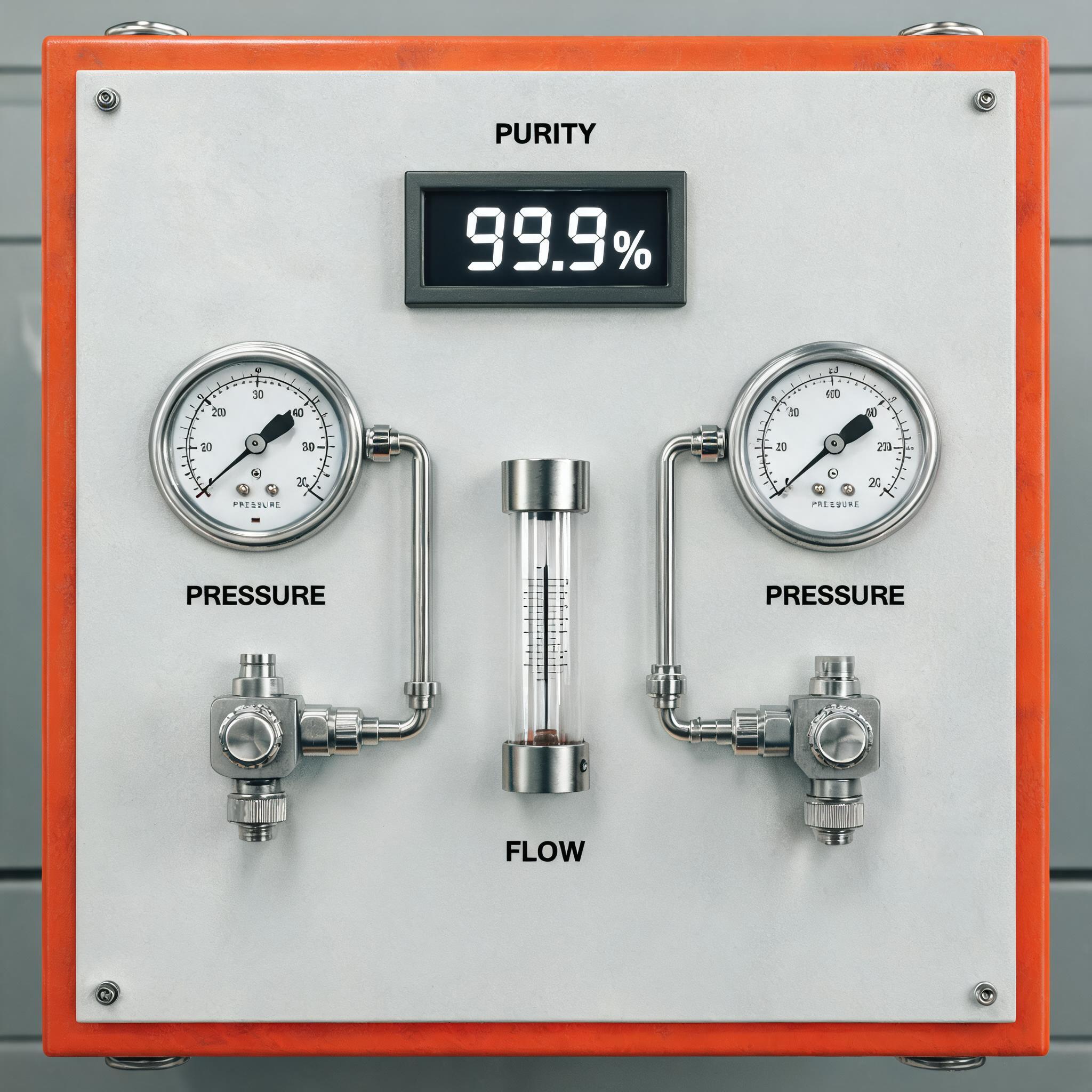
If you cut stainless steel or aluminum on a fiber laser, nitrogen is likely one of your largest consumable expenses — often second only to the machine payment itself. Most shops start with delivered gas: high-pressure cylinders bundled in racks, or a liquid dewar on a rental agreement. That works fine at low volume. But as cutting hours accumulate, the delivery model starts to look expensive, and the question becomes whether an on-site PSA nitrogen generator system pays for itself.
This article breaks the comparison down the way a production manager should: cost structure, purity and flow stability, logistics, and scalability. It ends with the honest counterpoint — the situations where cylinders are still the right answer.
Why Nitrogen Matters for Fiber Laser Cutting
Nitrogen serves as the assist gas when you need clean, oxide-free cut edges — typically on stainless steel, aluminum, and galvanized material destined for welding or finishing without post-processing. The nitrogen jet blows molten material through the kerf and shields the cut zone from oxygen, which is what prevents the dark oxide layer you get when cutting with air or oxygen.
Two requirements follow from that function:
- Purity. Oxygen contamination in the assist gas produces discoloration and oxide formation on the cut edge. Laser cutting generally requires nitrogen at roughly 99.9% purity or higher, and thicker stainless sections benefit from even tighter margins.
- Pressure and flow stability. The cutting head needs consistent pressure (commonly in the range of 0.6–0.8 MPa for many applications, higher for thick plate on some machines). Pressure droop mid-job — exactly what happens as a cylinder bank empties — causes edge quality inconsistency and scrapped parts.
Keep those two requirements in mind, because they are where the differences between supply modes show up most clearly.
How Cylinder and Dewar Supply Works — and What It Costs
Delivered nitrogen comes in three common formats:
- Single high-pressure cylinders (roughly 200–300 bar fill pressure, a few cubic meters of gas each). Convenient for very low consumption, but you pay a premium per cubic meter.
- Cylinder manifolds/packs — bundles of cylinders plumbed together with an automatic changeover. Better flow continuity, but each cylinder still carries its own fill charge.
- Liquid dewars and micro-bulk tanks — more economical per cubic meter than cylinders, but introduce rental fees and boil-off losses, since liquid nitrogen continuously evaporates even when you are not cutting.
The cost structure here has several layers that buyers often undercount:
- Gas commodity cost. The per-cubic-meter price, which is highest for single cylinders and lowest for bulk liquid — but never approaches the cost of separating your own nitrogen from air.
- Delivery and fuel surcharges. Charged on every drop, and they rise with fuel prices and distance.
- Rental/hazmat fees. Monthly cylinder or dewar rental, plus handling charges that appear as separate line items.
- Boil-off and residual losses. Liquid accounts lose product to evaporation; cylinder returns often retain residual gas you paid for but cannot use.
- Administrative overhead. Ordering, receiving, reconciling invoices, and managing return logistics all consume labor hours.
Individually these line items look small. Stacked together, they mean the delivered gas price per cubic meter can be a multiple of what it costs to generate nitrogen on site — which is the whole economic argument for generation. We walk through the generator side of the ledger in detail in our PSA nitrogen generator cost breakdown.
How On-Site PSA Generation Works
A Pressure Swing Adsorption (PSA) generator takes compressed air — which your shop likely already produces — passes it through carbon molecular sieve columns that adsorb oxygen, moisture, and CO2, and delivers nitrogen continuously. The columns alternate between adsorption and regeneration, so output is steady as long as the compressor feeds it.
The Xinhong PSA nitrogen generator for laser cutting is specified at 99.9% purity, 10–80 m³/h flow, and 0.6–0.8 MPa output pressure, in a compact footprint with CE certification. Because the gas is produced from ambient air, the ongoing input cost is essentially electricity to run the compressor — no delivery, no rental, no boil-off. Xinhong states a 6–12 month return on investment on the product page for shops eliminating bottled nitrogen; your actual payback depends on consumption and local gas pricing, so treat that range as the stated figure rather than a guarantee for every shop.
For a broader look at how this model replaces delivered gas entirely, see our article on on-site nitrogen generation replacing cylinder and bulk supply. And for the complete picture — assist gas selection, purity, generator sizing and cost — see our guide to assist gas and PSA nitrogen generation for laser cutting shops.
Head-to-Head Comparison
Cost Structure
Cylinders and dewars are pure operating expense: you pay per cubic meter forever, plus delivery, rental, and surcharges that you do not control. A PSA generator converts most of that into a fixed capital purchase plus electricity and routine maintenance (filter elements, periodic molecular sieve service). The more you cut, the flatter your per-cubic-meter nitrogen cost becomes. At low consumption, the capital cost per cubic meter may still exceed the delivered price — which is precisely why the decision hinges on your volume.
Purity and Flow Stability
A correctly maintained PSA system holds its specified purity continuously, and the generator's 0.6–0.8 MPa output range covers typical cutting requirements without the pressure decay you experience as a cylinder bank drains. Cylinder supply can deliver high purity, but stability depends on changeover discipline and manifold health; dewar systems depend on vaporizer capacity, which can fall short during sustained high-flow cutting. One operational note for any PSA installation: the generator needs a reliable, adequately sized compressed air supply upstream — dry, filtered air is what protects the molecular sieve and the purity spec.
Logistics
Delivered gas means scheduled deliveries, dock space, secure cylinder storage, handling training, and the operational risk of running out mid-shift — a night shift that exhausts the manifold at 2 a.m. stops the laser until the morning truck arrives. On-site generation removes the supply chain from the equation: as long as the compressor runs, nitrogen is available. That is also why mobile and portable nitrogen generators often beat cylinder delivery for field work, multi-building shops, and sites with irregular delivery access.
Scalability
With cylinders, scaling means more cylinders, more frequent deliveries, and possibly a larger tank — each step adds cost and complexity. With PSA, you size the unit to your peak flow demand. The 10–80 m³/h range of the Xinhong generator covers a wide span of laser cutting duty; what drives sizing is covered next. If consumption grows further, additional capacity can be added rather than renegotiated with a gas supplier.
What Drives Generator Sizing
Sizing a PSA generator comes down to flow, measured in m³/h. That number is determined by:
- Material type and thickness. Thicker stainless requires higher assist-gas flow; nitrogen consumption rises steeply with plate thickness.
- Cutting hours. Duty cycle per shift — a laser cutting nitrogen 8 hours a day consumes far more than one cutting 2.
- Number of lasers fed. A single generator can supply multiple cutting heads if total flow stays within capacity.
- Pressure requirement. The 0.6–0.8 MPa output range must match your cutting head's demand at the required flow.
A practical sizing exercise: total your peak simultaneous nitrogen demand across all lasers at your heaviest common thickness, add a margin for future work, and match that against the generator's flow curve at your required purity. Undersizing shows up as purity droop under load — another reason to work from real consumption data rather than estimates.
When Cylinders Still Make Sense
An honest comparison has to say this plainly: a generator is not automatically the right answer. Cylinder or dewar supply remains the sensible choice when:
- Consumption is genuinely low. A shop cutting stainless occasionally, or running the laser on air and oxygen most of the time, may never consume enough nitrogen to amortize a generator.
- Use is occasional or project-based. Short-term contracts, prototype work, or seasonal production do not justify capital equipment.
- Space, power, or compressor capacity is constrained. A PSA system needs floor space and a dependable compressed air supply; a shop without either may face additional investment just to support generation.
- Capital is unavailable or better deployed elsewhere. Delivered gas requires zero capital — sometimes that flexibility matters more than the long-term savings.
The dividing line is consumption. If your monthly nitrogen spend is modest and stable, keep the delivery contract. If you are watching cylinder packs empty weekly, or your dewar rental and boil-off charges keep climbing, run the numbers — the stated 6–12 month ROI on the Xinhong generator exists because many shops cross that line faster than they expect.
Frequently Asked Questions
What purity does nitrogen need to be for laser cutting?
Oxide-free cutting on stainless and aluminum generally requires 99.9% purity or better. Lower purity introduces oxygen into the assist gas stream, producing edge oxidation and discoloration. The Xinhong PSA generator is specified at 99.9% purity, which covers standard clean-edge cutting applications.
How much nitrogen does a fiber laser actually consume?
Consumption depends on material thickness, nozzle size, and cutting hours — thicker plate and larger nozzles dramatically increase flow. There is no single number; the practical approach is to track your current delivered-gas usage over a month, which gives you both the sizing baseline and the savings benchmark for evaluating a generator.
Is 0.6–0.8 MPa enough pressure for cutting?
For a wide range of stainless and aluminum cutting work, yes — that range covers typical assist-gas requirements for the Xinhong generator's specified applications. Very thick plate cutting on some machine configurations calls for higher pressures, which is a spec to confirm for your specific laser before selecting any supply system.
What does the generator need besides the unit itself?
A PSA generator needs a compressed air supply with adequate capacity for the generator's feed demand, plus air treatment (drying and filtration) to protect the molecular sieve. Electrical connection and floor space are modest given the compact footprint, but the compressor and dryer are integral parts of the total system cost and should be included in any ROI calculation.
Choosing Your Machine with Xinhong CNC
The cylinder-versus-generator decision comes down to your consumption profile — and the fastest way to resolve it is with real numbers. Send Xinhong CNC your materials, typical thicknesses, cutting hours, and current nitrogen arrangement, and we can recommend whether a PSA nitrogen generator matches your duty cycle and what sizing makes sense. Submit your application details through our inquiry form to get started.