
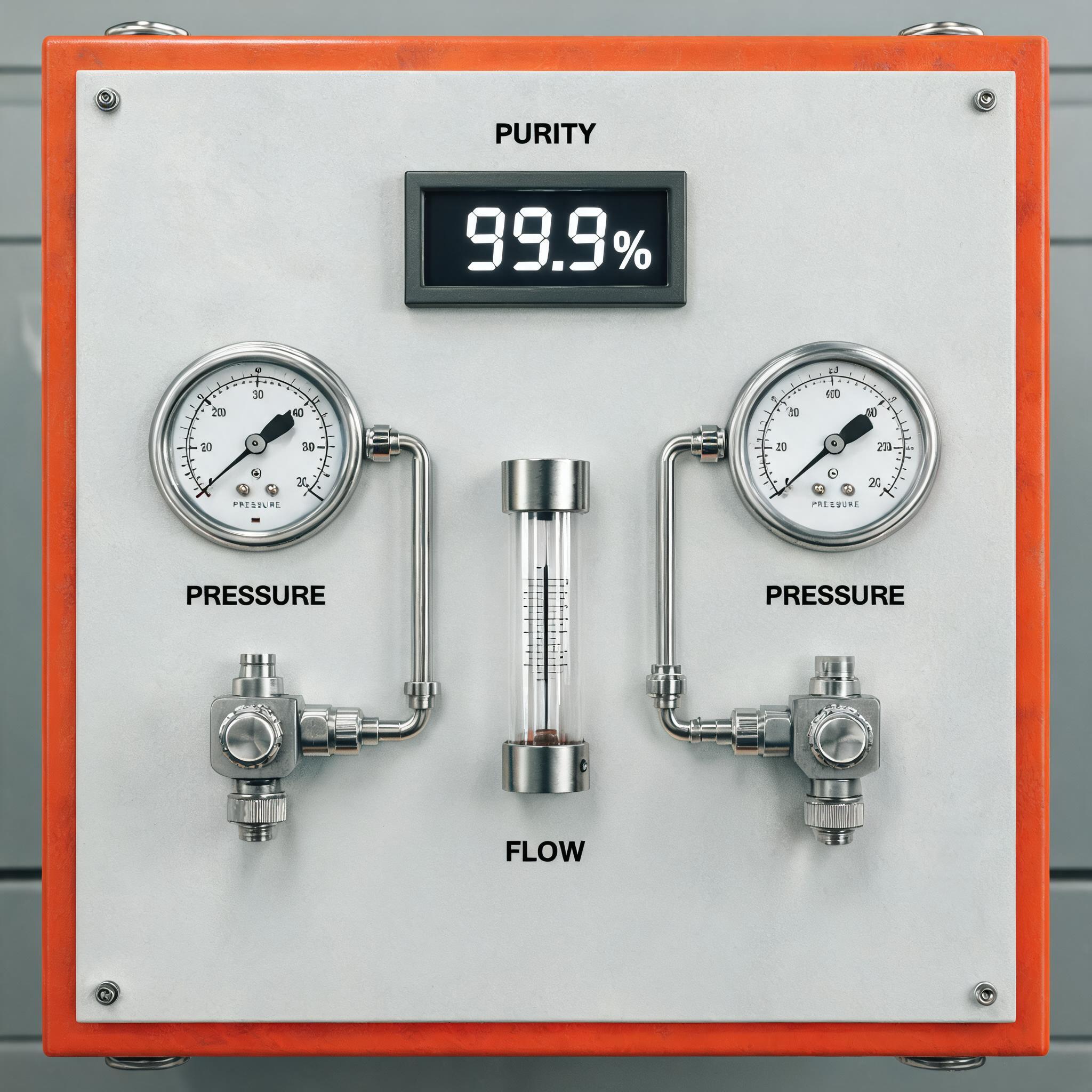
A practical decision framework for buyers comparing portable nitrogen generation with cylinder delivery, covering daily demand, purity, duty cycle, logistics, and storage. The article also explains when a fixed PSA system is the better choice for steady, higher-volume use, with verified specifications.
Key Takeaways
- Portable nitrogen generators can be a good fit when nitrogen demand is low, intermittent, or split across multiple locations.
- Cylinder delivery makes sense when demand is very low, purity requirements are extreme, or capital budget is tight.
- For fixed workshops with steady demand, a correctly sized PSA system often delivers the lowest long-term cost.
- Use daily volume, required purity, duty cycle, and logistics as your four core decision criteria.
If you are comparing a portable nitrogen generator against cylinder delivery, the decision usually comes down to how much nitrogen you need, how often you need it, and where you need it. Cylinder delivery is familiar and requires no capital equipment, but it comes with recurring costs, logistics planning, and storage requirements. Portable generation offers on-demand supply but has its own trade-offs in capacity, purity, and duty cycle. This article gives you a decision framework based on four practical criteria, then explains when a fixed PSA system is the more economical choice for steady, higher-volume operations.
Why Buyers Compare Portable Generation and Cylinder Delivery
Both supply options solve the same problem: getting nitrogen to a point of use without installing a large fixed system. Buyers typically evaluate them for mobile service work, temporary projects, remote sites, or low-volume laboratory and packaging applications where a permanent installation is not justified. The comparison is not about which technology is “better” in general—it is about which supply model matches your demand profile and operating constraints.
Cylinder delivery is a logistics arrangement. You pay for gas, rental, and delivery, and you manage inventory. Portable generation is an equipment purchase. You pay upfront for a unit, then produce nitrogen on site from compressed air. The cost structures differ, and so do the operational requirements.
Decision Criteria: Portable vs. Delivered Nitrogen
1. Daily Nitrogen Demand
Start with volume. How many cubic meters or liters of nitrogen do you consume per day, and at what flow rate? Cylinder delivery works well when daily demand is small—think a few cylinders per week or less. Portable generators are sized for modest flow rates, so they suit low-volume tasks such as blanking, purging small vessels, or supplying a single analytical instrument. If your daily demand is measured in tens of cubic meters per hour, neither portable generation nor cylinder delivery is likely to be the most efficient choice; a fixed system becomes worth evaluating.
2. Required Purity
Purity drives both technology selection and cost. Cylinder nitrogen is available in high purities, including grades above 99.999%. Portable nitrogen generators typically use membrane or PSA technology and produce purity levels that depend on flow rate and system design. If your process needs ultra-high purity, cylinders or bulk liquid may be the only practical option. For many industrial blanking, purging, and packaging applications, purity in the 95–99.9% range is sufficient, and on-site generation can meet that requirement. Keep in mind that on a given portable unit, achievable purity typically drops as flow rate increases—so a single headline purity number is not enough. Always ask the supplier for a purity-versus-flow curve, or for a guaranteed purity at your actual required flow rate, before comparing offers.
3. Duty Cycle and Mobility
How often does the equipment run, and does it need to move? A portable nitrogen generator earns its place when nitrogen is needed intermittently at different locations—for example, field service, temporary production lines, or multiple small facilities. If the unit will sit in one place and run most of the day, portability adds cost and complexity without adding value. Cylinder delivery, by contrast, is location-independent as long as you can receive and store cylinders, but it requires planning for delivery schedules and may not suit remote sites with unreliable logistics.
4. Cylinder Logistics and Storage
Cylinder delivery brings recurring logistics: order placement, delivery windows, cylinder handling, and storage space. High-pressure cylinders require secure, ventilated storage and may be subject to local regulations. Rental fees and delivery charges accumulate. For low-volume users, these logistics are manageable. For higher-volume users, they become a significant operational burden. Portable generation removes delivery scheduling but introduces maintenance and compressed-air supply requirements. Neither option is logistics-free; the question is which logistics you are better equipped to handle.
| Criteria | Portable Nitrogen Generator | Cylinder Delivery |
|---|---|---|
| Daily demand | Low, intermittent | Very low to moderate |
| Purity | Typically 95–99.9% (confirm at flow) | Wide range, including ultra-high purity |
| Duty cycle | Intermittent or mobile use | Any, but logistics scale with volume |
| Logistics | Compressed air supply and maintenance | Delivery scheduling, cylinder handling, storage |
| Upfront cost | Equipment purchase | Low (cylinder rental and gas charges) |
General industry reference. Actual performance varies by product and supplier.
The Honest Counterpoint: Fixed Workshops Usually Need a Fixed PSA System
Portable generation and cylinder delivery are both compromise solutions for low-volume or mobile needs. If your workshop runs a steady production schedule, uses nitrogen every shift, and consumes more than a few cylinders per week, the economics shift. A fixed PSA nitrogen generator sized to your demand typically produces gas at a lower cost per cubic meter than delivered cylinders, and it removes delivery logistics entirely.
For example, a fixed-installation PSA nitrogen generator system in our catalog is specified for 99.9% purity and 10–80 cubic meters per hour of flow, with an inlet pressure of 0.6–0.8 MPa. That 10–80 m³/h figure is the rated generation range, not a continuous-duty output: for continuous or near-continuous operation, size the system with headroom above your average consumption rather than running it at the top of the range, and confirm the sizing with the supplier. The supplier states a payback period of 6–12 months compared with bottled nitrogen. That payback claim is supplier-stated and has not been independently verified; it depends on your gas consumption, local cylinder prices, and operating hours. Treat it as an indicative range and test it against your own gas spend before making a decision.
Fixed PSA system reference (verified catalog detail):
Purity: 99.9% · Flow: 10–80 m³/h (rated generation range; allow headroom for continuous duty) · Inlet pressure: 0.6–0.8 MPa
Supplier-stated payback (not independently verified): 6–12 months vs. bottled nitrogen
If your demand falls within that flow range and you need continuous or near-continuous supply at a fixed location, a PSA system is worth a serious look. It is not portable, and it requires a compressed-air supply and installation space, but for a fixed workshop those are manageable conditions. You can review the PSA nitrogen generator system for the full specifications and compare them against your demand profile.
When Portable Generation Still Makes Sense
To be clear, portable nitrogen generators are not obsolete. They solve real problems that fixed systems cannot:
- Mobile service work: field technicians who need nitrogen at multiple customer sites.
- Temporary projects: construction, commissioning, or short-term production runs where installing a fixed system is impractical.
- Very low demand: occasional purging or blanking where a cylinder would last months.
- Space-constrained sites: locations without room for a PSA system and compressed-air infrastructure.
- Risk diversification: a backup supply for critical operations that cannot tolerate delivery delays.
Bottom line: when does a portable generator beat cylinder delivery?
A portable unit is usually the better choice when most of these conditions apply at once: nitrogen demand is low and intermittent rather than continuous, work moves between multiple sites, cylinder delivery to your location is slow or unreliable, and the purity you need is within the unit's rated purity-versus-flow range. If your demand is steady, continuous, and concentrated at one fixed location, none of these conditions hold—and that is exactly the case where a fixed PSA system takes over as the more economical option.
The key is to match the supply model to the demand pattern. Portable units are a poor fit for continuous, high-volume demand. Cylinders are a poor fit for high-volume users who want to eliminate recurring gas costs. Fixed PSA systems are a poor fit for mobile or highly intermittent needs. Choose based on your actual operating profile, not on a general preference for “on-demand” or “delivered.”
Frequently Asked Questions
Portable generation is usually the better fit when nitrogen demand is low and intermittent, when you need supply at multiple locations, or when delivery logistics to your site are unreliable. It also helps when you want to avoid cylinder storage and handling. If you use less than a few cylinders per week and rarely need nitrogen on a continuous basis, a portable unit can be practical—provided you can supply compressed air and handle maintenance.
Purity depends on the technology and flow rate. Many portable units produce nitrogen in the 95–99.9% range, but achievable purity drops as flow increases on a given unit. Always ask the supplier for a purity-versus-flow curve or a guaranteed purity at your required flow rate. If your process requires ultra-high purity (above 99.99%), cylinders or bulk liquid are likely more suitable.
Start with your peak flow demand in cubic meters per hour and your required purity. The fixed PSA system in our catalog covers 10–80 m³/h at 99.9% purity, with an inlet pressure of 0.6–0.8 MPa—this is the rated generation range, so allow headroom above your average consumption for continuous operation. Compare your peak demand to that range; if you are within it, the system may be a fit. Also consider your duty cycle—continuous operation favors a fixed system, while intermittent use may not justify the capital cost.
Cylinder delivery involves recurring gas charges, cylinder rental fees, delivery charges, and the labor and space for handling and storage. High-pressure cylinders also require compliance with local storage regulations. These costs scale with volume, so the more nitrogen you use, the more attractive on-site generation becomes. For very low volumes, however, the logistics burden is small and cylinders remain a simple solution.
It can for low-volume, intermittent needs, but not for all applications. If you require very high purity, very high flow, or uninterrupted supply, portable generation may not be sufficient. Many buyers keep a cylinder backup for critical processes. The right answer depends on your risk tolerance and process requirements.
Not sure which supply model fits your operation?
Describe your nitrogen demand—daily volume, required purity, and whether you need mobility—and our team will recommend a supply approach. If a fixed PSA system is the better fit, we will confirm whether the catalog system matches your specifications.