
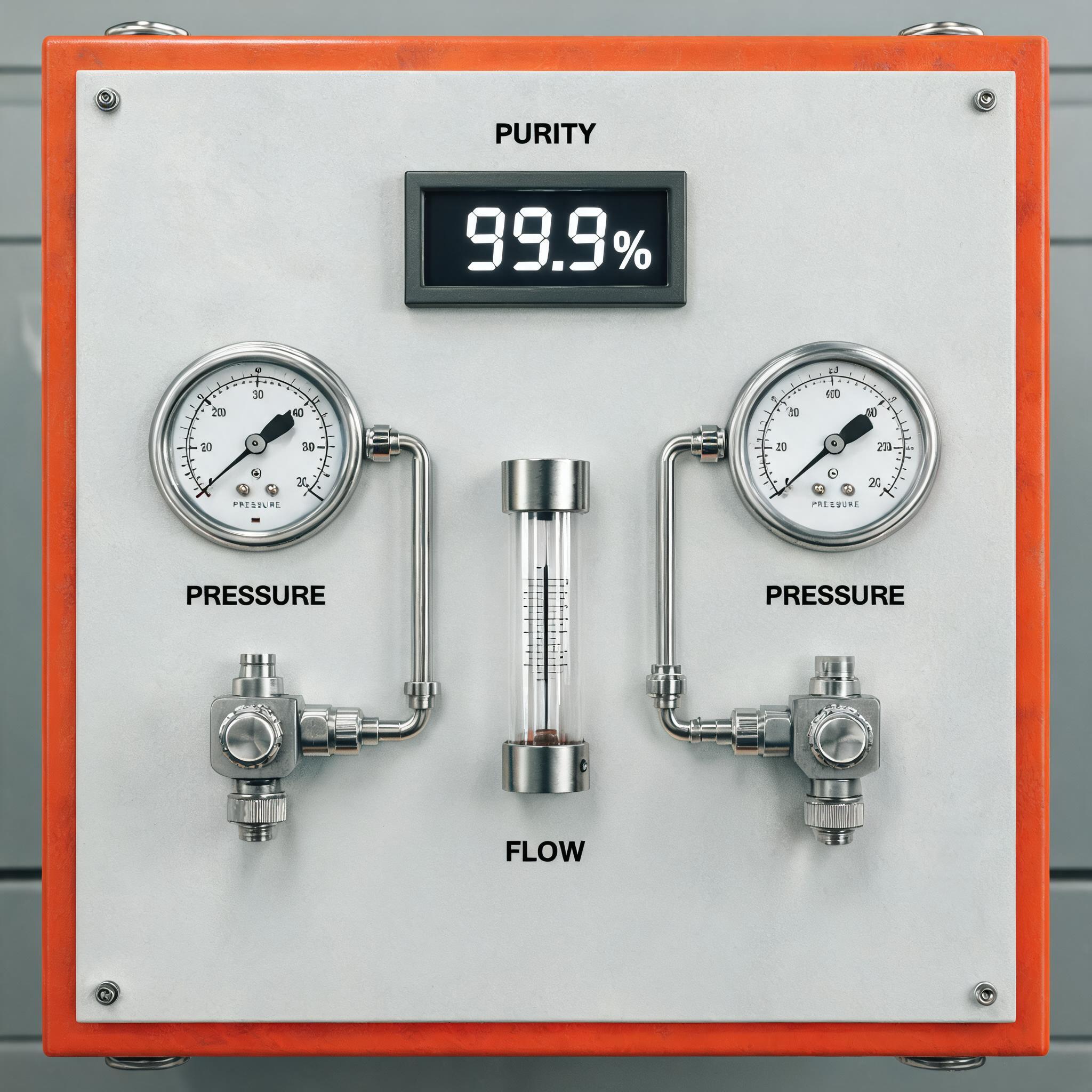
A practical guide for buyers comparing nitrogen purity grades and output ranges for laser cutting assist gas. Learn how 99.9% purity affects cut edge quality, when ultra-high purity (99.999%) is needed, how to match generator flow to your cutting machine, and what to ask suppliers before ordering.
Key Takeaways
- At matched flow and cutting parameters, 99.9% purity is the standard requirement for bright, oxide-free cut edges on stainless steel and aluminum.
- Ultra-high purity (99.999%) is available on request for demanding applications.
- PSA nitrogen generators deliver 99.9% purity at 10–80 m³/h with 0.6–0.8 MPa inlet pressure.
- Match generator flow to your cutting machine's consumption—undersizing leads to pressure drops and poor cuts.
- Always verify purity at your required flow rate and check inlet air quality before ordering.
Laser cutting of stainless steel and aluminum relies on nitrogen as an assist gas to prevent oxidation and achieve clean, weldable edges. The purity of that nitrogen directly affects cut quality, speed, and cost. But not every shop needs the same purity level, and choosing the right flow rate is just as critical as choosing the right purity. This article explains what purity means for cut edges, when 99.9% is sufficient, when to consider ultra-high purity, and how to match generator output to your machine's demand. It also lists the key questions to ask any supplier before you order a high purity nitrogen generator.
What Nitrogen Purity Means for Cut Edge Quality
During laser cutting, nitrogen is used to blow molten material out of the kerf and shield the cut zone from oxygen. Even small amounts of oxygen react with the hot metal, forming oxides that discolor the edge and can impair weldability. The purity of the nitrogen determines how effectively oxidation is suppressed.
At 99.9% purity, the residual oxygen is low enough to produce bright, oxide-free cut edges on stainless steel and aluminum—the standard requirement for most fabrication work, provided flow, pressure and cutting parameters are also matched. This level is widely accepted in industries where post-cut cleaning is undesirable and weld quality matters.
Higher purity levels, such as 99.999%, further reduce oxygen content. While 99.9% is sufficient for most laser cutting, ultra-high purity may be specified for certain critical applications, such as cutting thick sections or materials prone to oxidation, or where the highest possible edge quality is demanded. However, higher purity typically comes with higher generator cost and may require additional purification stages. Buyers should confirm with their cutting machine manufacturer whether 99.9% meets the required edge quality standard for their specific material and thickness.
When 99.9% Is Sufficient vs. When to Request Ultra-High Purity
For the majority of laser cutting operations on stainless steel and aluminum, 99.9% nitrogen is the standard and sufficient purity. It delivers bright, oxide-free cuts suitable for welding and painting without additional edge preparation. If your work is primarily thin to medium sheet and you are not experiencing edge discoloration issues, 99.9% is likely adequate; confirm the thickness and material ranges against your cutting machine manufacturer's requirements.
Consider requesting ultra-high purity (99.999%) when:
- Cutting thick stainless steel or aluminum where even minimal oxidation affects weld integrity or appearance.
- Your cutting machine manufacturer specifies a higher purity for optimal results.
- You process materials for aerospace, medical, or other critical applications with stringent cleanliness requirements.
- You have experienced intermittent edge discoloration with your current gas supply and have ruled out other causes.
Ultra-high purity configurations are available on request from some suppliers, including Xinhong's nitrogen generator system. Keep in mind that higher purity may require additional equipment and higher operating costs, so it should be justified by a clear quality or performance need.
Matching Generator Flow to Cutting Machine Demand
Purity alone is not enough—the generator must also supply nitrogen at a flow rate that matches your cutting machine's consumption. If the generator's output is too low, pressure will drop during cutting, leading to inconsistent assist gas flow and poor cut quality. Conversely, oversizing the generator adds unnecessary capital cost.
PSA nitrogen generators from Xinhong deliver 99.9% purity at 10–80 m³/h with an inlet pressure of 0.6–0.8 MPa. To select the right model, you need to know:
- Peak nitrogen consumption of your cutting machine (typically specified in m³/h or Nm³/h). This is often higher than average consumption because the machine may use more gas during piercing or cutting thick material.
- Required pressure at the cutting head—ensure the generator's outlet pressure, after any additional regulation, meets the machine's requirement.
- Duty cycle: will the machine run continuously or intermittently? The generator should be sized to handle the peak demand without excessive cycling.
- Future expansion: if you plan to add cutting machines, consider a generator with some spare capacity.
A simple way to estimate required flow is to sum the maximum nitrogen consumption of all cutting machines that will operate simultaneously. For example, if you have two machines each requiring up to 30 m³/h, a generator rated for at least 60 m³/h at 99.9% purity would be appropriate — with that rating confirmed at your required purity and inlet conditions. However, always confirm with the machine manufacturer's specifications and consult the generator supplier for precise sizing.
Note that the generator's rated flow is typically specified at a certain purity and inlet conditions. Ensure the quoted flow is at your required purity and that the inlet air pressure (0.6–0.8 MPa) and temperature are within the generator's specified range.
Key Questions to Ask Any Supplier Before Ordering
Before committing to a high purity nitrogen generator, ask these questions to ensure the system meets your needs and that the supplier can support you:
- What is the guaranteed purity at my required flow rate? Purity and flow are interdependent—a generator may achieve 99.9% at a lower flow but drop to 99.5% at maximum output. Request a performance curve or written guarantee at your specific flow and pressure.
- What inlet air quality is required? PSA generators need clean, dry, oil-free compressed air. Ask about the required dew point, particulate filtration, and oil content—and whether the supplier provides the necessary air treatment equipment.
- How is purity verified? Will the system include a continuous oxygen analyzer? Is the analyzer calibrated and what is its accuracy? Ask for the verification method and whether third-party testing is available.
- What are the utility requirements? Confirm compressed air consumption, power supply, and cooling needs to ensure your facility can support the generator.
- What maintenance is required? Understand the maintenance schedule for filters, carbon molecular sieve replacement, and analyzer calibration, and ask about the availability of spare parts and service support.
- Can the system be upgraded to ultra-high purity later? If your needs may evolve, ask whether additional purification modules can be added.
For detailed specifications and to discuss your application, visit the PSA nitrogen generator product page. Our team can help you select the right purity and flow for your laser cutting operation.
Frequently Asked Questions
Is 99.9% nitrogen purity enough for laser cutting stainless steel?
Yes, 99.9% purity is the standard for producing bright, oxide-free cut edges on stainless steel and aluminum. It is sufficient for most laser cutting applications.
Can I get higher purity than 99.9% from a PSA generator?
Ultra-high purity configurations (99.999%) are available on request. These may require additional purification equipment and should be specified based on your application requirements.
How do I determine the right flow rate for my generator?
Calculate the maximum nitrogen consumption of all cutting machines that will operate simultaneously, add a margin for future expansion, and confirm with the machine manufacturer's specifications. The generator should deliver the required purity at that flow rate.
What inlet pressure does the generator need?
The PSA nitrogen generator requires an inlet pressure of 0.6–0.8 MPa. Ensure your compressed air system can provide this pressure consistently.
Ready to choose the right nitrogen generator for your laser cutting? Explore our PSA nitrogen generator systems or contact us with your flow and purity requirements.