
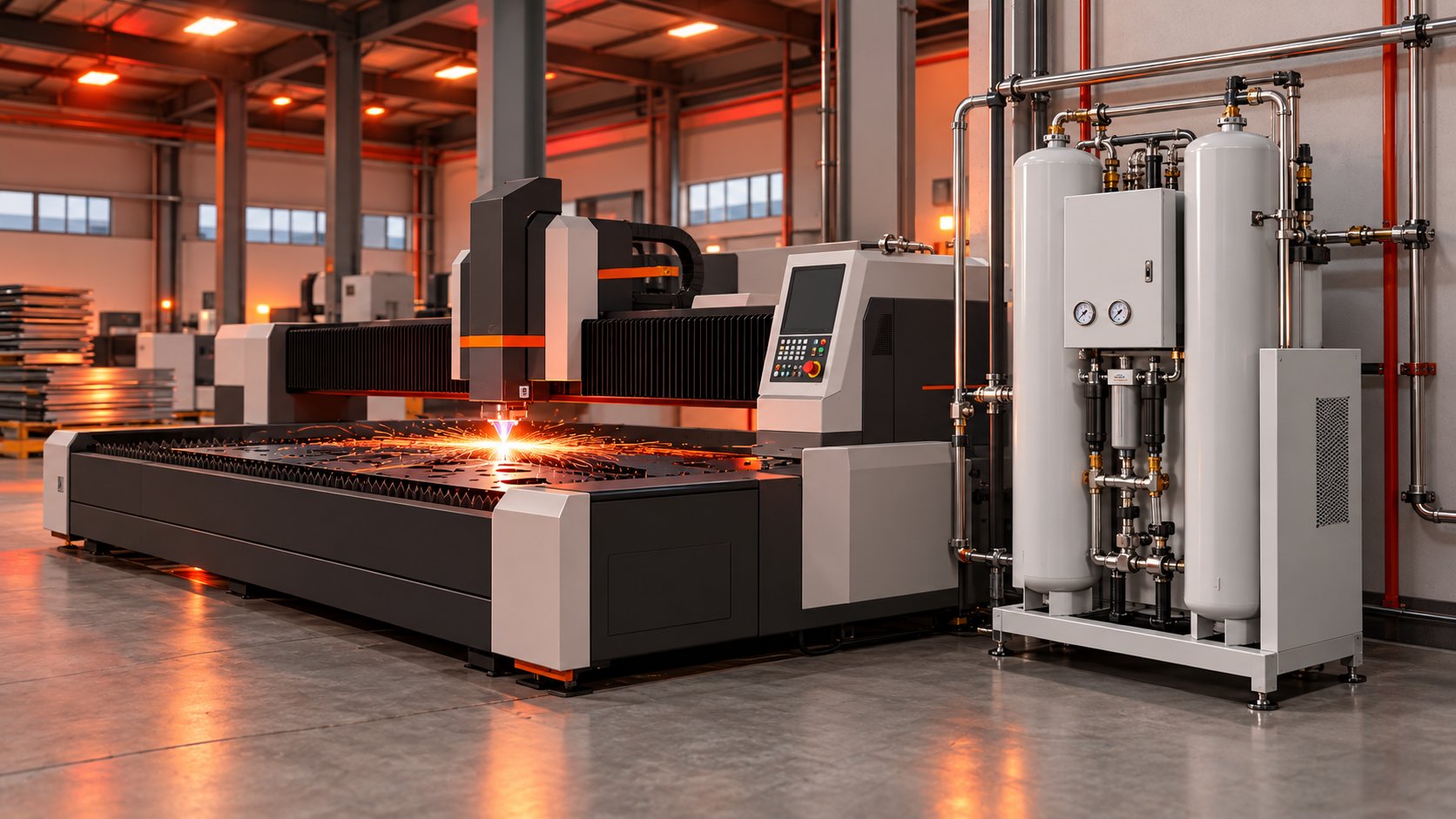
Discover why switching to an on-site PSA nitrogen generator lowers your laser cutting gas costs and how to size it correctly. This guide covers purity requirements, flow rates, and ROI.
If you run a laser cutting shop, you already know the recurring cost: bottled nitrogen. Every tank you rent, every delivery, every time a cylinder runs dry mid-shift. For shops cutting stainless steel, aluminum, or any material where oxidation ruins the edge, nitrogen is not optional—it is a constant operating expense.
An on-site nitrogen generator changes that equation. Instead of paying for gas and logistics, you produce nitrogen from compressed air at your facility. This article explains why shops switch to PSA nitrogen generators and, more importantly, how to size one correctly for your cutting workload.
On this page
Why shops move away from bottled nitrogen
Bottled nitrogen carries hidden costs beyond the gas itself. You pay for cylinder rental, delivery fees, and administrative handling. When a tank runs out, you stop cutting. That downtime is expensive, especially on a production line with deadlines.
Bulk liquid nitrogen (LN2) solves the running-out problem but introduces other issues: large storage tanks, long-term supply contracts, and a minimum usage volume that smaller shops may not meet. If your consumption fluctuates, you are still paying for a fixed supply agreement.
An on-site generator eliminates the logistics. You feed it compressed air, and it separates nitrogen on demand. You only produce what you use, and you never wait for a delivery.
How a PSA nitrogen generator works
Pressure Swing Adsorption (PSA) is the most common technology for on-site nitrogen generation. The system uses two vessels filled with carbon molecular sieve (CMS). Compressed air enters one vessel, and the CMS preferentially adsorbs oxygen, allowing nitrogen to pass through. When the first vessel saturates, the system switches to the second vessel while the first regenerates by depressurizing.
The result is a continuous, reliable supply of nitrogen at your required purity. For laser cutting, the standard target is 99.9% purity. This level prevents oxidation during cutting, leaving a clean, bright edge on stainless steel and aluminum without secondary processing.
Shandong Xinhong CNC Technology Co., founded in 2005, manufactures PSA nitrogen generators specifically for laser cutting applications. Their systems are ISO 9001:2015 certified and CE marked, delivering 99.9% purity nitrogen with flow rates from 10 to 80 m³/h and an inlet pressure requirement of 0.6–0.8 MPa.
Sizing step 1: Determine purity
Purity is the first decision because it directly affects both cut quality and operating cost. For laser cutting, 99.9% nitrogen is the common benchmark. Lower purity (99.5%) may be acceptable for some mild steel applications, but for stainless steel and aluminum, higher purity prevents discoloration and dross.
Higher purity requires more compressed air per cubic meter of nitrogen. If you over-specify purity, you waste energy. If you under-specify, you ruin parts. Match the purity to your most demanding material, then verify with a gas analyzer.
| Purity level | Typical application | Relative air consumption |
|---|---|---|
| 99.5% | Mild steel, some non-critical cuts | Baseline |
| 99.9% | Stainless steel, aluminum, clean edge requirement | Higher |
| 99.99% | Specialized high-alloy materials | Highest |
Most laser cutting shops standardize on 99.9%. It balances quality and operating cost. Confirm with your laser manufacturer what purity your machine's cutting head requires for your material mix.
Sizing step 2: Calculate flow rate
Flow rate is the volume of nitrogen your cutting process consumes, measured in cubic meters per hour (m³/h). This is the most critical number for sizing. Get it wrong, and your generator will either be too small (stalling production) or too large (wasting capital).
To calculate your required flow, you need three data points:
- Cutting gas consumption per hour for each laser machine. This is listed in your laser cutter's manual, typically for different nozzle sizes and material thicknesses.
- Number of machines that will draw from the generator simultaneously.
- Duty cycle—the percentage of time the laser is actively cutting versus piercing, moving, or idle.
Here is a simplified estimation method:
For a single 4 kW fiber laser cutting 10 mm stainless steel, average nitrogen consumption is roughly 15–25 m³/h. If you run two machines simultaneously at similar loads, your peak demand is around 40–50 m³/h. A generator rated for 50 m³/h at 99.9% purity would cover this scenario.
Xinhong's PSA nitrogen generators cover a range of 10 to 80 m³/h. This span suits single-machine job shops up to multi-machine production facilities. If your calculated demand exceeds 80 m³/h, you would either install a larger central system or operate multiple units in parallel.
Do not forget to account for future growth. If you plan to add a second laser next year, sizing the generator now with that capacity in mind is cheaper than replacing the unit later.
Sizing step 3: Check inlet and outlet pressure
PSA generators require a specific inlet pressure to operate efficiently. For Xinhong's units, that is 0.6–0.8 MPa. Your existing air compressor must be capable of delivering this pressure continuously, not just at peak. If your compressor is undersized, you will starve the generator and see pressure drops during cutting.
The outlet pressure of the nitrogen generator must match your laser cutter's inlet requirement. Most laser cutting heads need 1.0–2.0 MPa for high-pressure cutting. If your generator outputs at a lower pressure, you will need a booster compressor between the generator and the laser. Verify this in your laser's technical specifications.
| Parameter | Typical value for laser cutting |
|---|---|
| Nitrogen purity | 99.9% |
| Flow rate | 10–80 m³/h (per machine or system) |
| Generator inlet pressure | 0.6–0.8 MPa |
| Laser inlet pressure | 1.0–2.0 MPa (may require booster) |
What the return on investment looks like
The financial case for on-site nitrogen is straightforward: you replace a recurring consumable cost with a capital investment that pays back over time. For shops currently buying bottled or bulk nitrogen, the payback period for a PSA system typically ranges from 6 to 12 months.
This estimate depends on your current gas price, your consumption volume, and your electricity cost. The more nitrogen you use, the faster the payback. A shop running one laser for a single shift will see a longer payback than a shop running three machines around the clock.
Beyond the direct gas savings, consider the operational benefits:
- No more cylinder changeovers interrupting production.
- No minimum order quantities or supply contracts.
- Consistent purity—you are not at the mercy of a supplier's batch quality.
- Full control over your gas supply chain.
Xinhong's systems are CE certified and run below 75 dB, so they do not require special acoustic enclosures in most workshops. Routine maintenance is limited to replacing filter cartridges monthly—a simple task that keeps the system running reliably.
What to verify with a supplier
Before purchasing a nitrogen generator, confirm the following with the manufacturer:
- Purity guarantee: Does the system deliver 99.9% purity continuously, or only under ideal conditions?
- Flow rate at purity: A generator's flow rating is always tied to a purity level. Ensure the m³/h rating is specified at 99.9%, not at a lower purity.
- Inlet air quality: PSA systems require clean, dry compressed air. Verify the required air quality (filtration and dew point) and whether the supplier includes the necessary pre-filters.
- Booster requirement: If your laser needs pressure above the generator's outlet, factor in the cost of a booster compressor.
- After-sales support: Ask about spare parts availability, filter cartridge sourcing, and technical support response times.
If you are unsure about your flow calculation, ask the supplier to size the system for you. Provide them with your laser machine models, nozzle sizes, materials, and typical cutting hours. A reputable manufacturer will walk you through the calculation rather than selling you the largest unit.
Frequently asked questions
Can I use an on-site nitrogen generator for both cutting and assist gas?
Yes, as long as the flow and pressure requirements are met. Assist gas for piercing and cutting may require different pressures. Ensure your system can supply the maximum pressure needed, or install a separate booster for the high-pressure line.
How much compressed air do I need for the generator?
A PSA nitrogen generator consumes roughly 3–5 times more compressed air than the nitrogen it produces, depending on purity. At 99.9% purity, expect a ratio of about 4:1. Your air compressor must be sized for this additional demand.
What maintenance does a PSA nitrogen generator require?
Filter cartridges are the primary consumable. Xinhong recommends replacing them monthly to protect the carbon molecular sieve and maintain performance. The sieve itself has a long service life, typically several years, before replacement is needed.
Will the generator affect my laser cutting quality?
No, if the purity and pressure are correct. The nitrogen produced by a PSA system is functionally identical to bottled nitrogen for cutting purposes. The key is proper sizing and maintaining inlet air quality to avoid contaminating the sieve.
Ready to size a nitrogen generator for your laser cutting shop?
Review your laser machine's gas consumption specs, then explore Xinhong's PSA nitrogen generator for laser cutting to see how it fits your operation.