
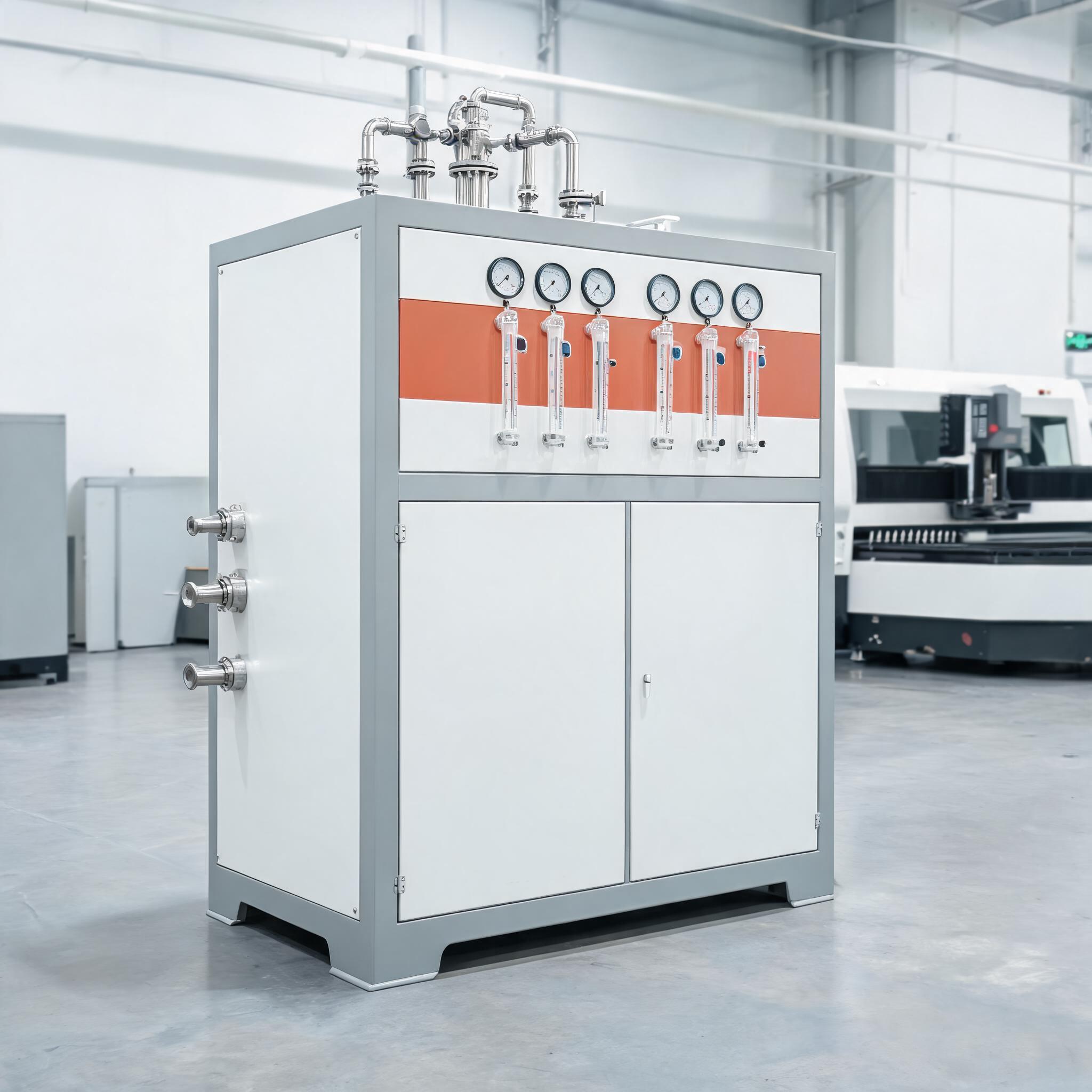
A supply-mode decision guide for laser cutting shops: compare cylinders, bulk liquid delivery, and on-site PSA nitrogen generation on cost structure, logistics, purity consistency, and pressure stability. Includes sizing guidance and payback conditions.
Fiber laser cutting shops face a recurring supply decision: keep buying nitrogen in cylinders or bulk liquid, or generate it on site. The choice affects cost per part, floor space, delivery dependency, and cut quality consistency. This article compares the three supply modes on the factors that matter for laser cutting, explains how to size an on-site generator, and outlines the payback logic using the manufacturer-typical 6–12 month range.
- Cylinders suit low consumption or intermittent cutting; cost per cubic meter is highest and handling is frequent.
- Bulk liquid lowers unit cost at high volume but ties you to delivery schedules and tank footprint.
- On-site PSA generation removes delivery dependency and, with clean dry inlet air and a buffer tank, holds output at the generator's rated purity and set pressure; typical payback is 6–12 months versus bottled nitrogen, depending on local gas prices and actual consumption.
- Sizing starts with peak assist-gas flow of your laser, not average monthly usage.
The three supply modes compared
Each mode delivers the same gas but with a different cost and operational profile. The table below summarizes the trade-offs for a laser cutting shop.
| Factor | Cylinders | Bulk liquid (delivered) | On-site PSA generation |
|---|---|---|---|
| Cost structure | High cost per m³; pay per cylinder plus delivery and rental | Lower cost per m³ at volume; tank rental and delivery charges apply | Capital purchase plus electricity and maintenance; no per-m³ gas purchase |
| Logistics | Frequent cylinder changes; storage and handling labor | Scheduled deliveries; tanker access and tank footprint required | No deliveries; generator and compressed air supply occupy floor space |
| Purity consistency | Varies by supplier and cylinder; residual moisture possible | Generally consistent; can vary with tank level and evaporation | Stable at the generator’s rated purity (e.g., 99.9% for the PSA unit below) |
| Pressure stability | Drops as cylinder empties; regulator adjustments needed | Stable until tank pressure falls; requires vaporizer and regulator | Continuous output at set pressure; buffer tank smooths demand spikes |
Cost structure: what drives the bill
Cylinder supply is convenient for low volume but carries the highest unit cost. You pay for the gas, the cylinder rental or deposit, delivery, and the labor to change cylinders. For a shop cutting thick stainless or running high-power lasers for long shifts, cylinder consumption climbs quickly and so does the handling burden.
Bulk liquid supply reduces the unit cost at higher volumes. The trade-off is a long-term tank lease, scheduled deliveries, and the need for a vaporizer to convert liquid to gas. If your cutting schedule is stable and consumption is high, bulk can be economical. But you remain exposed to delivery lead times and tank level management.
On-site PSA generation shifts the cost from gas purchase to capital and electricity. You buy a generator, connect it to a compressed air supply, and produce nitrogen at the point of use. The ongoing cost is electricity and periodic maintenance—primarily filter cartridge replacement. Because you no longer buy gas by the cylinder or liter, the cost per cubic meter becomes predictable and largely independent of supplier price changes. The actual break-even depends on your local electricity rate, current gas price, and annual consumption; request a quote with your real cutting data to calculate it.
Logistics and floor space
Cylinders require secure storage, frequent changes, and floor space for racks. Bulk liquid needs a tank, tanker access, and safety distance. On-site generation eliminates deliveries entirely. The PSA generator has a compact footprint by design, but it needs a clean, dry compressed air supply and a buffer tank. Noise is below 75 dB for the referenced unit, but whether you need soundproofing depends on your shop's background noise and local occupational noise limits — check both before positioning it beside workstations. Plan for the generator footprint plus the air compressor and dryer if not already present.
Purity consistency and pressure stability
Laser cutting of stainless steel and aluminum typically requires nitrogen purity of 99.9% or higher to avoid oxidation on the cut edge. Cylinder purity can vary between suppliers and even between batches; moisture ingress is possible if cylinders are not handled correctly. Bulk liquid purity is generally consistent, but pressure can fluctuate as the tank empties.
On-site PSA generation delivers a continuous stream at the generator’s rated purity. The PSA Nitrogen Generator for Laser Cutting is rated at 99.9% purity and 10–80 m³/h flow, matching assist gas demand for fiber lasers from 1000W to 12000W. Stable pressure at the nozzle helps maintain consistent cut quality, especially on thick sections where assist gas pressure affects dross formation and cut speed.
How to size an on-site generator
Size the generator by peak assist-gas flow, not average monthly consumption. Laser cutting uses nitrogen only during piercing and cutting; the peak demand occurs when cutting thick material at high power. Use the laser manufacturer’s specified assist gas flow for the thickest material you plan to cut, then add a margin for simultaneous operations if you have multiple lasers.
The referenced PSA generator covers 10–80 m³/h. To select the right model, gather:
- Maximum assist gas flow required by your laser(s) at the thickest cut.
- Required purity for your materials (99.9% is common for stainless).
- Inlet pressure available from your compressed air system: the generator requires 0.6–0.8 MPa.
- Whether you need a buffer tank to handle demand spikes.
If your peak flow exceeds 80 m³/h, you may need multiple units or a larger custom system; confirm with the supplier. The goal is to match generator output to the laser’s demand at the cutting nozzle, accounting for pressure drop in the distribution piping.
Payback logic: the 6–12 month range and its conditions
The manufacturer-typical payback for on-site PSA generation versus bottled nitrogen is 6–12 months. This range is not a guarantee; it depends on three variables:
- Local gas price. Higher cylinder or bulk liquid prices shorten payback.
- Actual consumption. Shops running multiple shifts or cutting thick material consume more nitrogen and save more per month.
- Electricity rate. The generator consumes electricity to compress air and run the PSA process; lower rates improve the economics.
To calculate your own payback, request a quote with your monthly nitrogen consumption (in m³ or cylinders), current gas price, and electricity rate. The supplier can then model the monthly savings against the generator price. Maintenance is minimal: monthly filter cartridge replacement is the primary routine task, which keeps downtime low.
Decision checklist
Use this checklist to decide whether on-site generation fits your shop:
- Do you cut stainless steel or aluminum regularly with nitrogen? If not, on-site may not be justified.
- Is your monthly nitrogen spend significant relative to a generator’s cost? If you spend more on gas than a generator would cost over 6–12 months, on-site is worth evaluating.
- Do you have reliable compressed air capacity at 0.6–0.8 MPa? The generator needs clean, dry air.
- Can you allocate floor space for the generator and buffer tank? The unit has a compact footprint and noise is below 75 dB.
- Are you willing to handle monthly filter changes? This is the main maintenance item.
For shops that answer yes to most of these, on-site PSA generation offers a way to stabilize nitrogen gas supply, reduce delivery dependency, and control cost per part. The PSA Nitrogen Generator for Laser Cutting is CE certified and designed for fiber laser assist gas. To evaluate your case, contact the supplier with your cutting parameters and current gas costs for a payback estimate.