
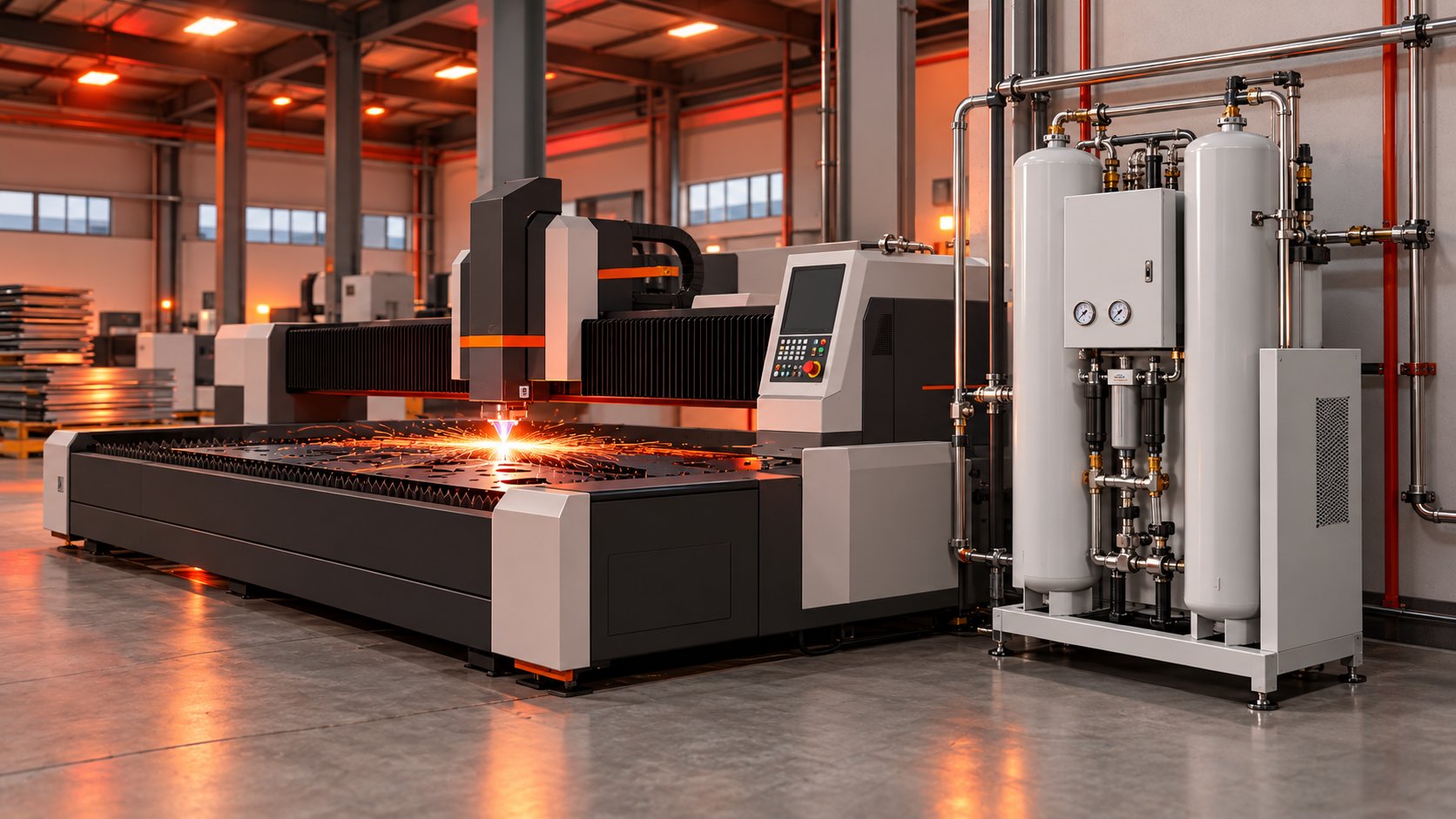
A practical selection guide for industrial nitrogen generators. Compare PSA and membrane technologies, and match purity and flow to your actual operation before you buy.
Buyer's Selection Guide
What to Decide Before You Buy an Industrial Nitrogen Generator
Buying an industrial nitrogen generator is a capacity decision, not a brand preference. The two questions that determine everything else are: what purity do your processes actually need, and what continuous flow rate do they consume? Answer those two with real numbers, and the technology choice — PSA versus membrane — becomes straightforward. Skip them, and you will either overpay for purity you cannot use or stall production on a unit that is undersized.
This guide walks through the selection criteria in the order they matter, so you can shortlist a system with confidence.
Start With Purity: The Most Expensive Mistake Is Over-Specifying
Nitrogen purity is expressed as a percentage, and the gap between 95% and 99.9% is not a small step — it is a different machine. Higher purity requires more compressed air, more adsorbent material, and a larger footprint. If your application runs fine on 95% purity, buying a 99.9% system means paying for capability you will never switch on.
Match the purity grade to the actual process:
- 95–99% — inerting, blanketing, fire prevention, pneumatic conveying.
- 99–99.5% — food packaging, modified atmosphere storage, some electronics dry storage.
- 99.9% and above — laser cutting, heat treatment, pharmaceutical blanketing, applications where oxygen contamination directly ruins the product.
For reference, a PSA nitrogen generator in this class delivers 99.9% purity at a flow rate of 10–80 m³/h. If your process needs 99.9%, the specification exists and is achievable on a single packaged unit. If it does not, say so before you request a quote.
PSA vs Membrane: Two Technologies, Two Jobs
There is no universally "better" technology. There is only the technology that fits your purity, flow, and operating pattern. Here is the practical difference.
PSA (Pressure Swing Adsorption)
PSA generators pass compressed air through a bed of carbon molecular sieve. Oxygen is adsorbed under pressure, and nitrogen passes through. Two beds alternate — one producing, one regenerating — which gives a continuous supply. PSA is the right choice when you need high purity (up to 99.9% or higher) and a steady, predictable flow.
Membrane Generators
Membrane systems use hollow fiber membranes that separate gases by permeation rate. Oxygen and water vapor permeate out faster than nitrogen. Membranes are compact, have no moving parts in the separation stage, and respond quickly to changes in demand. However, they typically deliver lower purity — usually in the 95–99.5% range — and purity drops as flow increases. Membranes suit applications where the purity requirement is moderate and the duty cycle is variable.
| Selection Criterion | PSA Generator | Membrane Generator |
|---|---|---|
| Typical purity range | Up to 99.9% and higher | 95–99.5% |
| Flow characteristic | Stable at rated purity | Purity falls as flow rises |
| Footprint | Larger (adsorbent vessels) | Compact |
| Moving parts | Pneumatic valves cycling | None in separation stage |
| Best fit | Laser cutting, heat treatment, high-purity blanketing | Inerting, tank blanketing, variable demand |
For a buyer running laser cutting, the decision is usually already made: the process demands 99.9% purity, and that points to PSA.
Flow Rate and Inlet Conditions: Size the System, Not the Guess
Flow rate is the second hard number you must bring to the conversation. It is measured in cubic meters per hour (m³/h), and it must account for both average consumption and peak demand. A system sized only for average flow will fail during peak shifts.
The PSA unit referenced above covers 10–80 m³/h at 99.9% purity. Within that range, your job is to define the operating point. Consider these factors:
- Number of shift hours — a single-shift operation may tolerate a smaller buffer; continuous operation needs headroom.
- Peak vs average draw — if multiple machines pull nitrogen simultaneously, size for the sum of peaks.
- Future expansion — it is cheaper to buy one correctly sized unit now than to replace it in two years.
Inlet air quality is equally important. The generator is only as good as the compressed air fed into it. For the system to perform as rated, the inlet pressure should be in the range of 0.6–0.8 MPa. Feed air must be clean and dry — an upstream filter and dryer are not optional accessories; they are part of the system's operating requirement.
Operational Costs: Where the Payback Comes From
The business case for on-site generation is simple: stop buying bottled nitrogen, and the generator pays for itself. The payback period depends on your current consumption and local gas prices, but a realistic planning figure for a system in this class is 6–12 months versus bottled nitrogen supply. After that point, the cost of nitrogen is essentially the cost of electricity to run the air compressor.
Ongoing maintenance is modest but not zero. A PSA generator requires regular filter cartridge replacement — plan for a monthly filter cartridge change as part of the routine. The rest of the system is designed for continuous operation, and the unit itself runs below 75 dB, which keeps it acceptable for placement near working areas without special acoustic enclosures.
Key takeaway: Calculate your current annual spend on bottled nitrogen, including delivery and handling. If the figure is meaningful, a generator with a 6–12 month payback is a working-capital decision, not a speculative one.
Quality and Compliance: What to Verify With the Supplier
When comparing suppliers, check the documentation that supports the machine, not just the brochure claims. For equipment that will run continuously in a production environment, three things matter:
- Manufacturing quality system — a supplier operating under ISO 9001:2015 has documented procedures for design, production, and testing.
- Electrical and safety compliance — CE marking indicates the equipment meets applicable EU safety, health, and environmental requirements.
- Track record — ask which markets the supplier regularly serves. A supplier exporting to Europe and other global regions is accustomed to different voltage standards, documentation requirements, and after-sales expectations.
These are verification points, not marketing slogans. Ask for the certificates and confirm they apply to the specific model you are quoted.
A Practical Checklist Before You Send an Inquiry
To get a useful quote on the first round, prepare these five answers in advance:
- Required purity — the exact percentage your process needs, not a range.
- Continuous flow rate — in m³/h, including peak demand.
- Inlet air conditions — your existing compressor pressure and whether dry, filtered air is available.
- Operating schedule — shifts per day and days per week.
- Current supply method — bottled gas, liquid nitrogen, or no current supply.
With these numbers, a supplier can match you to a specific model immediately. Without them, every quote you receive will include assumptions that may not fit your plant.
Ready to Compare a Specific System?
If your process requires 99.9% purity and a flow rate between 10 and 80 m³/h, a PSA nitrogen generator is the system class to evaluate. Shandong Xinhong CNC Technology Co., Ltd., founded in 2005, manufactures PSA nitrogen generator systems for laser cutting and other high-purity applications. The company is ISO 9001:2015 certified, its equipment is CE marked, and it supplies customers across Europe and global markets.
Review the specifications of the PSA nitrogen generator system to see how it matches your operating requirements, and prepare your flow and purity numbers before you contact the supplier.