
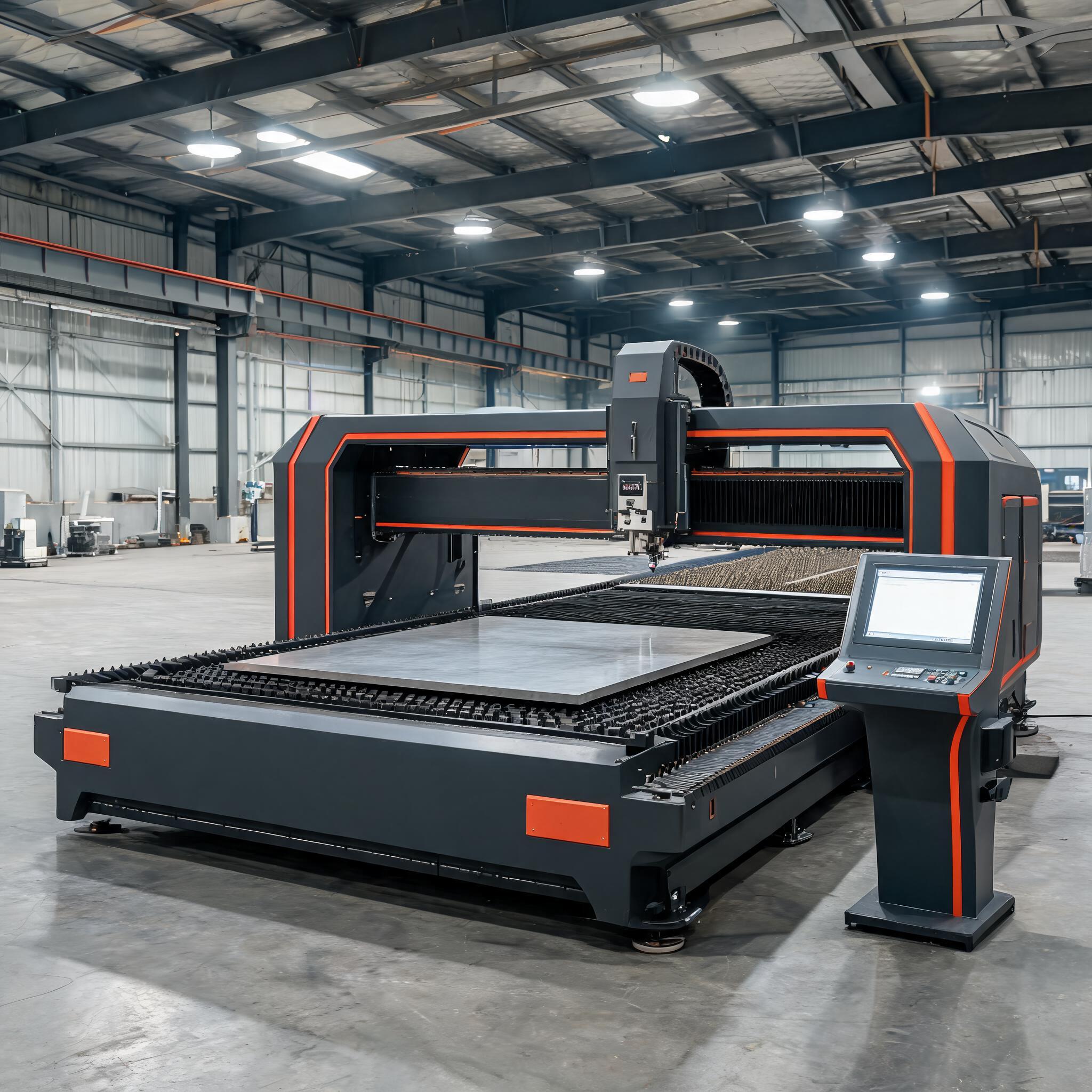
A 30000W fiber laser cutting machine has no single list price. This guide breaks down the six configuration items that move the cost — laser source brand, machine frame and drive, cutting head and gas pressure rating, cooling, CNC control, and automation — and lists the parameters you must give a manufacturer before a quotation can be accurate.
Buyer Guide
A 30000W fiber laser cutting machine is configured, not stocked. Two machines with the same laser power can carry very different quotations, and neither figure means anything until you know what sits behind the wattage. This article explains what drives the price and what you need to supply before a quotation can be accurate.
Key takeaways
- 30kW is the highest power level in the Xinhong platform, and it is priced as a configured system rather than a catalog item.
- Laser source brand, frame and drive, cutting head and gas pressure rating, cooling circuit, CNC control and automation each shift cost in a different direction.
- Rated cutting capacity (carbon steel to 70mm, stainless steel to 40mm, aluminum to 30mm, brass to 16mm) tells you what the machine can be asked to do, not what it will cost.
- The fastest way to get a comparable quote is to send a material and thickness list, table size, annual volume, and site power details.
Why a 30000W machine has no single list price
Above roughly the 6kW to 12kW band, fiber laser cutting machines stop behaving like standard goods. A 30kW system is built around what the buyer intends to cut: thick plate in a job shop, stainless steel in a food equipment plant, or mixed material with frequent changeovers. Each of those uses pushes the configuration in a different direction.
The laser source alone is offered in several brands and power options, and the rest of the machine — the bed, the drive train, the cutting head, the chiller, the control cabinet — has to be matched to that source. The price quotation you receive reflects the combination, not the nameplate figure. That is why two suppliers can quote the same 30kW class of machine and be far apart: they are describing different machines.
The six cost drivers, item by item
1. Laser source brand and power option
The Xinhong 30000W platform offers IPG, RAYCUS or GW as laser source options. These are different suppliers with different market positions, and the source is typically the single largest line in any quotation. The choice affects not only purchase cost but also beam quality consistency, service network and spare-part lead time in your region. Ask which source is quoted and why that source was proposed for your material mix — a supplier who cannot explain the choice is quoting a wattage, not a solution.
2. Machine frame, drive train and table size
The 30000W model uses a working table of 2000 × 6000mm, with dual servo motors and helical gear rack transmission. That drive arrangement, and the structural stiffness needed to hold positioning accuracy of ±0.05mm and repeatability of ±0.03mm while moving a gantry at cutting speed, is a real cost item. A heavier, more rigid frame and a higher-grade drive train cost more than a lighter build, and they are what allow the machine to hold tolerance on thick plate over a long bed. Maximum cutting speed is listed at 30 m/min and depends on material and thickness, so treat any single speed figure as a reference point rather than a promise.
3. Cutting head and auxiliary gas pressure rating
The 30000W platform carries a maximum auxiliary gas pressure of 30 bar. High-pressure cutting of stainless steel and aluminum depends on that head and gas capability, and heads rated for high pressure are a different cost class from standard heads. This is also where operating cost enters the picture: nitrogen consumption at high pressure is a recurring expense that can outweigh small differences in purchase price over the life of the machine. If you plan to cut stainless steel regularly, ask how the gas supply will be arranged; the Xinhong topic on PSA nitrogen generator cost breakdown explains where that money actually goes.
4. Cooling configuration
The 30000W machine uses a three-circuit industrial water cooling system. At 30kW, the laser source, the optics and the cutting head each have their own heat load, and a three-circuit chiller keeps them separate. Cooling capacity and redundancy are a cost item, and they are also a reliability item: undersized cooling is one of the ways a high-power machine loses uptime in a hot workshop. Ask what ambient temperature range the chiller is specified for in your site conditions.
5. CNC control system
The control system is a Schneider Modicon M241 PLC. Control architecture affects how the machine integrates with your production planning, how parameters are managed across material recipes, and how easily your operators and maintenance team can work with it. It is not the largest cost line, but it is the one that determines how much of the machine's capability your team can actually use. Confirm the control platform in writing and ask for the technical documentation that ships with the machine — the 30000W package includes technical documents, training and installation and commissioning guidance.
6. Automation and material handling
A 2000 × 6000mm table is a large sheet, and loading it by hand limits how much of the machine's capacity you can reach. An exchange table configuration is available on this platform, and it changes both the price and the throughput equation: while one table is cutting, the other can be loaded. Whether it pays for itself depends on your annual volume and how often you change sheets. Automation options are usually quoted separately, so ask for them as a distinct line item rather than folded into a single figure.
Two further items sit outside the machine itself and are frequently forgotten: freight and logistics to your site, and installation and commissioning. Both should appear explicitly in a quotation.
20000W or 30000W: the capability and cost trade-off
Not every buyer needs 30kW. The 20000W fiber laser cutting machine sits one step below the top of the range, and the decision between the two is a question of the thickness range you actually run, not of wanting the biggest number.
A 30kW system extends the thick-plate envelope and can raise cutting speed on mid-range thickness, which matters when thick carbon steel or stainless steel is a regular part of your order book. The 30000W fiber laser cutting machine page lists the rated range: carbon steel to 70mm, stainless steel to 40mm, aluminum to 30mm and brass to 16mm. If your work sits mostly below those thicknesses, the lower-power model may leave budget for automation, gas supply or a second shift — items that often affect output more than the last few kilowatts.
Ask both questions in the same enquiry: what thickness do I cut every week, and what thickness do I cut occasionally? The occasional job rarely justifies the top power level on its own.
What you need to send to get an accurate quote
Because the price is assembled from configuration, a supplier cannot quote accurately from "30kW machine" alone. The list below is what moves a quotation from a rough indication to something you can compare against another supplier.
| Information | Why it changes the quote |
|---|---|
| Materials and thickness range (routine and occasional, separately) | Determines laser source choice, cutting head and gas pressure requirement, and whether 30kW is justified at all |
| Sheet size you buy | Confirms whether the 2000 × 6000mm table fits your supply, or whether handling needs change |
| Annual output and shift pattern | Drives the case for an exchange table, automation and any redundancy in cooling |
| Site power supply | The platform runs on 380V/50Hz three-phase, customizable; your actual supply determines what is needed on site |
| Workshop ambient conditions | Affects chiller specification and installation planning |
| Exchange table or automation requirement | Quoted as separate options; needs to be stated up front to appear as a line item |
| Delivery destination and site access | Freight, unloading and installation planning |
| Operating language and operator experience | Shapes the training and documentation package |
No article can give you a 30000W price figure that means anything for your workshop. Ask the manufacturer to quote against your material list and site details, and ask for the laser source brand, cutting head rating, chiller configuration and control platform to be named in the quotation. That is what makes two quotes comparable.
Frequently asked questions
Why are quotations for the same 30kW power so different?
Because the power rating is one specification among many. Laser source brand, cutting head pressure rating, chiller configuration, drive train, control platform and automation options all vary between offers. A quotation that names only the wattage is not yet a comparable offer.
Does a higher power machine always cost more to run?
Power consumption and auxiliary gas are the main running costs, and both depend on what you cut and how the machine is programmed. High-pressure nitrogen for stainless steel is often the larger variable. Ask for the gas supply plan alongside the machine quote.
Can the machine be configured for my site voltage?
The standard supply is 380V/50Hz three-phase, and it can be customized. State your actual site supply in the enquiry so it is addressed in the quotation rather than after delivery.
What is included with the machine?
The 30000W package includes technical documentation, training and installation and commissioning guidance. Confirm the scope of each in the quotation, since travel, duration and language support affect the commercial terms.
Next step: send your cutting list
To receive a quotation you can actually compare, send the manufacturer a short brief: the materials and thicknesses you cut, the sheet size you buy, your annual output and shift pattern, your site power supply, and whether you need an exchange table or automation. With those inputs, the laser source, cutting head, cooling and control configuration can be specified against your work — and the price will mean something.
Start with the 30000W fiber laser cutting machine specification page, and compare it against the 20000W model before you decide which power level your order book supports.