
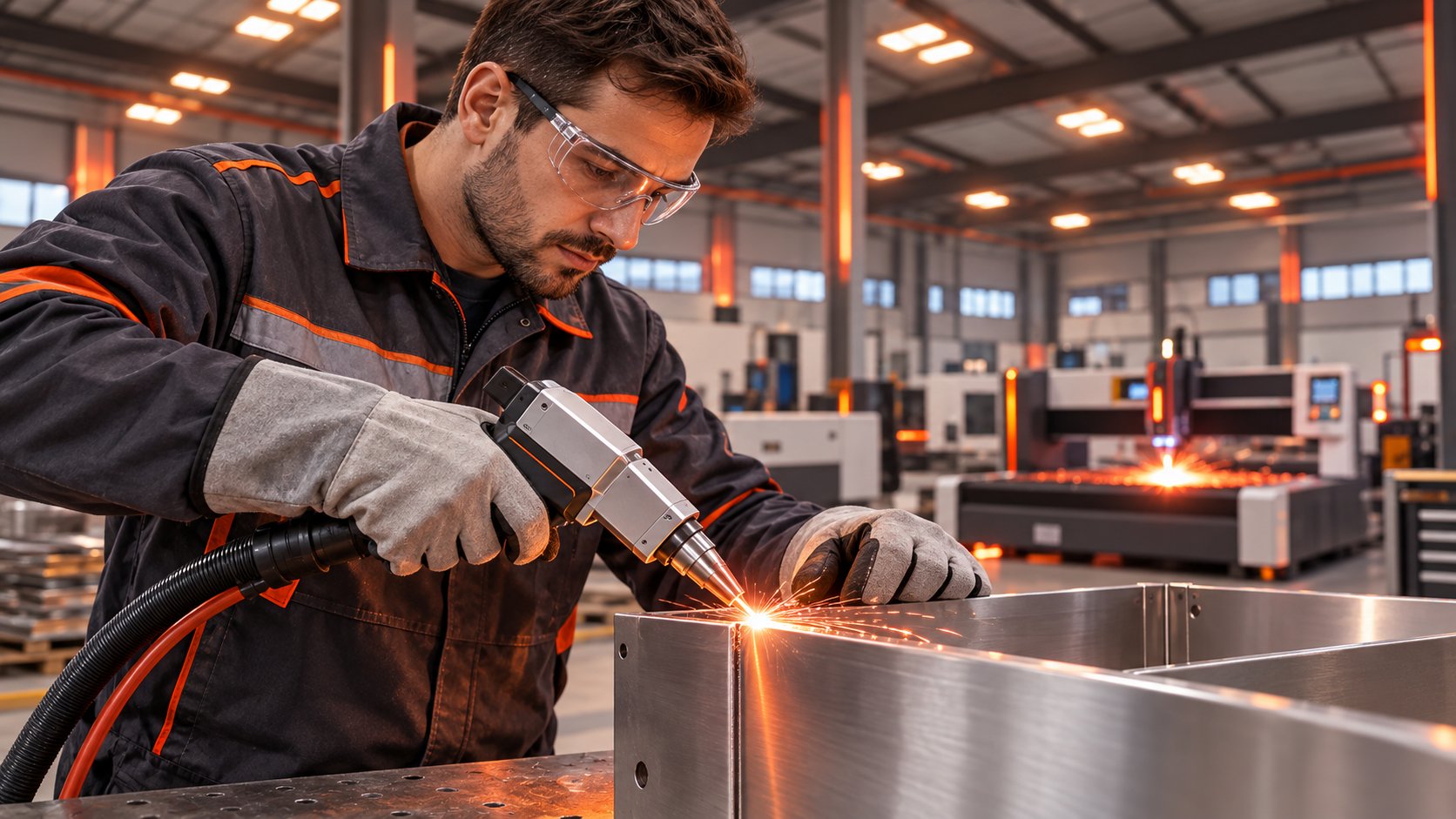
Choosing a handheld laser welder starts with matching power to your material thickness and deciding whether you need a 2-in-1 weld-and-clean function. This guide compares 1500W and 2000W models, explains key features, and outlines what to verify with your supplier before purchase.
If you are researching a handheld laser welder, you are probably comparing power ratings, trying to decide between a welding-only unit and a 2-in-1 model, and checking what a realistic handheld laser welder price looks like for your budget. The right choice depends less on the machine name and more on the materials you weld, the thickness you handle regularly, and whether you also need surface cleaning or rust removal.
This guide walks through the key selection criteria—power, functions, and features—and explains how they map to typical shop needs. It also covers what to verify with a supplier before you commit, so you can compare quotes on the same basis.
Power: matching the machine to your material thickness
Power is the first decision because it determines the maximum material thickness you can weld reliably. Handheld laser welders typically range from 1000W to 3000W, with 1500W and 2000W being the most common for general fabrication work.
For a shop that works mainly with thin to medium gauge stainless steel—sheet metal, enclosures, brackets, or light structural parts—a 1500W handheld laser welding machine is a common entry-level choice. It handles most jobs up to about 3–4 mm in a single pass, and it is lighter and less expensive than higher-power units.
If your work regularly involves thicker sections—say, 4–5 mm stainless steel—a 2000W handheld laser welder gives you more headroom. The 2000W model can weld stainless steel up to 5 mm, which covers heavier frames, tanks, and equipment that need deeper penetration.
| Power | Typical material thickness (stainless steel) | Best for |
|---|---|---|
| 1500W | Thin to medium gauge (up to ~3–4 mm) | Sheet metal, light fabrication, repair work |
| 2000W | Up to 5 mm | Heavier frames, thicker sections, more demanding joints |
There is no universal rule that higher power is always better. A 2000W machine is heavier and uses more electricity, which may not be justified if your work is mostly thin material. On the other hand, underpowering a machine for thick sections leads to incomplete fusion and rework. Match the power to your thickest regular job, not the occasional one.
Functions: welding-only vs. 2-in-1 weld-and-clean
Many handheld laser welders on the market come as a 2-in-1 unit that combines welding and surface cleaning. The cleaning function uses the laser to remove rust, paint, or oil from metal surfaces before welding or as a standalone prep step.
If your shop frequently prepares old or painted metal—for repair work, refurbishment, or maintenance—a 2-in-1 machine saves you from buying a separate laser cleaner. For example, a 2-in-1 unit rated for 5 mm stainless steel welding also removes rust and paint, which means you can handle both preparation and welding with one tool.
However, if your work is almost exclusively new, clean metal, a welding-only machine may be sufficient. The extra cleaning capability adds cost and complexity, and you may never use it. Consider your actual workflow: do you spend significant time grinding or sanding before welding? If yes, the 2-in-1 function could directly reduce that step.
Key takeaway: Choose a 2-in-1 only if you have a real need for surface prep. Otherwise, a welding-only unit gives you the same welding performance at a lower price.
Features that affect daily operation
Beyond power and cleaning capability, several features determine how easy the machine is to use and how consistent your results are.
Laser source quality
The laser source is the core component that affects beam quality and stability. Reputable manufacturers use established brands such as IPG, RAYCUS, or GW. These are widely recognized in the industry, and their availability simplifies spare parts and service. When comparing quotes, ask which laser source is inside the machine—it is not something you can easily change later.
Control system
A reliable control system ensures consistent power delivery and protects the machine during operation. Some manufacturers, like Shandong Xinhong CNC Technology Co., use Schneider Electric controls, which are known for industrial reliability. This matters if you run the machine for long shifts or in demanding environments.
Cooling system
Handheld laser welders generate heat, and the cooling system must keep the laser source at a stable temperature. A water-cooled system is standard for most industrial units. Check the cooling capacity and whether it is adequate for your ambient temperature.
Fiber length and ergonomics
The fiber cable length determines how far you can move from the machine. A longer fiber (e.g., 10 m) is useful for large workpieces or when you need to move around the part. The weight of the handheld head also affects operator fatigue—test it if possible.
Warranty and support
Warranty terms vary. Ask for the warranty period on the laser source and the machine itself, and confirm what it covers. Also check the availability of spare parts and technical support. A supplier with a local distributor or responsive remote support can reduce downtime.
What to check with your supplier
When you have shortlisted a few machines, verify the following points before you pay:
- Certifications: Does the machine have CE marking and ISO 9001 certification? These are basic compliance and quality management indicators. For example, Shandong Xinhong CNC Technology Co. is ISO 9001:2015 certified and CE marked.
- Laser source brand: Confirm the exact brand and model. As mentioned, IPG, RAYCUS, and GW are common choices.
- Control system: Ask which brand is used. Schneider Electric is a sign of industrial-grade components.
- Spare parts availability: Are consumables like protective lenses and nozzles readily available? What is the lead time?
- Training and documentation: Does the supplier provide an operation manual, video training, or on-site instruction?
- Shipping and installation: Clarify what is included in the price—delivery, installation, commissioning, and any initial training.
You can also request a sample weld test with your own material. A reputable supplier will be willing to demonstrate the machine on a representative piece. This is the most direct way to verify that the power and features match your needs.
Product options to consider
If you are evaluating specific machines, here are three configurations that cover the common choices:
| Model | Power | Functions | Ideal for |
|---|---|---|---|
| 1500W handheld laser welding machine | 1500W | Welding only | Thin to medium gauge stainless steel, general fabrication |
| 2000W handheld fiber laser welding machine | 2000W | Welding only | Thicker sections up to 5 mm stainless steel |
| 2-in-1 handheld fiber laser welding and cleaning machine | Typically 1500W–2000W | Welding + cleaning (rust/paint removal) | Shops that need surface prep before welding |
These links point to specific product pages where you can see detailed specifications and request a quote.
Frequently asked questions
What is the difference between 1500W and 2000W?
The main difference is the maximum weldable thickness. A 2000W machine can weld stainless steel up to 5 mm, while a 1500W is best for thin to medium gauge. Also, higher power generally means a heavier machine and higher energy consumption.
Can a 1500W welder handle stainless steel that is 5 mm thick?
It is not ideal. For 5 mm stainless steel, a 2000W machine provides the necessary penetration. Using a 1500W on thick material may require multiple passes or result in weak welds. Match the power to your thickest regular job.
Is a 2-in-1 weld-and-clean machine worth the extra cost?
It depends on your workflow. If you frequently remove rust or paint before welding, a 2-in-1 saves you from buying a separate cleaner. If you work with new, clean metal, a welding-only machine is more cost-effective.
What should I ask the supplier before buying?
Ask about the laser source brand, control system, certifications (CE, ISO 9001), warranty, spare parts availability, and what is included in the price (shipping, installation, training). A sample weld test is also recommended.
Next step
Choosing the right handheld laser welder comes down to your material thickness, the need for cleaning, and the features that affect daily operation. Start by defining your thickest regular job, then compare machines on that basis.
If you are ready to compare specific models, review the 2000W handheld laser welder, the 1500W handheld laser welding machine, or the 2-in-1 weld-and-clean model. Contact the supplier with your material specs and request a quote or a sample test.