
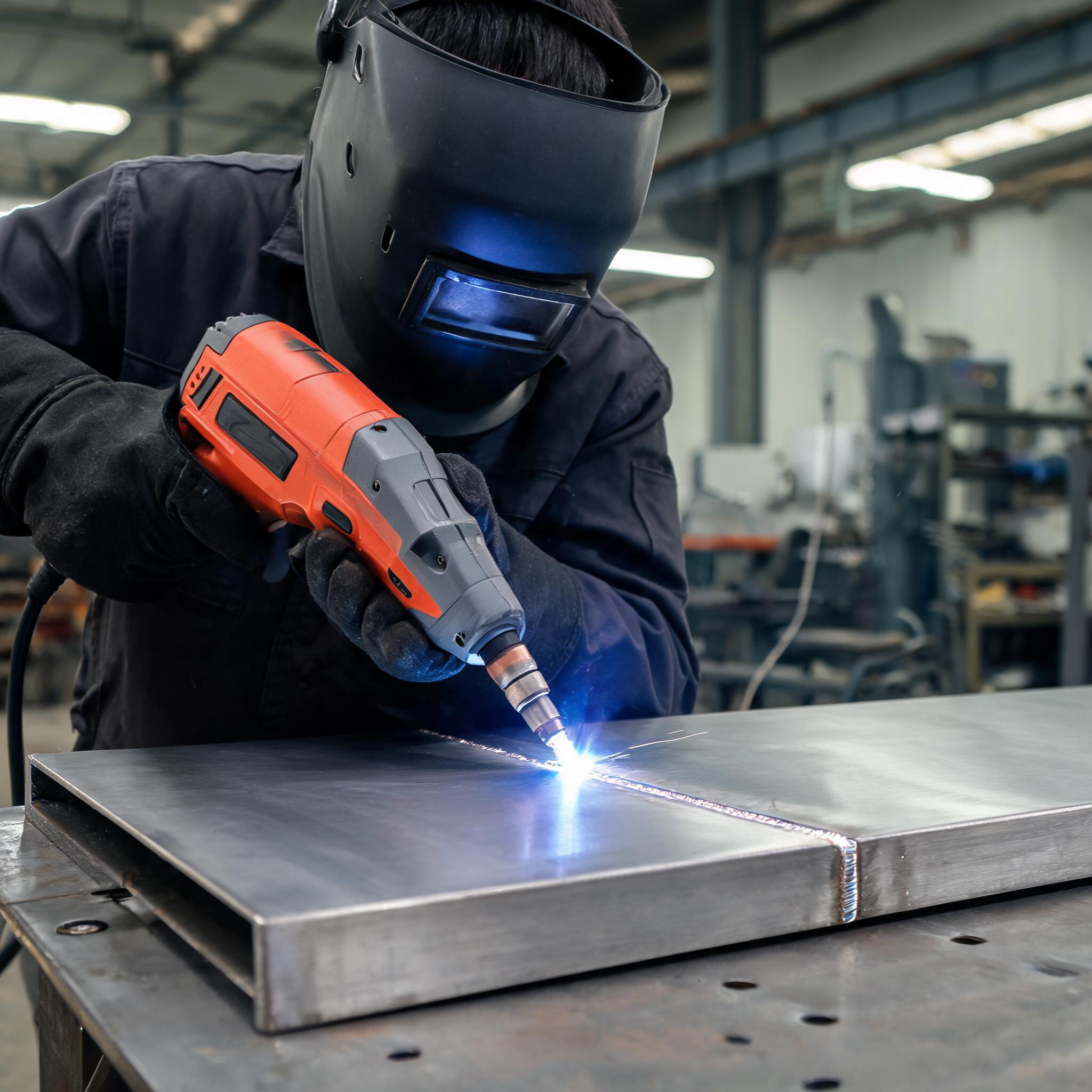
A practical safety baseline for shops adopting handheld fiber laser welding. Covers the three hazard groups—laser radiation including reflected beams, fume, and electrical/process hazards—and outlines controls, PPE, and when a fixed interlocked enclosure is the right choice.
Laser Welding Safety: Radiation, Fume and PPE for Handheld Fiber Laser Welders
Handheld fiber laser welders put a multi-kilowatt beam in an operator's hands. That mobility is the reason shops adopt them—and the reason safety planning has to start before the unit arrives, not after. This article sets out the three hazard groups you need to manage (laser radiation including reflected beams, fume, and electrical and process hazards), the practical controls for handheld work, and the point at which a fixed interlocked enclosure becomes the better choice.
- Handheld laser welding exposes operators to direct and reflected laser radiation, metal fume, and electrical/process hazards. Each needs its own control.
- Reflections off the workpiece and surrounding surfaces are a primary hazard with handheld units because the beam is not confined.
- Fume extraction at the weld point, wavelength-rated eyewear and clothing, a controlled workspace, and operator training form the baseline.
- A fixed interlocked enclosure is appropriate when the work can be done at a station and you need to keep the beam contained.
Why handheld laser welding needs its own safety baseline
A handheld fiber laser welder is not a small version of a fixed welding cell. The operator holds the welding gun—on a 2000W handheld fiber laser welder, the gun weighs 2.2kg—and moves it along the joint. The beam path changes with every movement, so the hazard area changes too. A safety baseline for this equipment has to account for a moving beam, a moving operator, and a workpiece that may reflect part of the beam.
The wavelength matters for PPE and for enclosure design. The 2000W handheld fiber laser welder uses a 1080nm wavelength, with IPG or RAYCUS source options and CE marking. That 1080nm figure is the number you match eyewear and viewing windows against; protection rated for a different wavelength is not a substitute.
The three hazard groups
1. Laser radiation, including reflected beams
The direct beam is the obvious hazard, but with handheld welding the reflected beam deserves equal attention. When the beam strikes a shiny metal surface—the workpiece itself, a fixture, a polished table, a nearby tool—part of the energy can bounce away from the joint. The operator is often positioned where that reflection travels. This is why laser welding safety for handheld units cannot rely on the operator simply avoiding the beam path; the beam path is not fixed.
Controls for radiation start with containment of the work area and wavelength-appropriate protection:
- Protective eyewear rated for the operating wavelength. Eyewear must match 1080nm. Do not assume general welding goggles are suitable.
- Protective clothing rated for the operating wavelength. Exposed skin and clothing in the beam path are a risk; use laser-rated apparel rather than ordinary workwear.
- Controlled workspace. Mark the area, restrict access, and keep people who are not part of the operation out of it. Reflections can travel beyond the immediate weld point.
- Beam containment where practical. Screens and barriers reduce stray reflections and keep the hazard inside the work zone.
The 2000W handheld fiber laser welder is supplied with CE marking, which indicates the unit is built to the applicable European requirements. CE marking is a starting point for the equipment; it does not replace the site-level controls above.
2. Fume and airborne emissions
Laser welding vaporizes and condenses metal at the weld point, producing fume. Because handheld welding happens where the operator stands, fume control has to work at the source. A general shop ventilation system is not the same as fume extraction at the weld point.
- Extraction at the weld point. Position the extraction as close to the weld point as the work allows, so it captures fume as it is generated. The extraction nozzle needs to follow the weld, which is why handheld work benefits from an extraction arrangement that moves with the operator or the gun.
- Filtration appropriate to the metals being welded. Different base metals and coatings produce different fume; the filtration stage should match what you actually weld.
- Routine filter checks. A loaded filter stops capturing fume. Build filter inspection into your operating routine at the frequency set by the supplier's maintenance schedule and your usage.
- Workspace airflow. Extraction is the primary control; background ventilation supports it, but do not rely on dilution alone.
3. Electrical and process hazards
A fiber laser welder includes a high-power electrical supply, cooling, and a beam delivery system. Electrical hazards are managed through the equipment's own protection and through site electrical practice: correct supply, grounding, and inspection of cables and connectors. Process hazards include heat, sparks, and fire risk from the beam and from hot workpieces. Keep combustible material out of the weld area, and follow the same hot-work discipline you would apply to any welding process.
The welding gun and cable are part of the operator's working environment. Inspect them for damage as part of routine checks; a damaged cable is both an electrical and a beam-delivery concern.
Practical controls for handheld welding work
The following controls apply to open handheld use. They are the baseline before any welder is put into production.
| Control area | What it means in practice |
|---|---|
| Workspace | Marked, restricted area; barriers or screens to contain reflections; no unnecessary personnel inside. |
| Eyewear | Laser safety eyewear rated for 1080nm, worn by the operator and anyone in the controlled area. |
| Clothing | Laser-rated protective clothing covering skin in the beam path. |
| Fume | Extraction at the weld point with filtration matched to the metals welded; routine filter checks. |
| Electrical | Correct supply and grounding; inspection of cables, connectors and the gun. |
| Fire | Hot-work discipline; combustibles kept out of the weld area. |
| Training | Operator training covering the beam path, reflections, PPE use, fume controls, and emergency actions. |
Training deserves emphasis. A handheld welder's hazard area moves with the operator, so the operator's judgment is part of the control system. Training should cover where reflections can go, how to position the body relative to the workpiece, how to use the extraction, and what to do if the beam path is interrupted or the equipment behaves unexpectedly.
Open handheld use vs. a fixed interlocked enclosure
Open handheld welding is appropriate when the work is varied, the parts are large or awkward to move, and the operator needs to bring the welder to the workpiece. That is the case the handheld format was designed for.
A fixed interlocked enclosure becomes the better answer when the work can be brought to a station and you want the beam contained by construction rather than by operator positioning. The protective cabin is built for this: its viewing protection is specified under EN 12254 — the standard for laser protective screens — with optical density OD 6+ across a 900–11000nm wavelength range, a door interlock with a response time of 2 seconds or less, an IP54 rating, and CE and Machinery Directive compliance for the cabin. The wavelength range covers the 1080nm output of the handheld welder, and the interlock means the beam is stopped when the door is open.
| Consideration | Open handheld use | Fixed interlocked enclosure |
|---|---|---|
| Workpiece size and movement | Large or awkward parts brought to the welder | Parts that can be positioned at a station |
| Beam containment | Relies on workspace controls, screens and operator positioning | Contained by the cabin; interlock stops the beam when the door opens |
| Reflection control | Managed through barriers and procedures | Reduced by the enclosure itself |
| Fume | Extraction at the weld point | Extraction integrated with the station |
| Typical fit | Field work, repair, large fabrications | Repetitive or stationary welding where the part can be enclosed |
Many shops use both: open handheld welding for large or in-place work, and an enclosure for bench work. The decision is about whether the beam can be contained by the enclosure without preventing the work.
Planning the purchase around safety
Laser welding safety should be part of the purchase decision, not an afterthought. When evaluating a handheld fiber laser welder, confirm the wavelength so PPE and enclosure windows can be matched, confirm the gun weight against the work the operator will do, and decide before delivery whether the work will be done open, in an enclosure, or both.
The 2000W handheld fiber laser welder is a 1080nm unit with a 2.2kg welding gun, IPG or RAYCUS source options, and CE marking. The protective cabin provides an EN 12254 enclosure with OD 6+ across 900–11000nm, a door interlock of 2 seconds or less, IP54, and CE and Machinery Directive compliance. Together they cover both open handheld work and contained station work.
FAQ
Can I use standard welding goggles with a fiber laser welder?
No. Eyewear must be rated for the operating wavelength—1080nm on the 2000W handheld fiber laser welder. Standard welding goggles are not specified for that wavelength.
Is fume extraction really necessary for handheld laser welding?
Yes. Laser welding produces metal fume at the weld point, and with handheld work the operator is close to the source. Extraction at the weld point is the primary control.
Do I need an enclosure if I have a handheld welder?
Not always. Open handheld use is appropriate for large or in-place work with workspace controls in place. An interlocked enclosure is the better choice when the work can be done at a station and you want the beam contained by construction.
What does the door interlock do?
The protective cabin's door interlock responds in 2 seconds or less, stopping the beam when the door is opened. That prevents the beam from operating while the enclosure is open.
Planning a handheld laser welding installation?
Tell us about your workpieces, the metals you weld, and whether you plan open handheld use, an enclosure, or both. We can help you match the welder and the safety enclosure to your process.
View the 2000W handheld fiber laser welder or the protective cabin.