
This comparison walks production managers through the real trade-offs between robotic laser welding cells and handheld fiber laser welders: throughput and consistency versus flexibility and low entry cost. It covers fixturing, programming, staffing, safety enclosures and hybrid paths, using Xinhong CNC's own machine range as the reference point.
Laser welding has moved into mainstream fabrication because it concentrates heat in a narrow zone, which means lower distortion and faster travel on thin to medium sheet than most MIG or TIG processes. Once a shop decides to buy in, the first structural question is not wattage or price - it is architecture: a handheld laser welding machine operated by a person, or a robotic laser welding cell that runs a programmed path. Both use fiber laser sources; the difference is everything around the beam.
This article breaks the decision down the way a production manager actually experiences it: throughput and repeatability, flexibility on mixed work, fixture and programming effort, staffing, safety enclosures, and the middle-ground options between the two.
Throughput and Consistency: Where the Robot Earns Its Keep
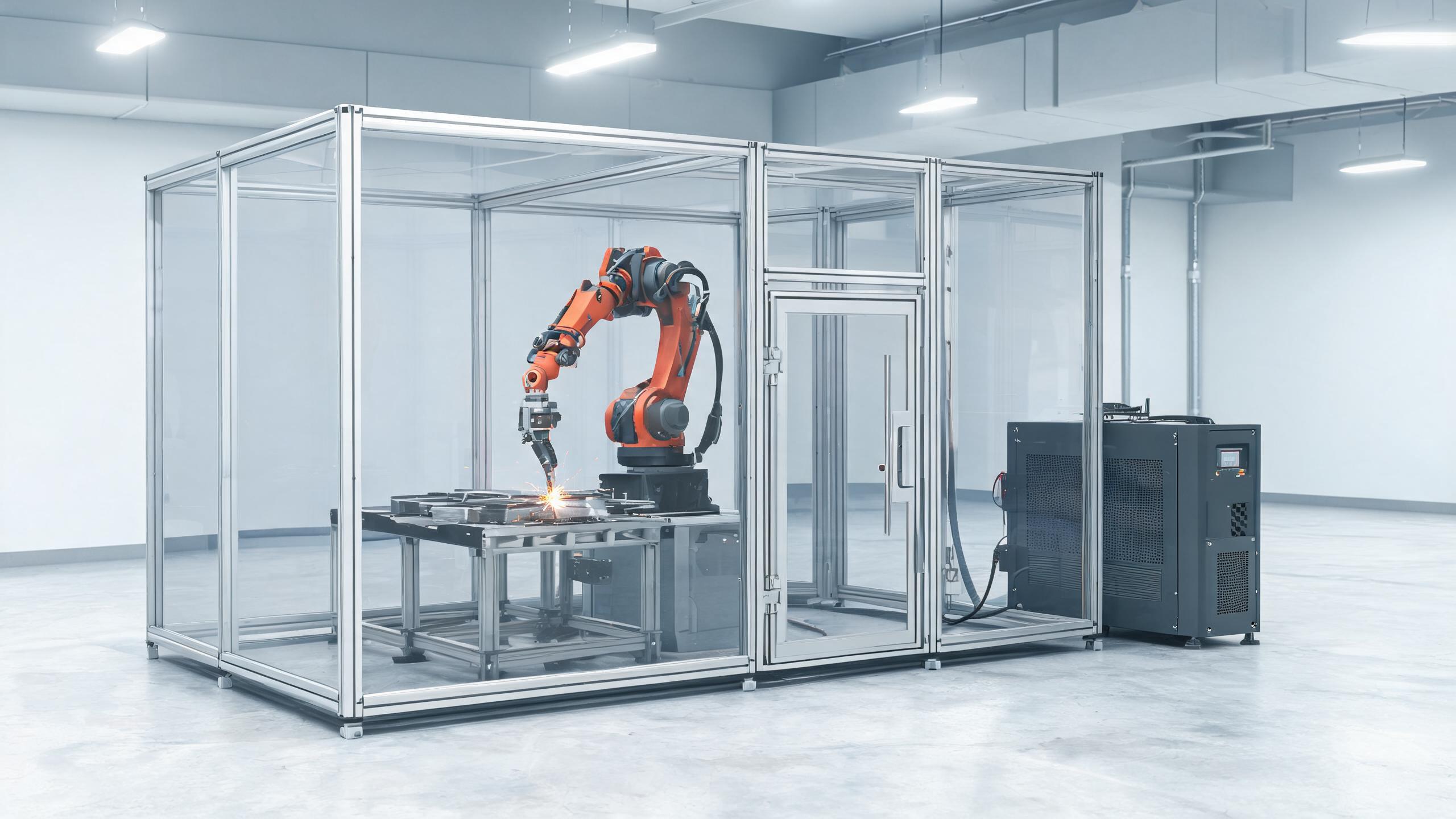
A robot does two things a human cannot sustain: it repeats a path identically, every cycle, and it does so around the clock. A robotic laser welding cell is built for exactly that. Our Automated Robotic Arm Fiber Laser Welding Machine combines a 6-axis robot with vision seam tracking, a Schneider CNC and a safety enclosure, and is rated for 24/7 automated operation with CE compliance.
The consistency gain is as important as the speed gain. A handheld operator drifts: standoff distance, travel angle and speed vary from weld to weld and from shift to shift, especially on long seams. Vision seam tracking on a robot corrects for small part-to-part deviations in the joint line, so weld placement stays within the same window all day. For joints that must meet repeatable quality targets - brackets, enclosures, tube-to-plate work, subassemblies going into a larger certified product - that repeatability reduces rework and inspection load in a way an operator rarely can.
The throughput math only works, however, when the part mix is stable. A robot amortizes its programming and fixturing cost across volume. If you run the same ten weldments every month in hundreds or thousands of pieces, the cell pays for itself. If you run fifty different jobs in single digits, it mostly pays for reprogramming.
Flexibility: Where the Handheld Torch Wins
A handheld fiber laser welder is the laser equivalent of picking up a MIG torch - and that is precisely its value. The operator walks to the work instead of the work coming to a fixture. Large weldments that will not fit in an enclosure, one-off repairs, architectural work, on-site style patching, and short-run jobs all favor the gun.
Our 2000W Handheld Fiber Laser Welding Machine delivers 5mm penetration on stainless steel, offers dual-mode continuous wave and pulsed output (CW for speed on straight seams, pulsed for control on heat-sensitive or thin material), and is water-cooled to support 8-hour shifts. For a job shop, that combination covers a wide slice of daily work without any programming at all: change the job, change the parameter set, pull the trigger. For a complete walkthrough of handheld power classes, penetration depth and configuration options, see our handheld fiber laser welding machine buyer's guide.
The limitations are the mirror image of the robot's strengths. Output depends on operator skill and stamina; a day of long overhead or awkward-position seams is slower and less consistent than a flat fixture. And penetration is capped by the source - a 2kW class handheld machine has a practical envelope around the 5mm-on-stainless mark, so thicker sections demand joint design changes, beveling, or a multi-pass approach.
Fixtures and Programming: The Hidden Cost of Automation
The visible price of a robot cell is the machine. The hidden cost is everything the robot needs around it:
- Fixturing. Every part family needs clamping that presents the joint in a known position. Modular fixture tables soften this, but each new weldment still consumes design and build time.
- Teaching or offline programming. Paths must be taught at the teach pendant or programmed offline, then proven out on real parts. Vision seam tracking absorbs minor deviation but does not replace a sound taught path.
- Part presentation. Loading, unloading and (in higher volumes) pallet changers determine whether the robot is actually the bottleneck or the operator is.
A handheld setup needs none of this. The joint is fixtured to the same standard as it would be for TIG - basic clamping to control fit-up - and there is no program to write. For a shop welding five different parts this week, that difference in overhead is the whole decision.
Staffing: Operator Versus Programmer
Handheld welding requires a trained laser welding operator. The learning curve is shorter than TIG, but it is still a skill role, and every machine-hour is bound to that person's hours. If the operator is sick or busy, the welder is idle.
A robotic cell shifts the labor profile. One programmer/process engineer supports the cell, and a less specialized loader can tend production once programs are proven. You effectively convert recurring skilled-welding hours into a one-time engineering investment. That is attractive when skilled welders are hard to hire - but only if your volume justifies having programming capacity on staff or on call.
Safety Enclosures and Workplace Layout
The two architectures handle laser safety differently, and this shapes your floor plan.
A robotic cell normally runs inside an interlocked safety enclosure with filtered viewing - the enclosure on our automated robotic arm machine is part of its standard configuration. The enclosure contains laser radiation, spatter and a large share of fume at the source, and it keeps personnel away from the moving arm. The trade is floor space and cost: the cell footprint is significantly larger than the welder alone.
A handheld machine operates in open air, which means the safety responsibility moves to the workplace: controlled laser area, class-appropriate laser eyewear and PPE for the operator and anyone in line of sight of the plume, fume extraction at the work, and trainee supervision. These are manageable requirements - we cover them in detail in our guide to laser welding safety, radiation, fume and PPE for handheld fiber laser welders - but they are standing requirements, not a one-time enclosure purchase.
The Middle Ground: Automated Heads on Fixed Paths
The choice is not strictly binary. Between the handheld gun and the full 6-axis cell sits a family of machines that automate the weld path without a full robot program. Our 2000W Industrial Fiber Laser Welder is an example: it pairs a fixed scanning head with robotic arm integration, delivers 5mm penetration on stainless steel and 4mm on aluminum, offers dual-mode CW/pulsed output, and includes a vision system with a laser crosshair to aid precise positioning. It is CE certified.
Machines in this class suit buyers whose work is repetitive in character but not yet at the volume - or the budget - of a full cell: long straight seams, tube rings, and rectangular frames where a guided or integrated motion path does most of what a robot would do, at lower programming overhead.
A Practical Decision Framework
| Decision factor | Favors handheld | Favors robotic cell |
| Part mix | Many different weldments, short runs, repairs | Few part families, high piece counts |
| Part size | Large weldments, work that cannot be fixtured in an enclosure | Parts that fit a fixture and enclosure |
| Quality requirement | Skilled operator can hold tolerance job by job | Repeatable weld placement and parameters every cycle |
| Staffing | Trained operators available | Programming/engineering capacity; operator hours scarce |
| Utilization | Single-shift, variable work | Multi-shift or 24/7 production |
| Safety layout | Open work area with controlled laser zone and PPE | Enclosure-based, personnel outside the cell |
Many shops land on a hybrid: a handheld unit absorbs repair work, prototypes and large assemblies, while a robot or automated-head machine takes over the handful of part families with real volume. Buying the handheld first is also a low-risk way to build laser welding competence - parameter knowledge, joint design, fume and safety practice - before committing to automation.
Frequently Asked Questions
When does a robotic laser welding cell actually pay off?
When you have a small number of part families produced at consistent volume, on multiple shifts. The robot's 24/7 capability and vision-guided repeatability only amortize the fixtures and programming across enough parts. Below that volume, the same capital sits idle between changeovers.
How much programming and fixturing does a robot cell need?
Each part family needs clamping that locates the joint repeatably, plus a taught or offline-programmed path that is proven out on real parts. Vision seam tracking compensates for small deviations in the joint line, but it does not eliminate the need for sound fixtures and programs. Budget engineering time per new part, not just per machine.
Is a handheld laser welder safe without an enclosure?
Yes, when operated inside a controlled laser area with the right PPE, fume extraction and trained supervision. Handheld machines are designed for open use; the enclosure that a robot cell provides is replaced by procedural controls - eyewear, barriers, warning signage, extraction. These are ongoing responsibilities rather than a one-time purchase.
What thickness can a 2000W handheld machine weld?
Our 2000W handheld unit achieves 5mm penetration on stainless steel, with dual-mode CW/pulsed output to trade speed against heat input, and water cooling sized for 8-hour shifts. For thicker sections, expect joint preparation such as beveling, or step up to a fixed-head machine like our 2000W industrial unit, rated at 5mm on stainless and 4mm on aluminum.
Choosing Your Machine with Xinhong CNC
The right answer depends on your part mix, thickness range and shift structure - not on which technology is more impressive. Xinhong CNC (Shandong Xinhong CNC Technology) manufactures both ends of this spectrum, from the 2000W handheld welder for job shops to the 6-axis robotic cell with vision seam tracking for automated production, and CE-certified fixed-head machines in between. Send us your typical materials, thicknesses and application, and we will recommend the architecture that fits your work rather than the one that fits a catalog.