
Handheld fiber laser welders and MIG sets solve different problems. This comparison covers weld quality, speed, consumables, operator skill, gap tolerance and thickness ranges so fabrication shops can decide where a laser welder pays off and where MIG remains the better tool.
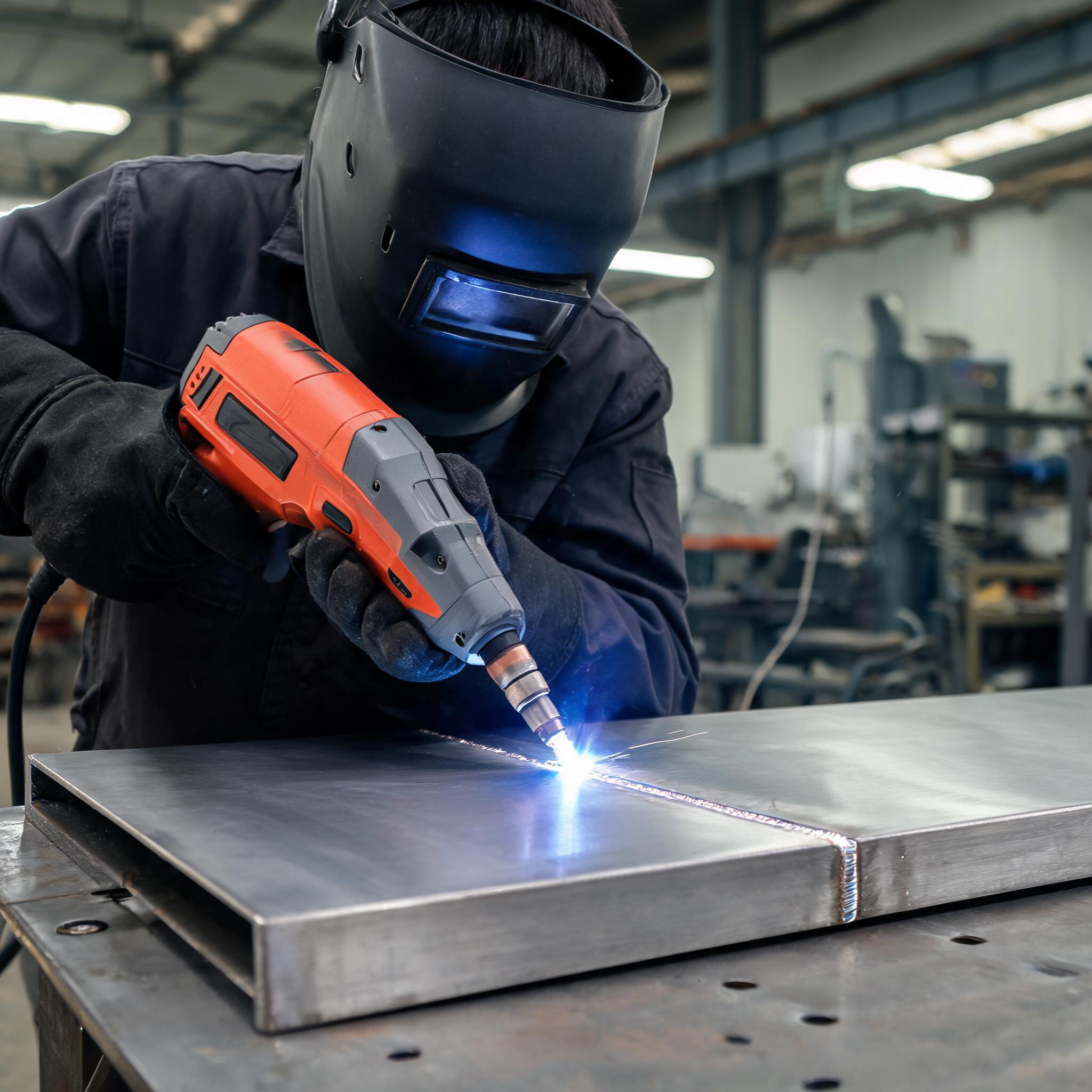
MIG has been the default welding process in small and mid-size fabrication shops for decades. It is inexpensive, forgiving on fit-up, and nearly every welder on the floor already knows how to run it. Handheld fiber laser welders now sit next to it as a genuine alternative for thin and medium-gauge sheet work — but they are not a drop-in replacement, and treating them as one leads to bad purchasing decisions.
This article compares the two processes on the factors that actually matter when you are deciding what to buy: weld quality, speed, running costs, operator skill, gap tolerance, and the thickness range each process can handle. The short version: laser wins on thin and medium sheet where distortion and finish matter; MIG wins on thick plate, wide gaps, and low entry cost.
Weld Quality: Heat-Affected Zone, Distortion, Spatter and Finishing
The fundamental difference is energy density. A fiber laser concentrates energy into a spot measured in fractions of a millimeter, while a MIG arc spreads heat over a much broader area. That single difference drives most of the quality comparison.
Heat-affected zone and distortion
Laser welding produces a narrow HAZ because only a small volume of metal is heated, and the weld is completed before the surrounding material absorbs much energy. On thin stainless steel — the material where distortion causes the most rework — this translates into visibly flatter parts. Our 1000W handheld fiber laser welding machine, for example, welds stainless steel up to 2mm and aluminum to 1.5mm with minimal heat distortion, which is precisely the regime where MIG tends to pull and buckle thin panels.
MIG, by contrast, deposits a larger molten pool with more total heat input. On sheet under about 2mm, that means more shrinkage, more straightening work after welding, and more risk of burn-through at the lower end of the thickness range.
Spatter and cleanup
MIG inherently generates spatter — droplets of molten metal expelled from the pool that stick to the surrounding surface. Every MIG-welded stainless part needs grinding or pickling near the joint before it is presentable. Laser welds are substantially cleaner because the process does not rely on transferring metal across an arc; with autogenous (no-filler) laser welding, there is no wire adding material that can be expelled, so post-weld cleanup time drops noticeably on visible parts.
Appearance and finishing cost
If your products are architectural stainless, food-service equipment, or anything where the weld line is visible, the narrow, consistent laser bead reduces polishing and blending hours. For structural or hidden welds, this advantage matters less and MIG's simplicity wins.
Speed and Throughput
Laser welding travels faster than MIG on thin and medium sheet — not because the machine moves faster, but because the concentrated energy keyholes through the joint efficiently and the operator does not pause for as much repositioning or cleanup. In practice, shops report the biggest productivity gain on parts under roughly 3mm, where a laser handpiece can complete a seam in a fraction of the MIG arc time and skip most grinding afterward.
MIG speed holds up better as thickness increases. On heavy sections the laser needs multiple passes or higher power, while MIG's generous filler deposition keeps building the joint. For plate work, MIG remains the faster and more economical process.
For a concrete example of where the speed advantage is real, the 2000W handheld fiber laser welding machine achieves 5mm penetration on stainless steel and runs in continuous wave (CW) or pulsed mode, with water cooling sized for 8+ hour shifts — the duty cycle matters when you are evaluating real throughput, not just bead speed.
Consumables and Running Cost
MIG runs three consumables continuously: filler wire, shielding gas, and contact tips. On an autogenous laser weld — which covers many common joints on sheet metal — you eliminate filler wire entirely and consume only shielding gas (and, on a fiber laser machine, no contact tips, liners, or drive rolls at all). Over a year of production, wire and tip consumption on a busy MIG station is a real line item.
However, be honest about the other side of the ledger. A handheld fiber laser welder has a higher purchase price than a comparable MIG set, and the machine contains a fiber laser source and optics that are more expensive to service than a MIG power source. Lenses and protective windows must be kept clean and replaced when damaged. MIG's running consumables are cheap and predictable; laser's running consumables are fewer but the capital and service cost per machine is higher. The economics favor laser where the process advantages — speed on thin material, less rework, no filler — actually apply to your product mix.
Operator Skill and Training Time
This is where the two processes are closer than most buyers expect — and it surprises people.
MIG is famously easy to start, but welding well with it still takes apprenticeship time: reading the pool, setting parameters, positioning work, and handling distortion on thin sheet. Achieving clean stainless MIG welds that do not need heavy cleanup is a genuine skill.
Handheld laser welding is mechanically easier to learn because the machine does much of the parameter control. The 2000W machine includes a laser crosshair alignment system, which shows the operator exactly where the beam will land — tracking a joint accurately still requires a steady hand, but the aim point is not guesswork. Dual CW/pulsed modes let the same operator switch between rapid seam welding and pulsed control on heat-sensitive parts without re-learning the machine.
Where skill genuinely matters for laser is safety discipline and joint prep. Fiber laser welds reflect, and the beam hazards are different from arc welding. If you are adding a laser welder to your floor, review laser welding safety, radiation, fume and PPE requirements for handheld fiber laser welders before deployment — appropriate eyewear, workspace controls, and fume extraction are not optional.
Gap Tolerance and Filler Wire
This is the honest limitation of laser welding and the strongest reason MIG survives in most shops.
MIG is a filler-heavy process: wire is always being deposited, so it bridges gaps and poor fit-up that would doom a laser weld. If your shop works with laser-cut parts that fit tightly and consistently, an autogenous laser weld handles most joints without filler. But if your parts come from hand cutting, rolled tube with variable edges, or assemblies that are tacked rather than fixtured, gaps will appear — and a keyhole weld cannot fill a gap it was not given wire or power for.
Laser welding can run with filler wire when a joint requires it, but the process is most efficient autogenous, which assumes good fit-up. The practical rule: the tighter and more consistent your fit-up, the better laser welding works for you. Shops with consistent fit-up gain the most; shops welding irregular fabrications should keep MIG for those jobs.
Thickness Ranges: Where Each Process Stops Making Sense
| Thickness | Better process | Why |
| Under 2mm stainless, under 1.5mm aluminum | Laser | Minimal distortion, fast travel, clean beads; the 1000W machine covers this range directly |
| 2–5mm stainless | Laser (with adequate power) | A 2000W machine achieves 5mm stainless penetration; faster than MIG with less cleanup |
| Above ~5mm steel and stainless | MIG | Filler deposition, gap tolerance, and lower cost per joint favor the arc process |
| Poor fit-up, gapped joints, field repair | MIG | Continuous wire bridges gaps; handheld laser needs consistent joint preparation |
When MIG Is Still the Better Choice
Keep MIG — or buy it instead of a laser welder — when most of these describe your work:
- Heavy structural steel or plate above the practical range of a handheld laser unit.
- Fit-up you cannot control: irregular parts, gap-prone assemblies, on-site or repair welding.
- A very tight capital budget where a MIG set's low entry cost is decisive.
- Welds that are hidden or structural, where finish quality adds no commercial value.
- Large-volume fillet welds on galvanized or coated structural sections, where MIG's filler deposit does the job simply.
When a Handheld Fiber Laser Welder Pays Off
A laser welder earns its place when thin and medium-gauge stainless or aluminum dominates your work, distortion and rework are costing you hours, weld appearance matters to your customers, and your fit-up is consistent enough for autogenous welding. Typical candidates include sheet-metal shops, stainless fabrication for food and architectural products, signage, enclosures, and tube-to-sheet assembly work. For shops in the 2mm-and-under stainless range, a lightweight, water-cooled unit like the 1000W handheld fiber laser welding machine covers the thickness range with minimal heat distortion; shops needing up to 5mm stainless penetration should step up to the 2000W unit. Both are CE compliant and water-cooled for continuous production shifts. For a full walkthrough of power classes, penetration depth and configuration options, see our handheld fiber laser welding machine buyer's guide.
Many shops end up running both: laser for thin sheet production and visible welds, MIG retained for thick plate and gapped joints. That is a reasonable outcome, not a failure to choose — the two processes are complementary more often than they are substitutes.
Frequently Asked Questions
Is the heat-affected zone really much smaller with laser welding?
Yes. The laser's energy is concentrated in a tiny spot and the joint is welded quickly, so a narrow band of material around the seam is affected. MIG spreads heat over a wider arc footprint with higher total heat input, producing a wider HAZ and more distortion — especially noticeable on sheet metal under about 2mm.
Does laser welding eliminate spatter cleanup?
It reduces it substantially, but does not eliminate it. Because there is no wire transferring across an arc in autogenous laser welds, far less spatter lands on the workpiece than with MIG, so grinding and blending near the weld are typically minimal. Good shielding gas coverage and clean optics keep this advantage intact.
Can a handheld laser welder replace MIG for gapped joints?
Not reliably. MIG deposits filler wire continuously and bridges gaps and inconsistent fit-up; a laser keyhole weld needs the joint faces in contact or nearly so. Laser welding can run with filler when needed, but if your parts routinely arrive with visible gaps, keep MIG for those assemblies or improve your fixturing and cutting accuracy.
How long does it take to train an operator on a handheld laser welder?
Basic operation is learned faster than MIG proficiency because the machine manages the process parameters and features like laser crosshair alignment show the operator where the beam will land. The deeper training commitment is safety and joint preparation: understanding reflection hazards, correct PPE, workspace setup, and producing consistent fit-up. Plan for both, not just the trigger-pull part.
Choosing Your Machine with Xinhong CNC
The right answer depends on your materials, thicknesses, joint types, and how well your parts fit up before welding. Send us the details of what you fabricate — material, thickness range, and typical joint configurations — and the Xinhong CNC team will recommend whether a 1000W or 2000W handheld fiber laser welding machine fits your production, or whether MIG should stay on the job. Submit your inquiry through our website and tell us what you build.