
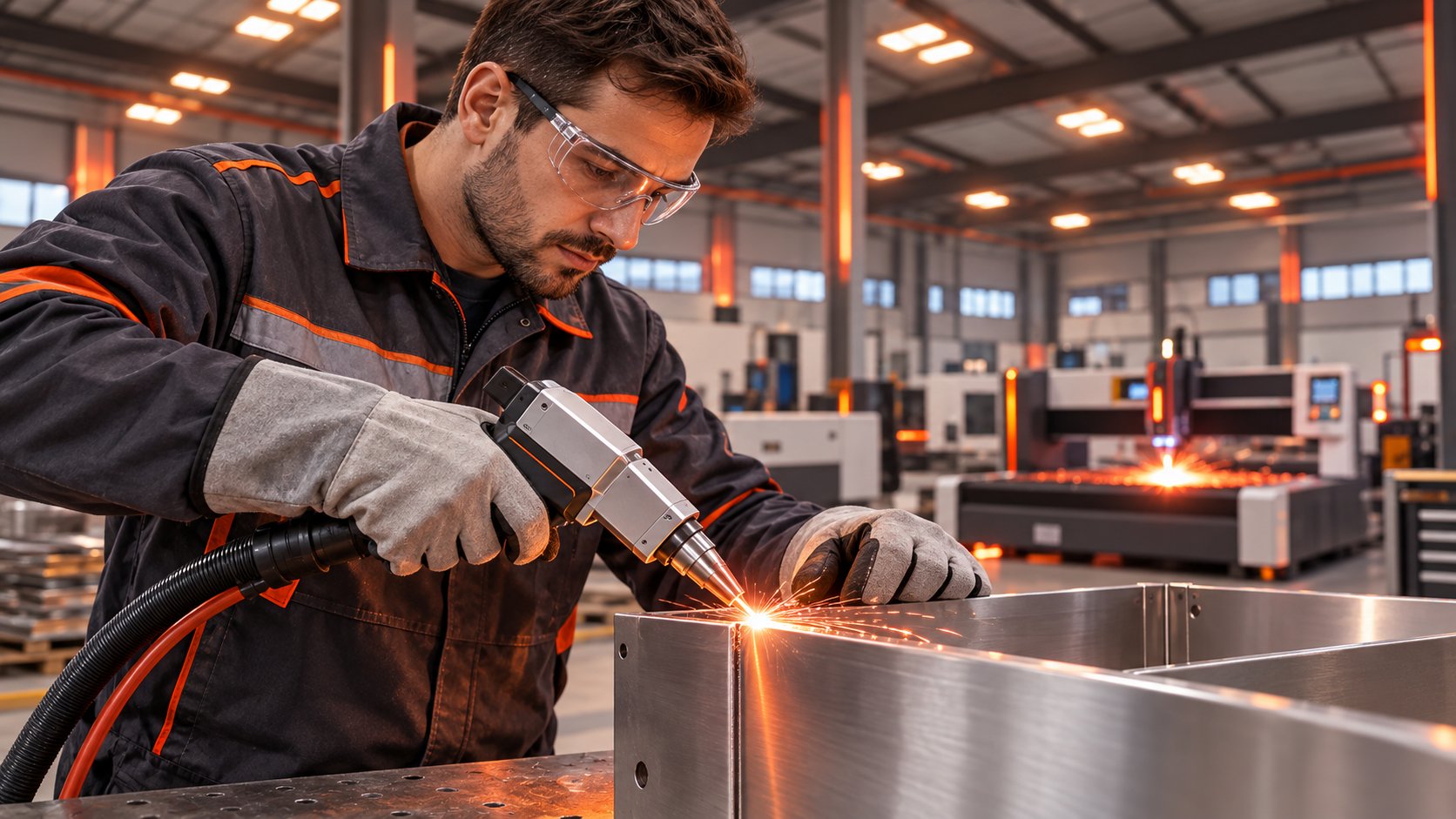
A practical pre-purchase checklist for B2B buyers evaluating portable laser welding machines—covering portability, power, cooling, safety, and after-sales support.
Portable Laser Welding Machine: What to Check Before You Buy
Portable laser welding machines have become a common sight in metal fabrication shops, but the range of specifications and price points makes it hard to compare one unit against another. For a B2B buyer, the goal is not just to find a machine that can weld—it is to find one that will perform consistently, survive shop-floor conditions, and receive support when something goes wrong. This article gives you a practical checklist, organized around the five areas that matter most: portability, power, cooling, safety, and after-sales support.
In this article
Portability: What Makes a Welder Truly Portable?
Portability is the main reason buyers choose a handheld laser welder over a traditional stationary unit. But portability is not just about whether the machine has wheels. You need to look at the complete system—the laser source, the cooling unit, the control cabinet, and the welding torch—and ask how easy it is to move around a workshop or between job sites.
Key factors to check:
- Weight and dimensions: A truly portable unit should be movable by one or two people without special lifting equipment. Ask for the weight of the complete system, not just the laser head.
- Wheel or cart design: If the machine is mounted on a cart, check the wheel quality and whether the cart can handle rough floors or thresholds.
- Handheld torch ergonomics: The torch should be balanced and comfortable to hold for extended periods. A heavy or poorly balanced torch will reduce weld quality and operator endurance.
- Setup time: How long does it take to connect the cooling system, power, and gas? A machine that requires complex setup defeats the purpose of portability.
For example, the 1500W handheld laser welding machine from Shandong Xinhong CNC Technology is designed as a compact unit that can be moved around a workshop. The company has been building laser equipment since 2005 and focuses on making the system easy to position near the workpiece.
Power: Matching Laser Output to Your Materials
Laser power directly determines the thickness and type of material you can weld. Buying too little power means you cannot handle thicker sections; buying too much power may be overkill for thin sheet metal and can increase costs. The two most common power levels for handheld welders are 1500W and 2000W.
Here is a quick comparison:
| Power | Typical Application | Material Thickness (Stainless Steel) |
|---|---|---|
| 1500W | Entry-level for thin to medium gauge stainless steel | Up to 3-4 mm (typical) |
| 2000W | Heavier fabrication, thicker sections | Up to 5 mm |
If you mostly weld thin to medium gauge stainless steel (e.g., sheet metal enclosures, light frames), a 1500W unit is a cost-effective choice. If you regularly weld thicker material, the 2000W handheld fiber laser welding machine offers more headroom. The 2000W unit can weld stainless steel up to 5 mm thick, which covers most common fabrication tasks.
Another important factor is the laser source itself. The quality and reliability of the laser source determine weld consistency and maintenance intervals. Look for machines that use well-known fiber laser sources from reputable manufacturers. Shandong Xinhong uses IPG, RAYCUS, and GW fiber laser sources, all of which are established names in the industry.
Cooling: Keeping the Laser Stable
Fiber lasers generate significant heat during operation. If the cooling system is inadequate, the laser output will fluctuate, leading to inconsistent welds and premature wear of the laser source. For a portable machine, cooling is even more critical because the system is often moved and operated in varying ambient temperatures.
What to check:
- Cooling type: Most portable laser welders use water cooling. Confirm the cooling capacity and whether it is sufficient for the laser power.
- Operating temperature range: Ask about the recommended ambient temperature range. If you work in a hot environment, you may need a more robust cooling system.
- Maintenance: Check how easy it is to clean or replace the cooling fluid and filters. Some units have accessible service panels.
- Noise level: The cooling unit can be noisy. If you work in a quiet environment, check the decibel rating.
Shandong Xinhong machines are equipped with integrated cooling systems designed for continuous operation. The company’s ISO 9001:2015 certification ensures that manufacturing processes are consistent, which extends to the cooling system assembly.
Safety: Protecting Operators and Workpieces
Laser welding involves high-intensity light, high temperatures, and potentially hazardous fumes. A professional buyer should never compromise on safety features. Here are the essential safety elements to look for:
- Laser safety class: Ensure the machine meets international safety standards. CE marking indicates compliance with European safety requirements.
- Protective housing: The laser source should be enclosed to prevent accidental exposure to the beam.
- Emergency stop: A clearly accessible emergency stop button is essential.
- Safety interlocks: The machine should automatically shut off if the housing is opened or if a fault is detected.
- Fume extraction: Laser welding produces fumes that are harmful if inhaled. Check if the machine has a fume extraction port or if you need to connect an external extraction system.
- Operator training: Even with safety features, operators must be trained on safe handling of the laser torch and proper use of personal protective equipment (PPE).
Shandong Xinhong’s machines are CE marked, confirming that they meet European safety directives. The company also uses Schneider Electric controls, which are known for their reliability and safety features.
After-Sales: What Support Do You Really Need?
After-sales support can make the difference between a profitable investment and a costly downtime. When evaluating a supplier, ask these questions:
- Warranty coverage: What does the warranty cover, and for how long? Is the laser source covered separately?
- Spare parts availability: How quickly can you get replacement parts like lenses, nozzles, or cooling pumps?
- Technical support: Is support available by phone, email, or video call? What is the response time?
- Training: Does the supplier offer training for your operators, either on-site or remotely?
- Documentation: Are manuals and troubleshooting guides available in your language?
Shandong Xinhong CNC Technology, founded in 2005, serves Europe and global markets. Their long experience in exporting means they have established logistics and support channels. They are ISO 9001:2015 certified, which indicates a commitment to quality management, and they provide comprehensive documentation with each machine.
Frequently Asked Questions
What thickness can a 1500W portable laser welder handle?
A 1500W unit is suitable for thin to medium gauge stainless steel. For most applications, it can weld up to about 3-4 mm in a single pass. For thicker material, a 2000W unit is recommended.
Can a portable laser welder replace a TIG welder?
For many applications, yes. Laser welding is faster and produces less heat distortion, but the initial investment is higher. It is best for production environments where speed and consistency are priorities.
How long does it take to learn to use a handheld laser welder?
Basic operation can be learned in a few hours, but achieving consistent quality takes practice. Most suppliers, including Shandong Xinhong, provide training materials and support.
What maintenance does a portable laser welder require?
Regular maintenance includes cleaning the lens, checking the cooling fluid level, and inspecting the torch and cables. The laser source itself is generally low-maintenance but should be serviced by qualified technicians.
Final Checklist Before You Purchase
Use this summary when you compare quotes:
- Verify the portability of the complete system, not just the laser head.
- Match the laser power to your typical material thickness.
- Check the cooling system’s capacity and maintenance requirements.
- Confirm safety certifications (CE) and built-in safety features.
- Ask about warranty, spare parts, and technical support.
- Review the supplier’s experience and market presence.
By working through this checklist, you can select a portable laser welding machine that will perform reliably on your shop floor and deliver a solid return on investment.