
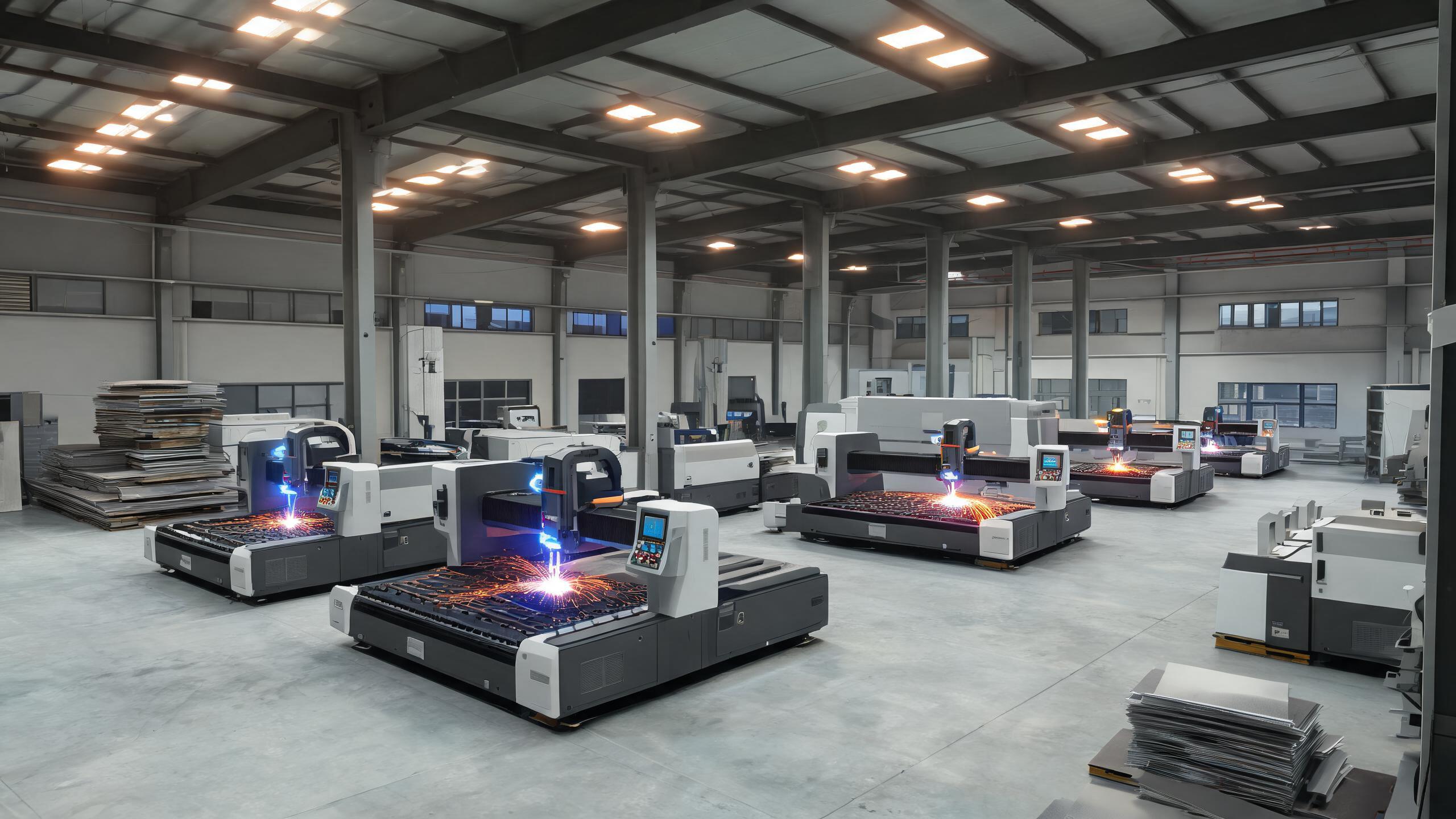
A laser cutting machine uses a focused, high-power laser beam to melt or vaporize metal along a CNC-controlled path. This article explains the working principle, main components, materials and thicknesses it handles, and how it compares with plasma, waterjet, and other cutting methods.
Key takeaways
- A laser cutting machine focuses a high-power beam through a lens or fiber optic to melt or vaporize metal, creating a clean cut.
- CNC control moves the cutting head precisely along the programmed path, enabling repeatable, accurate parts.
- Fiber laser machines typically cut mild steel, stainless steel, aluminum, brass, and copper up to 20–30 mm, depending on laser power.
- Compared with plasma or waterjet, laser cutting offers a narrow kerf, minimal heat-affected zone, and fine edge quality on thin to medium plate.
What is a laser cutting machine?
A laser cutting machine is a CNC-controlled industrial tool that uses a focused, high-power laser beam to cut sheet metal and plate. The beam melts or vaporizes the material along a programmed path, producing a clean, narrow cut with minimal mechanical force on the workpiece.
Laser cutting is widely used in sheet metal fabrication and automotive component manufacturing because it combines speed, precision, and repeatability. Unlike mechanical cutting, the laser never touches the material, so there is no tool wear and no risk of distorting thin parts.
How a laser cutting machine works
The working principle is straightforward: a laser source generates a high-energy beam, which is guided to the cutting head and focused to a small spot on the material surface. The concentrated energy heats the metal to its melting or vaporization point, and a assist gas (typically oxygen or nitrogen) blows the molten material away, leaving a clean cut.
Key steps in the process:
- Beam generation – The laser source (for fiber lasers, usually IPG, RAYCUS, or GW) produces a continuous or pulsed beam.
- Beam delivery – The beam travels through fiber optics or mirrors to the cutting head.
- Focusing – A lens or focusing mirror concentrates the beam to a small spot, increasing energy density.
- CNC movement – The controller moves the cutting head along the X/Y axes according to the part program, while the material or head moves in Z for focus control.
- Cutting – The molten metal is blown away by the assist gas, forming the kerf (the width of the cut).
The entire process is controlled by CNC (Computer Numerical Control), which reads the part geometry from a CAD file and converts it into precise motion commands. This allows complex shapes, tight radii, and repeatable production runs.
Main components of a laser cutting machine
A typical fiber laser cutting machine consists of several key subsystems:
- Laser source – The heart of the machine; generates the beam. Common brands include IPG, RAYCUS, and GW, with power ratings from 1000W to 30000W.
- Cutting head – Holds the focusing lens, nozzle, and often a height sensor to maintain focus distance.
- CNC controller – Interprets the part program and controls axis motion. Some machines use Schneider Electric controls for reliable automation.
- Motion system – Includes servo motors, linear guides, and ball screws or rack-and-pinion drives to move the head or table.
- Bed or worktable – Supports the sheet during cutting; may be a fixed table or a shuttle table for faster loading.
- Assist gas system – Supplies nitrogen or oxygen to aid cutting and protect optics.
- Cooling system – Maintains stable temperature for the laser source and optics.
What materials and thicknesses can it cut?
Fiber laser cutting machines are primarily used for metals. The most common materials are:
- Mild steel
- Stainless steel
- Aluminum
- Brass
- Copper
The maximum thickness depends on laser power. As a practical guide, a 1000W fiber laser machine can cut mild steel up to 12 mm, while a 6000W machine handles much thicker plate. For very thick sections, plasma or waterjet may be more economical, but laser offers better edge quality on thin to medium plate.
For example, a 1000W fiber laser cutting machine with a 3000x1500mm or 4000x2000mm bed is designed for cutting 1–12 mm metal, with ±0.05mm/m positioning accuracy and a rapid speed of 120 m/min. This is a typical entry-level configuration for small fabrication shops.
How it compares with other cutting methods
Laser cutting is one of several thermal and mechanical cutting processes. Here’s how it stacks up against the most common alternatives:
| Method | Kerf width | Edge quality | Heat-affected zone | Material thickness | Typical use |
|---|---|---|---|---|---|
| Laser (fiber) | Very narrow (0.1–0.3 mm) | Excellent, smooth edges | Small | Up to 20–30 mm (depending on power) | Precision sheet metal, complex shapes |
| Plasma | Wide (1.5–5 mm) | Good but rougher | Larger | Up to 50 mm or more | Thick plate, structural steel |
| Waterjet | Very narrow (0.5–1 mm) | Excellent, no heat | None | Very thick (up to 200 mm) | Heat-sensitive materials, thick blocks |
| Oxy-fuel | Wide (1–3 mm) | Moderate | Large | Very thick (up to 300 mm) | Carbon steel plate |
Laser cutting is often preferred for sheet metal because it delivers high accuracy, narrow kerf, and minimal distortion. It also allows unattended operation and quick changeovers between different part geometries.
Common applications in industry
Laser cutting machines are used across many sectors. The most common include:
- Sheet metal fabrication – producing enclosures, brackets, panels, and custom parts.
- Automotive components – cutting body panels, frames, and interior parts.
- Electronics enclosures – precise cutouts for connectors and vents.
- Architectural metalwork – decorative panels, railings, and cladding.
- Machine building – cutting guards, covers, and structural components.
For a fabrication shop, a laser cutting machine can replace several processes (shearing, punching, or manual cutting) and reduce setup time, especially for low-to-medium volume production.
Choosing the right laser cutting machine
When evaluating a laser cutting machine, focus on these parameters:
- Laser power – determines the maximum thickness you can cut and the speed at which you can cut thin material.
- Working area (bed size) – must accommodate your largest sheet size.
- Positioning accuracy – important for parts that must fit together tightly.
- Rapid speed – affects cycle time, especially for thin sheet cutting.
- Laser source brand – a reliable source (e.g., IPG, RAYCUS, GW) reduces downtime.
- Controller brand – a proven CNC system (e.g., Schneider Electric) improves reliability and ease of use.
For example, a 1000W fiber laser cutting machine is a common starting point for shops cutting up to 12 mm mild steel. It offers a 3000x1500mm or 4000x2000mm bed, positioning accuracy of ±0.05mm/m, and a rapid speed of 120 m/min.
If you need to cut thicker plate or want higher throughput, a 6000W fiber laser cutting machine is a more capable option.
Supplier quality and certification
When buying a laser cutting machine, the supplier’s manufacturing quality is as important as the machine specs. Look for:
- ISO 9001:2015 quality management certification
- CE certification for safety and compliance
- Experience in the industry – for example, Shandong Xinhong CNC Technology Co., Ltd. has been building laser cutting equipment since 2005.
- Use of well-known components (laser sources, controllers) to ensure reliability and easy service.
Shandong Xinhong CNC Technology Co., Ltd. is a Chinese manufacturer with 100-300 employees, producing fiber laser cutting machines from 2000W to 30000W. The company is ISO 9001:2015 and CE certified, uses IPG/RAYCUS/GW laser sources and Schneider Electric controls, and exports to Europe and other global markets.
Frequently asked questions
Can a laser cutting machine cut thin sheet without distortion?
Yes, because the laser beam applies no mechanical force, thin sheet (1 mm and above) can be cut with minimal distortion, especially when using nitrogen as an assist gas to avoid oxidation.
What is the difference between fiber and CO2 lasers?
Fiber lasers use a solid-state source and are more energy-efficient, have a smaller beam diameter, and require less maintenance than CO2 lasers. They are also better at cutting reflective metals like aluminum and copper.
How thick can a 1000W laser cut?
A 1000W fiber laser can typically cut mild steel up to 12 mm, stainless steel up to 6-8 mm, and aluminum up to 4-5 mm, depending on the assist gas and focus settings.
What maintenance does a laser cutting machine need?
Regular maintenance includes cleaning the cutting head lens, checking the nozzle condition, replacing assist gas filters, and inspecting the cooling system. The laser source itself is generally low-maintenance, especially fiber lasers.
Is laser cutting suitable for small production runs?
Yes, because no hard tooling is required. You simply upload a new CAD file and the machine can cut a different part immediately, making it ideal for prototypes and small batches.
If you are evaluating a laser cutting machine for your shop, the key is to match the machine’s power and bed size to your typical material thickness and part dimensions. Talk to a supplier who can provide detailed specifications and support.