Class 4 describes the beam of an open fiber laser; Class 1 describes a fully enclosed machine where that beam is inaccessible during normal operation. This article explains the difference in plain terms, lists what an enclosure must include to make the conversion, gives a requirements checklist, and shows how enclosure choice pairs with the machine purchase decision.
Laser Safety & Machine Selection
Two questions decide whether a fiber laser machine is safe to operate and easy to pass through an internal safety review. First, what hazard class is the laser source? Second, what does the enclosure around it actually do? Buyers often see the terms class 1 laser safety enclosure and class 4 laser safety enclosure used loosely, sometimes as if they were competing products. They are not. One describes the beam, the other describes what happens to the beam once a machine is built around it.
- Class 4 is the hazard class of an open, high-power fiber laser beam; Class 1 describes a fully enclosed machine whose laser is inaccessible during normal operation.
- An enclosure converts a Class 4 source into a Class 1 machine only when it covers the laser wavelength, blocks the beam optically, shuts the laser off when a door opens, and is documented as compliant.
- Enclosure requirements should be matched to the machine you buy, not chosen afterward, because the panel, interlock and window ratings depend on the laser wavelength and power inside.
In this article
The two classes in plain terms
Laser classes describe the level of hazard a person faces when working with the laser. The numbers are not brand tiers or quality grades. They are a way of saying how accessible the beam is.
Class 4: the open beam
A fiber laser cutting source in the kilowatt range is a Class 4 laser. Class 4 means the beam is a serious hazard to eyes and skin when it is open, and it can also start fires if it strikes flammable material. This is the situation on a machine where the cutting area is exposed, or where the beam path is reachable without a barrier.
Class 4 is not a defect. It is simply the correct description of a high-power laser before any protective housing is placed around it. A fiber laser cutting head would not cut steel if it did not produce a concentrated Class 4 beam.
Class 1: the enclosed machine
Class 1 describes a machine where the laser is fully enclosed and inaccessible during normal operation. The operator loads material, closes the door, and runs the program. The laser inside may still be Class 4, but the enclosure makes the machine Class 1 from the operator's point of view.
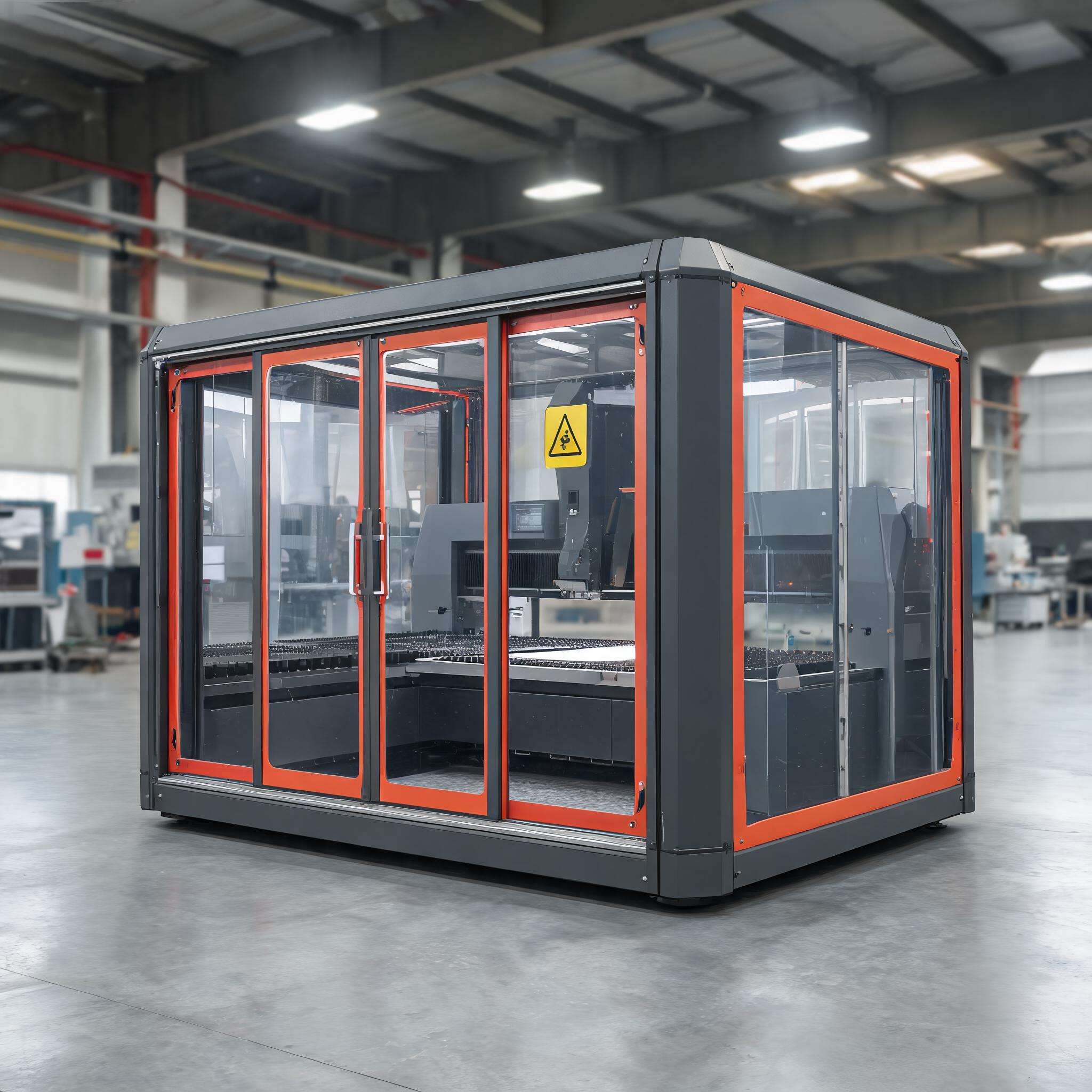
This is the practical distinction for buyers: a class 1 laser safety enclosure is not a weaker or stronger laser. It is a protective cabin that contains a Class 4 beam and gives the finished machine a Class 1 operating profile.
Why the terms appear together
When a supplier quotes a class 4 laser safety enclosure, they usually mean an enclosure built to contain a Class 4 source. The enclosure itself does not have a laser class; it is a barrier and interlock system. The class refers to the laser it is designed around. If a sales page confuses the two, ask which source the enclosure was specified for and what optical rating its viewing panels carry.
| Term | What it describes | What the buyer should confirm |
|---|---|---|
| Class 4 laser | An open, high-power fiber laser beam | Laser power and wavelength of the cutting source |
| Class 1 machine | A fully enclosed machine; laser inaccessible in normal operation | Door interlocks, panel optical rating, and compliance documents |
| Class 1 laser safety enclosure | The protective cabin that makes the conversion | Wavelength range, optical density, interlock response, ingress protection |
What an enclosure must include to make a Class 4 source into a Class 1 machine
A steel box with a window is not enough. Several elements have to work together, and each one answers a different failure mode.
Wavelength coverage
Laser safety filters are wavelength-specific. Fiber laser cutting commonly runs at 1080 nm, and the window or panel has to be rated for that wavelength. Any other light sources on the machine — alignment lasers, pointer lights or visible process glow — are outside that rating and must be checked separately against the panel specifications.
The protective cabin from Xinhong specifies a wavelength range of 900–11000 nm, which covers the 1080 nm output of fiber laser cutting sources. Before ordering, match the stated range against every laser and alignment source on the machine you are buying, and ask the supplier in writing which sources the rating covers.
Optical density
Optical density (OD) is the blocking strength of the viewing material at a given wavelength. A higher number means less laser energy passes through. The same product is listed at OD 6+, under the EN 12254 standard for laser protective screens. Rather than treating a number alone as a guarantee, confirm the relevant standard, the wavelength range it applies to, and that the window assembly — not only the raw material — carries the rating.
Interlocked doors
The interlock is what turns a physical barrier into a safety system. When the access door opens, the laser must be shut down before a person can reach the beam path. The Xinhong protective cabin specifies a door interlock that shuts the laser down in 2 seconds or less. Response time matters because it defines the gap between the door opening and the beam stopping; a slower circuit leaves a longer exposure window.
Ask how the interlock behaves on restart as well. A door that is simply re-closed should not always mean the laser resumes immediately; the operating procedure and controls need to be consistent.
Safe viewing windows
Operators need to watch the cut, so the window has to be both transparent and protective. Check the material, its optical rating, its condition after cleaning, and how it is mounted. Scratched or clouded windows are not just a visibility problem — they can indicate damaged filtering material, and they should be replaced rather than polished.
Ingress protection and build quality
Cutting shops produce dust and spatter. The Xinhong cabin is specified at IP54, which limits dust ingress and protects against water splashes. That matters for the life of the interlock components and for keeping the inside of the windows clean enough to see through.
CE and Machinery Directive documentation
An enclosure is part of a machine's safety function, so the paperwork should follow it. The Xinhong protective cabin is stated as CE and Machinery Directive compliant. For a European installation or a customer audit, confirm that the documents match the exact configuration you purchase — enclosure, machine, and interlock circuit together.
Laser safety enclosure requirements checklist
Use this list during quotation and again at acceptance. Each point should be answerable with a document, a plate, or a demonstration — not a verbal assurance.
- Wavelength match. The enclosure's stated range covers every laser and alignment wavelength on the machine.
- Optical rating. Viewing panels state their standard and OD, for example EN 12254, OD 6+, and the wavelength range those figures apply to.
- Interlock response. Opening the access door shuts the laser down in 2 seconds or less, and the test can be demonstrated on site.
- Interlock integrity. Cables, switches and control logic are protected from dust, coolant and accidental damage.
- Ingress protection. The cabin's IP rating, such as IP54, suits the dust and spatter level of your cutting process.
- Window condition. Viewing windows are clean, correctly mounted, and covered by a replacement policy for scratches or damage.
- Door and panel fit. Doors close flush, latches hold, and gaps or feed-throughs do not leave line-of-sight paths to the beam.
- Compliance documents. CE and Machinery Directive documentation is supplied and matches the delivered configuration.
- Operator procedure. A clear startup, restart and emergency procedure is provided and matches the interlock behavior.
Do not treat the class label as a substitute for the checklist. A machine may be described as Class 1 and still need its window rating, interlock timing and documentation verified against your configuration and the market where it will be installed.
How enclosure choice pairs with the machine purchase decision
The common mistake is to buy a machine, then look for an enclosure. The enclosure should be specified against the laser inside the machine, so the two decisions run together.
Laser power sets the exposure
A higher-power source raises the energy reaching the enclosure in the event of a direct hit, and it raises the value of a fast, reliable interlock. If you are comparing a 2000W fiber laser cutting machine with a higher-power model, compare the enclosure specification at the same time. The machine listing for the 2000W fiber laser cutting machine should be read alongside the protective cabin specification, not separately.
Get the enclosure data with the machine quote
Ask for the enclosure specification in the same quotation as the machine: wavelength range, optical density and standard, interlock timing, IP rating, and the compliance documents. If the enclosure is sourced separately, ask who confirms that it matches the machine's laser and controls.
Match the enclosure to the installation
An enclosure that meets the specification still needs to fit the floor plan, the material loading path, and the maintenance access. Confirm door size, how scrap and finished parts are removed, and whether the cabin obstructs service access to the cutting head or the chiller. These are operational details that decide whether the safety feature is actually used as intended.
Record the acceptance test
At delivery, witness the interlock test, check the window rating against the certificate, and file the compliance documents with the machine record. This turns the quote's claims into a documented installation.
Need the enclosure specification for your machine?
The fiber laser protective cabin lists its EN 12254, OD 6+, 900–11000 nm, 2-second interlock, IP54 and CE/Machinery Directive details. Compare them with your laser source, then ask for the matching documentation for the machine you plan to buy.
Common buyer questions
Does a Class 1 enclosure make the laser itself Class 1?
No. The laser source inside is usually still a Class 4 fiber laser. The enclosure and interlock system make the completed machine Class 1 during normal operation, because the beam is inaccessible when the doors are closed.
Can I add an enclosure to a machine I already own?
In principle, if the enclosure matches the laser's wavelength and power, the interlock interfaces with the machine controls, and the combined installation is documented. In practice, this requires the machine builder or a qualified integrator to confirm compatibility. The safer route is to specify the enclosure with the machine order.
What does OD 6+ mean in practice?
It is an optical density rating for the protective material. What matters for the buyer is that the rating is stated for the relevant wavelength range and that the window assembly is supplied under a recognized standard such as EN 12254. Ask for the documentation rather than relying on the number alone.
How fast must the interlock respond?
The Xinhong cabin is specified at 2 seconds or less from door opening to laser shutdown. Confirm that the machine's own control circuit supports that timing in your installation, and have it demonstrated at acceptance.