
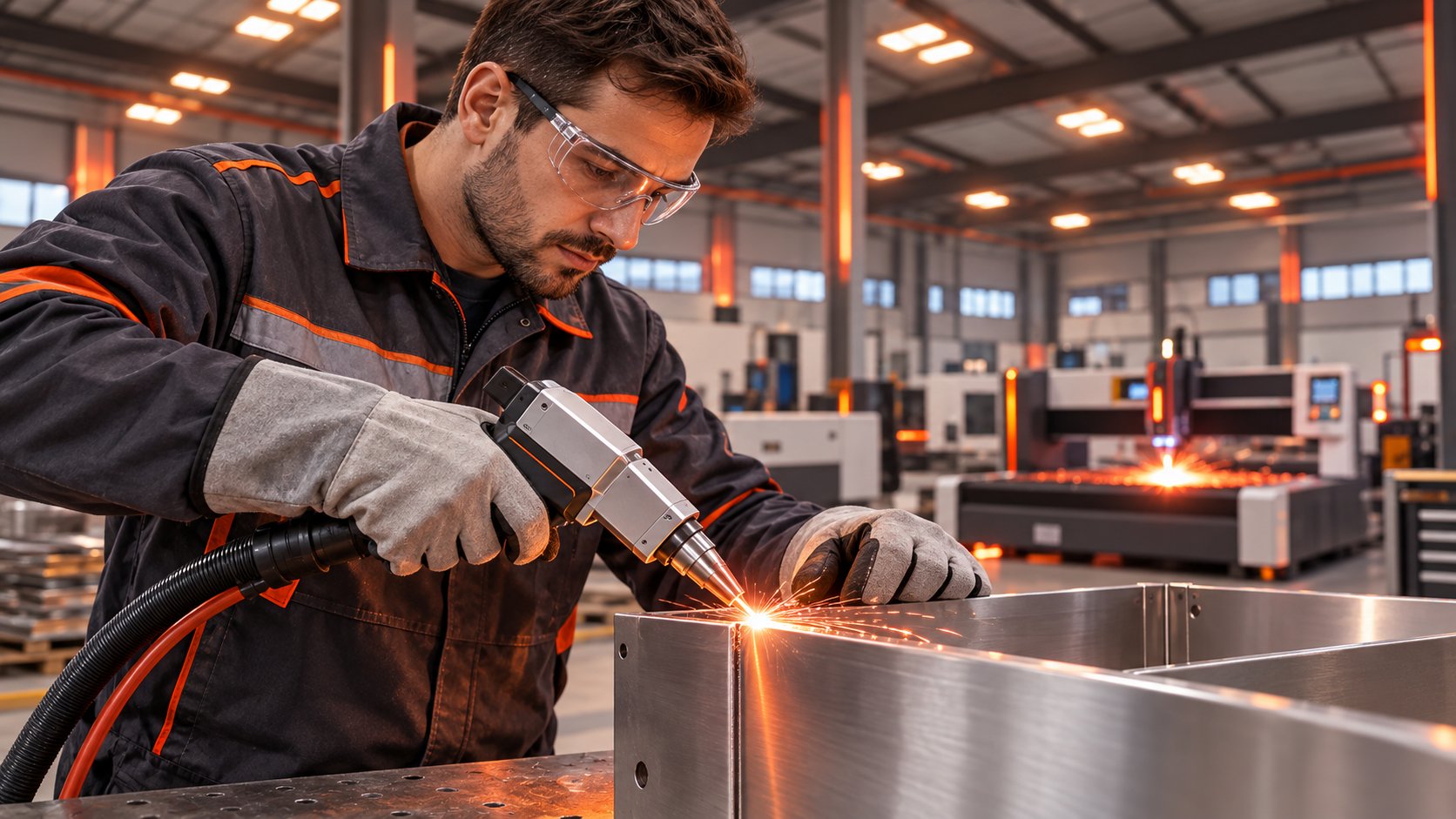
A technical guide for B2B buyers on fiber laser welding: how the process works, penetration and speed characteristics, and how to match 2000W industrial or handheld machines to your application.
Fiber Laser Welding: What the Process Actually Does
If you are evaluating a fiber laser welding machine for a production or fabrication line, the first question is not brand or price. It is whether the process fits the joint geometry, material thickness, and throughput you need. Fiber laser welding uses a focused laser beam to melt and fuse metal, with a fiber-delivered beam that produces a narrow, deep weld at high speed. It is a solid-state process, which means the beam is generated by laser diodes and delivered through an optical fiber to the welding head.
The practical result is a weld with a high depth-to-width ratio. The beam can penetrate thicker sections without requiring the wide V-grooves typical of arc welding. Because the heat-affected zone is small, distortion is lower and the weld bead is consistent. For a buyer, the relevant comparison is usually against TIG or MIG welding: fiber laser offers faster welding speed and lower heat input per meter of weld, but it requires precise joint fit-up and line-of-sight access to the seam.
Key Takeaways for Buyers
- Fiber laser welding is a high-speed, low-heat-input process suited to clean, well-fitted joints in sheet metal and light-to-medium sections.
- A 2000W industrial fiber laser welder provides more penetration for thicker sections or faster welding speeds than lower-power units.
- A 2000W handheld fiber laser welder can weld stainless steel up to 5mm, making it a flexible tool for manual and on-site work.
- Choose between industrial and handheld configurations based on whether your work is automated/stationary or manual/varied.
How a Fiber Laser Welding Machine Works
A fiber laser welding machine has three main functional groups: the laser source, the beam delivery system, and the welding head. The laser source generates the beam. In industrial equipment, the source is typically a ytterbium-doped fiber laser operating at a wavelength around 1070 nm. This wavelength is absorbed well by most metals, which is why fiber lasers are effective for steel, stainless steel, aluminum, and copper alloys.
The beam is delivered through a fiber optic cable to the welding head. The head focuses the beam onto the workpiece through a lens or a set of optics. The focused spot is small, often below 1 mm, which creates a high power density at the joint. This is what allows deep penetration without excessive heat spreading into the surrounding material.
In most configurations, an assist gas is used to shield the weld pool from oxidation. Argon or a nitrogen mixture is common. The gas also helps to suppress plasma formation that can scatter the beam at higher power levels. For a buyer, the gas supply is a running cost to plan for, but it is not a complex requirement.
Industrial vs. Handheld Fiber Laser Welder
The main decision for a buyer is between an automated industrial system and a handheld welder. They use the same laser source technology but are built for different workflows.
| Configuration | Best For | Typical Operation |
|---|---|---|
| Industrial fiber laser welder | Automated production lines, repetitive joints, high-volume parts | Fixed welding head or robot-mounted; parts are fixtured and moved under the beam |
| Handheld fiber laser welder | Manual welding, on-site repair, varied part geometries, low-to-medium batch work | Operator holds the head; suitable for corners, edges, and hard-to-reach seams |
The industrial format gives you repeatability and speed. The handheld format gives you flexibility and lower setup cost. Both can use a 2000W laser source, but the application fit is different. If you weld the same joint thousands of times a day, industrial automation is the rational choice. If your work changes continuously or happens at different locations, a handheld unit will be more practical.
What 2000W Delivers in Practice
Power is the main driver of penetration and speed. A 2000W industrial fiber laser welder provides more penetration for thicker sections or faster welding speeds than a lower-power machine. This is not a vague claim; it is a direct consequence of power density. More watts at the same spot size means the beam can melt material faster and deeper.
For a 2000W handheld fiber laser welder, a practical benchmark is that it can weld stainless steel up to 5mm in a single pass. Beyond that thickness, you would typically need multiple passes or a higher-power system. For comparison, a lower-power handheld unit might handle 2–3mm stainless steel comfortably. The 2000W level is a reasonable middle ground: it covers common sheet metal and light structural sections without the cost and complexity of a 4000W or 6000W system.
| Material | 2000W Handheld (single pass) | 2000W Industrial (typical) |
|---|---|---|
| Stainless steel | Up to 5mm | Deeper penetration possible with automated control and gas optimization |
| Mild steel | Similar range to stainless | Faster speeds at equivalent thickness |
| Aluminum | Weldable, but requires clean surface and proper gas shielding | Automated control helps manage reflectivity and heat dissipation |
The table above is a starting point, not a guarantee. Actual results depend on joint fit-up, surface cleanliness, gas selection, and travel speed. When you evaluate a machine, ask the supplier for a welding test on your specific material and thickness. A reputable manufacturer will do this before you commit.
When to Use a Fiber Laser Welder: Application Fit
Fiber laser welding is not the right answer for every joint. It excels in specific conditions. Use it when you have:
- Clean, well-fitted joints. The beam does not tolerate gaps the way MIG wire does. If your parts have poor fit-up, you will need to add filler material or adjust your fabrication process.
- Thin to medium sheet metal. For 0.5mm to 5mm stainless steel, fiber laser is often faster and produces less distortion than TIG welding.
- High-volume or automated production. The speed of the process pays off when you are welding hundreds or thousands of identical parts.
- Precision requirements. If you need a narrow weld bead, minimal heat-affected zone, and consistent penetration, fiber laser is a strong candidate.
It is less suitable for thick-section structural welding (above 10–12mm), where arc processes may still be more economical, or for joints with variable gaps that require significant filler metal. It also requires line-of-sight access to the joint. If the seam is hidden or the geometry is complex, a different process may be easier.
Common Industries and Use Cases
Fiber laser welding machines are used in a wide range of fabrication settings. Typical applications include:
- Kitchen equipment and stainless steel furniture (sinks, countertops, frames)
- Sheet metal enclosures and electrical cabinets
- Automotive components and exhaust systems
- Pipe and tube welding for handrails and frames
- Battery and electrical connection welding (with appropriate power settings)
- On-site repair and maintenance work with handheld units
Each of these benefits from the key characteristics of fiber laser welding: speed, low distortion, and a clean, repeatable bead. If your production involves any of these, it is worth testing a sample part.
Choosing the Right Machine and Supplier
Once you have confirmed that fiber laser welding fits your application, the next step is selecting the machine configuration and the supplier. Here is what to evaluate.
Machine Configuration
- Power: 2000W is a practical starting point for general fabrication. If you only weld thin sheet (under 2mm), a lower power may be acceptable. If you weld thicker sections regularly, consider a higher power.
- Industrial vs. handheld: Decide based on your workflow. Industrial for automation, handheld for flexibility.
- Controls and automation: For industrial units, look for programmable controls, consistent gas delivery, and integration options with your existing line.
Supplier Evaluation
When evaluating a supplier, ask for specific technical details about the components and the quality system. For example, a manufacturer like Shandong Xinhong CNC Technology Co., founded in 2005, is ISO 9001:2015 certified and CE marked. They use IPG, RAYCUS, or GW fiber laser sources and Schneider Electric controls, and they serve European and global markets. These are concrete facts you can verify.
Ask the supplier for:
- Which laser source brand is installed, and what is the expected service life?
- What type of control system is used, and what is the learning curve for operators?
- What is the warranty and after-sales support structure?
- Can they weld a sample of your material before you order?
A supplier that can answer these questions with specifics is more likely to deliver a machine that meets your needs.
Example Configurations to Consider
If you are at the evaluation stage, here are two concrete machine types to request quotes for:
- 2000W industrial fiber laser welder – for automated production with higher throughput requirements.
- 2000W handheld fiber laser welding machine – for manual and flexible welding tasks, including stainless steel up to 5mm.
Both use the same 2000W laser source technology but are configured for different workflows. Your choice should be driven by your parts, your volume, and your labor model.
Frequently Asked Questions
What is the difference between a fiber laser welder and a TIG welder?
TIG welding uses an electric arc and a separate filler rod, which allows for more control over the weld pool but is slower and introduces more heat into the part. Fiber laser welding uses a focused beam that is faster and produces a narrower heat-affected zone. For thin stainless steel, fiber laser is often more productive, but TIG may be better for thick sections or where significant filler material is needed.
Can a fiber laser welder weld aluminum?
Yes, fiber lasers can weld aluminum. The 1070nm wavelength is absorbed by aluminum, but the material's high thermal conductivity and reflectivity require careful parameter control and clean surfaces. A 2000W machine can weld thin aluminum, but the process window is narrower than for steel.
How much training does an operator need for a handheld fiber laser welder?
Handheld units are designed to be easier to use than TIG, but they still require training. The operator needs to understand travel speed, focus position, and gas flow to produce consistent welds. Most suppliers offer basic training with the machine. Plan for a few days of practice before your operators are productive.
Is fiber laser welding safe?
Fiber laser welding requires eye protection. The beam and the reflected light can cause serious eye damage. Machines are equipped with protective enclosures or require the operator to use laser safety glasses. The welding area should be enclosed or have appropriate shielding. Follow the manufacturer's safety instructions and local regulations.
Next Step: Validate with a Test
Fiber laser welding is a proven process, but the right machine for your shop depends on your specific parts and production goals. The technical points in this guide will help you ask better questions. The final step is to test. Send a sample of your material to a supplier like Shandong Xinhong CNC Technology Co. and ask them to weld it. Compare the speed, the weld quality, and the distortion against your current process. That will give you the data you need to make a confident purchase decision.