
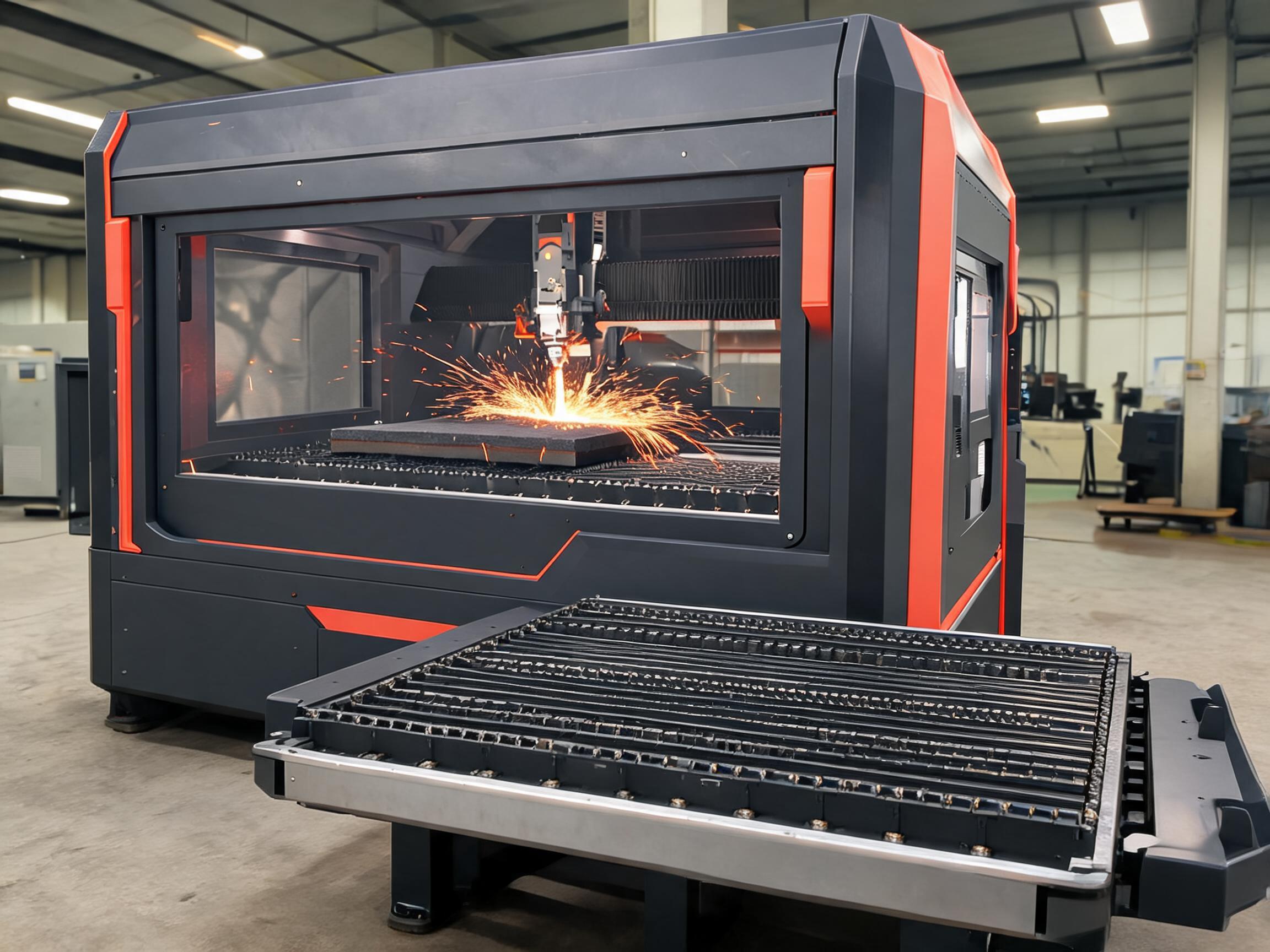
Aluminum and copper behave very differently from carbon steel under a fiber laser. This article explains why reflectivity and thermal conductivity make these non-ferrous metals harder to cut, gives real aluminum thickness limits by power class for 2000W, 20000W and 30000W machines, and sets out what to confirm with a supplier before quoting copper work.
If your shop cuts mostly carbon steel, moving aluminum and copper onto the same fiber laser is not a settings swap. The two metals reflect laser light and conduct heat in ways steel does not, and that changes both the thickness you can hold and the edge you get. Below are the aluminum limits for three real power classes, an honest account of what copper asks for, and the questions to put to a supplier before you quote either material.
- Aluminum and copper are highly reflective and highly heat-conductive; carbon steel is neither to the same degree.
- Aluminum capacity scales steeply with source power: 4 mm at 2000W, 25 mm at 20000W, 30 mm at 30000W with 30 bar high-pressure assist gas.
- Copper is more demanding than aluminum, and no fixed thickness figure should be quoted without confirming capability and edge quality for your exact thickness.
- Assist gas pressure and quality decide whether a cut is clean or drossy as much as the wattage does.
- Why aluminum and copper behave differently from carbon steel
- Aluminum thickness limits by power class
- Copper: what makes it harder
- Assist gas and edge quality
- Buying checklist for reflective-metal workloads
Why aluminum and copper behave differently from carbon steel
Three material properties drive the difference between cutting steel and cutting non-ferrous metals, and none of them can be waved away with a slower feed rate.
Reflectivity. Aluminum and, especially, copper reflect a large share of the laser energy that reaches the surface, rather than absorbing it into the cut. That reflected energy is why these metals are harder on the optics and nozzle than mild steel, why piercing takes longer, and why some machines reach their practical limit long before they reach their rated thickness on steel.
Thermal conductivity. Both metals carry heat away from the cut zone quickly. Steel holds heat where it is needed; aluminum and copper spread it into the surrounding sheet. The result is a wider heat-affected zone, more tendency for the kerf to wander on thin gauges, and a narrower window between "cuts cleanly" and "melts or drosses."
Oxidation and surface condition. Aluminum forms an oxide layer and copper tarnishes; both change how the beam couples into the surface. Reflectivity also rises as a metal gets cleaner and shinier, so polished copper is a different cutting problem from an oxidized mill finish.
The practical consequence: when you compare a fiber laser's steel capacity to its aluminum capacity, expect the aluminum number to be lower and the sensitivity to gas, focus and power to be higher. That is normal for reflective non-ferrous work, not a machine fault.
Aluminum thickness limits by power class
Aluminum sheet laser cutting is where the numbers are most concrete, because aluminum sits between steel and copper in difficulty. Published capability across our fiber laser range shows how sharply capacity grows with source power.
| Machine power class | Aluminum capability | Notable condition | Product reference |
|---|---|---|---|
| 2000W | Up to 4 mm | Entry-level non-ferrous work | 2000W fiber laser cutting machine |
| 20000W | Up to 25 mm | High-power production cutting | 20000W fiber laser cutting machine |
| 30000W | Up to 30 mm | Requires 30 bar high-pressure assist gas | 30000W fiber laser cutting machine |
The gap between 4 mm and 25 mm is not just a bigger box. Jumping to 20000W changes the assist gas supply, the chiller, the floor loading and the electrical service. Jumping to 30000W and 30 mm aluminum adds a high-pressure gas requirement: 30 bar is not something a standard shop air or nitrogen setup delivers, so the gas plant has to be planned as part of the purchase, not after it.
Two cautions on reading this table. First, these are maximum capabilities for the machine class; a 4 mm ceiling on a 2000W unit does not mean every 4 mm aluminum job cuts at production speed with a clean edge. Second, thin aluminum is often harder to keep flat and dross-free than mid-thickness plate, because the heat spreads so fast relative to the sheet. If your mix is mostly 1–3 mm aluminum, the 2000W class is the relevant conversation; if you need structural plate, plan around the 20000W or 30000W class.
Copper: what makes it harder
Copper laser cutting is a step beyond aluminum on both of the properties that make non-ferrous metals difficult. Copper reflects more and conducts heat better than aluminum, so the beam couples less efficiently and the cut zone loses heat faster. In practice that means copper asks more of the source, the optics, the nozzle and the assist gas for the same thickness, and it is far less forgiving of a poorly tuned process.
We deliberately do not publish a fixed copper thickness chart. Copper capability depends heavily on the alloy (pure copper and oxygen-free copper are not the same cutting problem as brasses and bronzes), on whether the material is a thin foil or a thick billet, and on the edge quality you are willing to accept. A number quoted without those conditions is a number that will disappoint someone.
The useful approach is to treat copper as a sample-first material:
- Send the supplier your alloy designation, thickness and a drawing that states the edge requirement.
- Ask for a cut sample in that exact material, and inspect dross, kerf width, taper and oxide on the cut face.
- Confirm what the sample machine configuration was, and that the quoted machine will be supplied in the same configuration.
- Ask what the supplier's stated limit is for your thickness, in writing, and what edge condition that limit refers to.
That is not a dodge. It is how you protect a copper job that has a real tolerance on it, particularly for busbars, heat-sink parts and electrical components where a rough or recast edge causes assembly problems later.
Assist gas and edge quality
With reflective metals, gas does more work than most first-time buyers expect. The 30000W aluminum spec above makes the point: reaching 30 mm depends on 30 bar high-pressure assist gas, not on power alone. Pressure and gas purity affect three things at once:
- Dross and adhesion. Insufficient pressure or a dirty gas supply leaves molten material clinging to the underside, which then needs secondary finishing.
- Speed at a given thickness. Higher usable pressure lets the process run faster without losing the cut, which matters on production aluminum sheet.
- Piercing. Reflective metals are slow and risky to pierce; a controlled pierce with adequate gas is part of why the thick end of the table is achievable at all.
Edge quality is where buyers should be specific rather than aspirational. "Clean cut" means different things on 2 mm aluminum cladding and on 20 mm plate. Decide up front whether the edge will be visible, welded, painted or gasketed, and state the acceptance criteria in the purchase order. A machine that meets a general capability figure can still miss a tight perpendicularity or roughness requirement on a given job, and only a sample cut in your material settles that.
Buying checklist for reflective-metal workloads
Use this list to turn a capability conversation into a machine specification. It also separates the questions a supplier can answer from the ones only a sample cut can.
- Map your thickness mix. List the aluminum and copper gauges you actually cut and the share of volume in each. Size the machine to the thick end of that mix with margin, not to the average.
- Match power class to aluminum ceiling. 4 mm at 2000W, 25 mm at 20000W, 30 mm at 30000W with 30 bar gas. If your thickest routine aluminum is 18 mm, you do not need a 30000W machine; if it is 28 mm, you do.
- Plan the gas plant for the top end. Confirm the assist gas pressure and purity the machine needs at your maximum thickness, and cost the supply, storage and regulation before signing.
- Check the utilities and floor. Power, chiller capacity and floor loading all scale with source power; confirm them against the site, not the brochure.
- Ask for a copper sample. Alloy, thickness, drawing and edge criteria, cut on a machine in the configuration you intend to buy.
- Get the limit in writing with its conditions. Any thickness claim should state the alloy, gas condition and edge quality it assumes.
- Confirm optics and consumable strategy. Reflective metals load the protective lens and nozzle differently from steel; ask what consumables to stock and how often to inspect them.
None of this makes aluminum or copper unreasonable to cut on a fiber laser. It does mean the machine should be chosen from your metal mix outward rather than from a steel-cutting headline figure. If you are sizing for aluminum sheet laser cutting or copper laser cutting, start from your thickest routine job, confirm the assist gas that job needs, and ask for a sample in your own material before the order. The three machine pages linked above state the aluminum capabilities for each power class; for copper, treat the sample and the written limit as part of the specification.