A buyer's guide to laser safety enclosures for fiber laser cutting machines: what Class 1 and Class 4 ratings mean, the five components of a compliant enclosure-EN 12254 OD6+ windows, fail-safe interlocks, IP54 structure, fume extraction-and how to specify one for your cell.
Buying Guide · Laser Safety Compliance
Why an Open Fiber Laser Is a Class 4 Hazard
Fiber lasers operating at 1000W and above emit invisible infrared radiation that can cause permanent eye damage and skin burns from reflected or scattered beams-even several meters from the cutting point. An open-frame fiber laser cutting machine is, by definition, a Class 4 laser product: the most hazardous laser class, where neither the beam nor its diffuse reflections are safe under any exposure condition. Diffuse reflections from cutting can threaten retinal tissue at distances beyond ten meters without physical guarding.
For European buyers this is not just a safety preference. The Machinery Directive 2006/42/EC and the laser safety standard EN 12254 place obligations on employers to provide effective physical guarding of Class 4 laser hazards. Without it, machines cannot legally operate in EU workplaces, and insurers increasingly require certified enclosures as a condition of coverage. In shared workshops-where staff, visitors, and forklift traffic pass near the machine-a laser safety enclosure is the difference between a compliant cell and a permanent liability.
What this guide covers:
• What Class 1 and Class 4 actually mean for a cutting machine
• The five components that define a compliant enclosure
• Sizing, integration, and material flow considerations
• A specification checklist for comparing enclosure suppliers
Class 1 vs. Class 4: What the Ratings Mean for Your Machine
The laser source inside every industrial fiber laser cutter is Class 4. The goal of an enclosure is to turn the complete system into a Class 1 laser product-a machine that contains all hazardous radiation, making the outside safe for anyone in the workshop. Class 1 does not mean low power; it means fully enclosed. Our detailed breakdown of Class 1 vs. Class 4 laser safety enclosures explains the ratings and what they imply for day-to-day operation and audits.
The Five Components That Define a Compliant Enclosure
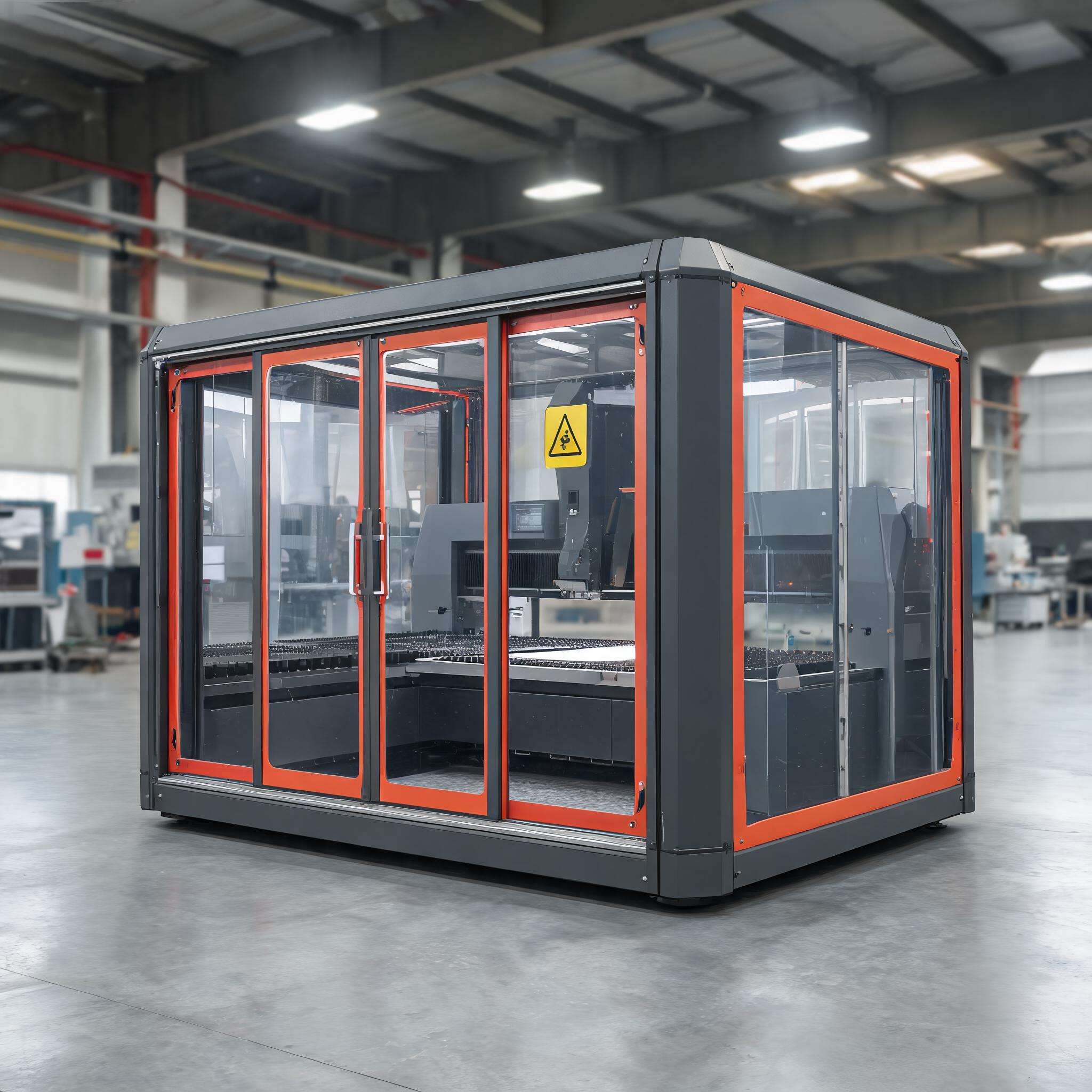
1. Laser-Safe Viewing Windows (EN 12254, OD 6+)
Polycarbonate viewing panels rated to Optical Density 6+ across the 900–11000nm wavelength range block 99.9999% of scattered fiber laser radiation. Windows must be independently tested to EN 12254, the European laser barrier standard. This is what lets operators watch the cutting process safely from any angle-instead of running blind behind solid walls.
2. Fail-Safe Door Interlocks (≤2s Power Cutoff)
Every access door needs magnetic interlocks hardwired to the laser controller: opening any door cuts power to the laser source within two seconds. The circuit must be fail-safe-power loss, sensor failure, or wiring damage all result in laser shutdown, never continued operation. After an interlock break, the laser should not restart until all doors are closed and the circuit is verified. A properly engineered protective cabin uses Schneider Electric safety relays in a hardwired interlock circuit rather than software-only protection.
3. Structure: Frame, Panels, and IP Rating
A 50×50mm welded square steel tube frame provides rigidity and vibration damping; 1.5mm powder-coated steel sheeting resists impacts from dropped parts and material handling. An IP54 enclosure rating protects against dust and splash-two constants in a laser cutting environment.
4. Integrated Fume Extraction
Pre-engineered extraction ports (typically 1–4 ports, 150–250mm diameter) connect the cabin to your fume extraction system and create negative pressure inside, so fume is captured through the ports rather than leaking through door gaps. Without engineered airflow, an enclosure becomes a fume box.
5. Visibility and Service Access
IP65-rated LED interior lighting (24V DC) keeps the cutting area visible, and removable bottom panels allow bed cleaning and slag removal without dismantling the enclosure. These details decide whether the enclosure is used correctly-or propped open.
Sizing and Integration: The Details That Get Missed
- Fit to the machine, not the other way around: an enclosure is custom-built to the machine's footprint, typical dimensions running 3000–8000mm × 2500–4000mm. Measure external dimensions, table size, and loading direction before requesting quotes.
- Material flow: decide between manual sliding doors, motorized lift doors for automated loading, pass-through conveyor openings, or integration with exchange table systems. Retrofitting material flow after installation is expensive.
- Third-party machines: enclosures can be engineered for machines other than the cabin supplier's own-provide the machine's drawings and interface points.
- Wavelength compatibility: OD 6+ windows at 900–11000nm cover all fiber laser cutting machines from 500W to 30000W; CO2, disk, or UV sources need separate verification.
Compliance Cost vs. Incident Cost
An enclosure is a one-time capital item with no consumables and minimal maintenance. Set against it: a single laser eye injury, a failed CE audit, an insurance claim denied for unguarded operation, or production halted by an investigation. For EU deployments the calculation is not really optional-CE marking of the complete machine requires effective guarding of the Class 4 source. For buyers in other markets, the same enclosure often satisfies multinational customers' own safety audits, which increasingly mirror EU requirements.
Enclosure Specification Checklist
- Window rating: OD 6+ across 900–11000nm, tested to EN 12254-ask for the test documentation, not just the claim
- Interlock performance: fail-safe magnetic interlocks, ≤2s laser power cutoff, hardwired (not software-only)
- Enclosure rating: IP54 or better
- Compliance: CE marking, Machinery Directive 2006/42/EC documentation
- Extraction: engineered port count and diameter matched to your fume system; negative-pressure design
- Custom fit: built to your machine footprint and loading direction, with mounting points aligned to the machine base
- Service access: removable panels for bed cleaning; lighting rated for the environment
- Delivery format: pre-fabricated panels with assembly hardware, factory-tested pre-wired interlock circuits, and installation guidance
Related Deep-Dive Topics
- Class 1 vs. Class 4 laser safety enclosures for fiber laser machines
- Laser welding safety: radiation, fume, and PPE
Related Guides
- High power fiber laser cutting machine buyer's guide
- Laser cutting steel plate: what fiber lasers can do from 12mm to 70mm
- Handheld fiber laser welding machine buyer's guide
Safety Equipment
- Laser safety enclosure & protective cabin – EN 12254 OD6+ windows, ≤2s fail-safe interlocks, IP54
Planning a Compliant Laser Cutting Cell?
Share your machine model, external dimensions, and workshop layout. We'll engineer an enclosure that meets CE requirements and fits your material flow.
Request an Enclosure Design Consultation