
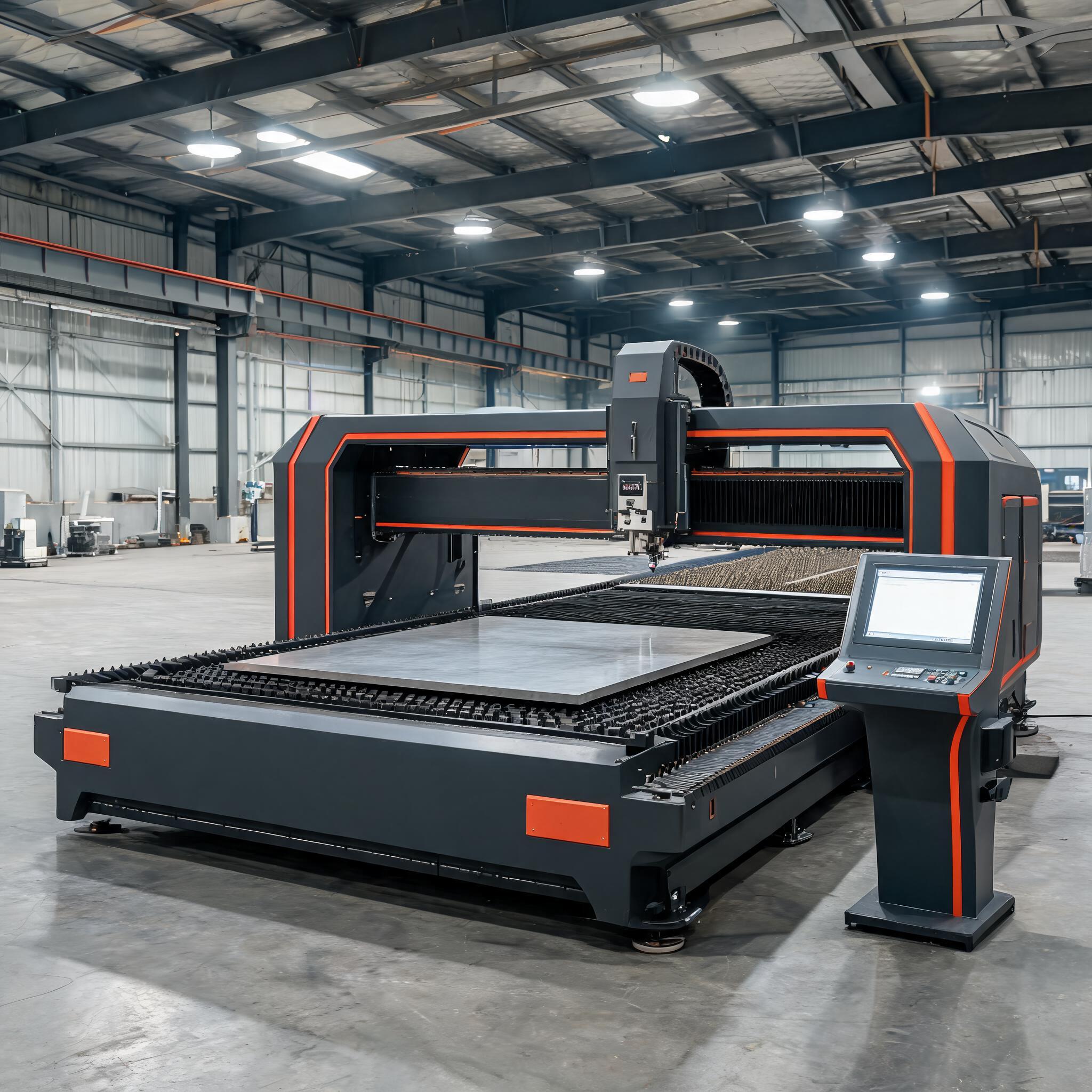
What fiber lasers can realistically do on thick steel plate: practical thickness limits by power from 12,000W to 30,000W, oxygen vs nitrogen assist gas on carbon steel, edge quality versus plasma and oxy-fuel, and how to match a machine to your thickness mix.
Buying Guide · Thick Plate Fiber Laser Cutting
Why Thick Steel Plate Is a Different Cutting Problem
Laser cutting steel plate above 20mm behaves nothing like cutting 3mm sheet. Heat has nowhere to escape, the kerf walls absorb energy, molten slag has a longer path out of the cut, and assist gas must push through a deep channel without losing pressure. For decades this thickness range belonged to plasma cutting, oxy-fuel, and waterjet-each with trade-offs in edge quality, speed, or cost. High-power fiber lasers (12,000W to 30,000W) have changed the economics of laser cutting steel plate in the 20–70mm range, and this guide explains what the technology can realistically do, and how to choose for it.
What this guide covers:
• Realistic thickness limits for carbon steel by laser power
• Oxygen vs. nitrogen assist gas on thick carbon steel
• Edge quality, kerf width, and secondary operations vs. plasma and oxy-fuel
• The industries where thick-plate laser cutting has replaced older processes
• How to match a machine to your actual thickness mix
How Thick Can a Fiber Laser Cut Carbon Steel?
The honest answer depends on power, edge quality expectations, and acceptable cycle time. Manufacturer marketing often quotes optimistic maximums; the figures below reflect the practical single-pass capability of production-configured machines:
| Machine Power | Max Carbon Steel | Max Stainless Steel | Max Aluminum | Bed Size |
|---|---|---|---|---|
| 12,000W | 35mm | 20mm | – | 2000×6000mm |
| 20,000W | 50mm | 30mm | 25mm | 2000×6000mm |
| 30,000W | 70mm | 40mm | 30mm | 2000×6000mm |
Two cautions when reading thickness specifications. First, maximum thickness and productive thickness are different: a machine may pierce and cut 70mm plate, but if that thickness is 5% of your workload, you are paying a premium for occasional capability. Second, edge quality degrades near the maximum-bright, square edges with minimal dross are realistic at 70–80% of the quoted limit, while cuts near the limit run slower and may need edge cleanup. For a thickness-by-power breakdown across materials, see our fiber laser thickness charts and the dedicated guide to 20mm–50mm steel cutting requirements.
Oxygen vs. Nitrogen on Thick Carbon Steel
On carbon steel plate, the assist gas choice is primarily oxygen. The exothermic iron-oxygen reaction adds energy to the cut, which is what makes 25–70mm plate feasible at all-and oxygen costs a fraction of nitrogen. The trade-off is an oxidized cut edge that may need cleaning before welding or painting.
- Oxygen: the standard for carbon steel above ~12mm. Lower gas cost, exothermic assist on thick sections, slightly oxidized edge.
- Nitrogen: chosen for a bright, oxide-free edge on carbon steel when parts go straight to welding or finishing-but at high thicknesses, nitrogen pressure and flow requirements push gas costs up sharply.
If you cut stainless steel or aluminum alongside thick carbon steel, nitrogen demand dominates your operating cost. That is why shops investing in 12,000W+ machines increasingly budget for on-site PSA nitrogen generation-producing 99.9% purity nitrogen on demand instead of relying on delivered cylinders. Our breakdowns of PSA generator costs and choosing purity and flow cover the sizing logic.
Fiber Laser vs. Plasma vs. Oxy-Fuel on Thick Plate
| Factor | Oxy-Fuel | Plasma (Hi-Def) | Fiber Laser (20kW+) |
|---|---|---|---|
| Practical Thickness (CS) | Up to 100mm+ | Up to 50–80mm | Up to 50–70mm |
| Edge Quality | Rough, requires cleanup | Moderate, some bevel | Clean, minimal dross |
| Kerf Width | 2–4mm | 2–5mm | 0.2–0.5mm |
| Cut Speed (30mm CS) | ~0.3–0.5 m/min | ~0.8–1.5 m/min | ~0.9–1.3 m/min |
| Material Waste | High | Moderate | Very low |
| Secondary Operations | Grinding, deburring | Deburring, bevel correction | Often none |
| Material Limitations | Carbon steel only | Most metals | Most metals |
| Operating Cost (thick plate) | Low (gas only) | Moderate | Higher (electricity + gas) |
The comparison shows where fiber lasers win and where they don't. Oxy-fuel still owns extreme thickness above 70mm and the lowest operating cost; plasma keeps an advantage on raw purchase price. But on combined edge quality, kerf width, material waste, and elimination of secondary operations, high-power fiber lasers deliver lower total cost per part across the 20–50mm range where most structural and heavy fabrication work happens. The full decision framework is in our plasma cutting vs. laser cutting comparison.
Where Thick-Plate Laser Cutting Is Used
Structural Steel and Construction
Fabricators processing I-beams, H-sections, and plate above 20mm were among the earliest adopters. Traditional workflows required sawing, drilling, and plasma cutting as separate operations; a 20,000W fiber laser cuts profiles, holes, and bevels in one setup, improving dimensional accuracy and cutting handling time.
Shipbuilding and Marine
Hull sections typically run 10–40mm steel, sometimes thicker. Fiber lasers at 20,000W–30,000W match or exceed plasma cutting speeds on these thicknesses with significantly cleaner edges, and the 0.2–0.5mm kerf wastes far less expensive marine-grade steel than a 2–5mm plasma kerf.
Pressure Vessels and Boilers
Weld joint preparation depends on edge quality. High-power fiber lasers cut 25–45mm plate with clean, square edges that need minimal preparation before welding-particularly valuable for tube sheets and flange plates where hole quality and edge perpendicularity are critical.
Heavy Machinery and Mining Equipment
Wear-resistant plate (Hardox and similar grades) in the 20–40mm range cuts efficiently on 12,000W–20,000W machines, though hardened grades require reduced speeds compared to standard carbon steel at the same thickness.
Practical Requirements Beyond the Laser
- Bed size: 2000×6000mm is the common working area for thick-plate machines; confirm it covers your longest regular part.
- Exchange table: twin-pallet loading keeps a heavy machine cutting while the operator unloads-on long thick-plate cycles this is the difference between 60% and 85% utilization.
- Gas supply: high-pressure oxygen on thick plate, or high-flow nitrogen for stainless work; size storage or on-site generation for peak demand, not average.
- Cooling: industrial-grade chillers rated for continuous duty at your ambient temperature; a 20kW–30kW source generates substantial heat.
- Safety guarding: a 12kW+ fiber laser is a Class 4 source; plan for a Class 1 safety enclosure where operators work near the machine.
Matching the Machine to Your Thickness Mix
A useful screening rule from production shops: if more than 30% of your work is 20mm+ carbon steel, a 12,000W–20,000W machine will likely improve throughput and reduce per-part cost versus outsourcing or multi-process workflows. If thick plate is your core business rather than a segment, the step to 30,000W buys headroom up to 70mm carbon steel and 40mm stainless-and consolidates oxy-fuel, plasma, and waterjet work onto one system. Either way, request sample cuts on your material grades at your thicknesses before committing; cutting trials reveal edge quality and speed far more reliably than specification sheets.
Related Deep-Dive Topics
- How thick can a fiber laser cut steel? 20mm–50mm requirements
- What can a fiber laser cut? Materials and thickness charts by power
- 2000W fiber laser cutting parameters for steel, stainless and aluminum
- Onsite nitrogen generation for laser cutting
- PSA nitrogen generator cost breakdown
Related Comparisons
- Plasma cutting vs. laser cutting for sheet metal shops
- Nitrogen cylinders vs. nitrogen generator: cost comparison
- Aluminum sheet laser cutting: power selection
- Copper laser cutting: thickness limits
Machines for Thick Plate
- 12,000W fiber laser cutting machine – up to 35mm carbon steel
- 20,000W fiber laser cutting machine – up to 50mm carbon steel / 30mm stainless
- 30,000W fiber laser cutting machine – up to 70mm carbon steel / 40mm stainless
- Laser safety enclosure & protective cabin – Class 1 guarding for high-power cells
Cutting 20mm+ Steel Plate Regularly?
Send us your thickness distribution and material grades. We'll help you evaluate whether a 12,000W–30,000W fiber laser fits your production-and show you sample cuts on your own plate.
Discuss Your Thick Plate Application