
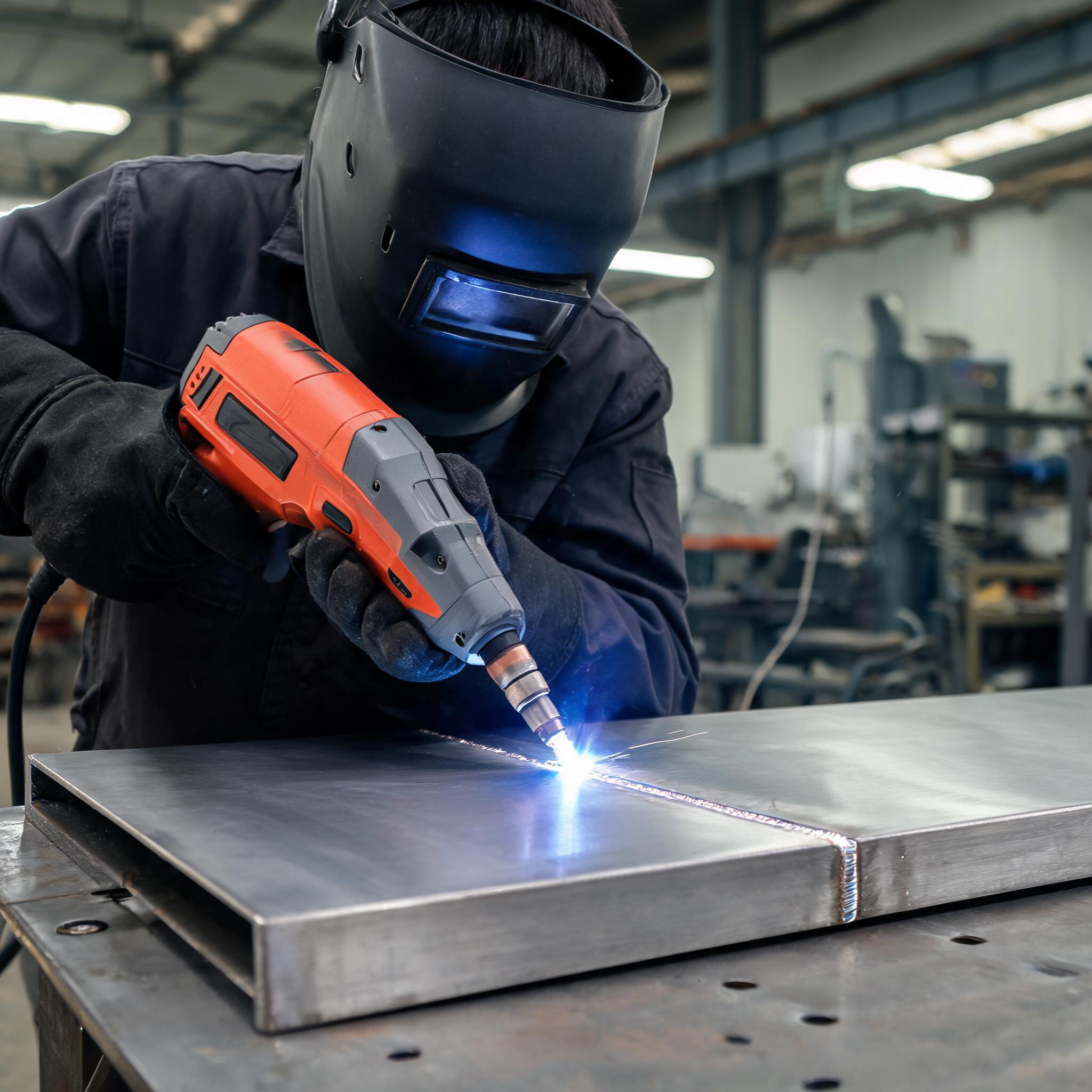
A buyer's guide to handheld fiber laser welding machines: real penetration limits for 1000W, 2000W, 2-in-1 and 3000W configurations, the features that matter in production-CW vs pulsed modes, crosshair targeting, wire feed-and how to choose between handheld and automated formats.
Buying Guide · Handheld Fiber Laser Welding
What a Handheld Fiber Laser Welder Actually Replaces
A handheld fiber laser welding machine occupies a specific slot in a fabrication workflow: faster than TIG on production joints, cleaner and lower-heat than MIG, and far more flexible than a fixed automated welding station when parts vary in size and geometry. If you are still weighing laser against conventional processes, our comparisons of laser welding vs. MIG and laser welding vs. TIG cover the quality and cost trade-offs in depth. This guide focuses on the purchase decision itself: how much power you need, which configuration fits your parts, and which features earn their keep in daily production.
Key Takeaways:
• Choose power by your thickest regular joint, not the rare one-off
• 1000W covers thin sheet; 2000W is the production workhorse for 4–6mm joints
• CW mode for deep penetration, pulsed mode for thin and heat-sensitive parts
• Wire feed capability solves gap problems that autogenous welding cannot
• Water cooling and parameter memory matter more for shift work than peak specs
Power Levels and Real Penetration Limits
Penetration depth is the honest way to compare handheld laser welders. Marketing often quotes beam power; what matters is how deep the machine welds in your material. Here is what Xinhong's handheld lineup actually delivers, from published machine specifications:
| Model | Laser Power | Stainless Steel | Aluminum | Carbon Steel | Best Fit |
|---|---|---|---|---|---|
| 1000W handheld | 1000W | Up to 2mm | Up to 1.5mm | – | Thin sheet: kitchenware, signage, decorative work |
| 2000W handheld | 2000W | Up to 5mm | Up to 4mm | Up to 6mm | Production work on medium-thickness joints |
| 2-in-1 weld + clean | 2000W | Up to 5mm | – | – | Welding plus rust/paint removal in one machine |
| 3000W industrial | 3000W | Up to 8mm | – | – | Heavy sections on a fixed workstation |
Two selection rules follow from this table. First, size the machine for the thickest joint you weld every week-a 1000W unit that handles 2mm stainless beautifully will frustrate a shop whose average job is 4mm. Second, note where the handheld format ends: the 3000W class with 8mm stainless penetration is a gantry-mounted industrial machine, not a handheld gun, because beam and optics at that power need a fixed architecture. If your work regularly exceeds 6mm, that is the boundary to consider.
Features That Earn Their Keep in Production
Continuous Wave vs. Pulsed Mode
Continuous wave delivers steady energy for deep penetration on thicker joints. Pulsed mode concentrates energy in controlled bursts for thin, heat-sensitive materials and dissimilar metal joins, where a continuous beam would warp or burn through. On the 2000W handheld machine, both modes are selectable from the touch panel, and up to 100 parameter sets can be stored and recalled-switching between a 1mm enclosure seam and a 4mm structural joint becomes a menu selection, not a re-tuning session.
Joint Targeting: The Laser Crosshair
Handheld welding lives or dies on aim. An integrated vision system with a laser crosshair projects the exact beam position onto the joint, so the operator sees where the weld will land before pulling the trigger-critical for tight-tolerance structural work and for training new operators quickly.
Wire Feed for Gaps and Build-Up
Autogenous laser welding (no filler) demands tight fit-up. Where gaps exist-rolled edges, imperfect press-brake work, repair jobs-a synchronized wire feed system delivering 0.6–1.6mm filler wire bridges the gap, builds up surfaces, and joins dissimilar metals. If your incoming parts are not consistently gapped to laser standards, wire feed is not an option; it is a requirement.
Cooling and Duty Cycle
Water-cooled systems with dual-temperature circulation keep beam quality stable through 8+ hour shifts, which is what separates a production tool from an occasional-use unit. Air-cooled portables exist, but for shift work, thermal stability protects both weld consistency and laser source life.
Welding Plus Cleaning in One Unit
For shops that also strip rust, paint, or coatings before welding, a 2-in-1 welding and cleaning machine shares one 2000W laser source between a welding gun and a cleaning head with quick-change coupling. It welds up to 5mm stainless and handles surface preparation in the same footprint-often the economical choice for maintenance and refurbishment shops, though a dedicated welder remains preferable for pure production welding.
Safety Is Part of the Specification
Handheld fiber lasers are Class 4 sources operated at arm's length. Beyond the machine's own interlocks and CE compliance, plan for certified laser safety eyewear at the correct optical density, fume extraction at the workpiece, and operator training. Our guide to laser welding safety: radiation, fume, and PPE walks through the full requirements. Enclosed production cells for higher volumes call for different guarding-see Class 1 vs. Class 4 enclosures.
Handheld or Automated: Where Each Format Wins
Handheld wins on flexibility: varied part geometries, oversized assemblies, on-site and repair work. Automation wins on repeat volume: a 6-axis robotic arm laser welding cell with vision seam tracking runs unattended and holds repeatability a human hand cannot across thousands of cycles. Many shops start handheld and add automation later for the highest-volume part families. The decision framework is in our robotic vs. handheld comparison.
Checklist: What to Verify Before You Buy
- Penetration on your materials: request weld samples on your actual stainless, aluminum, and carbon steel thicknesses-not a generic demo coupon
- Source brand and service: IPG or RAYCUS sources with regional support; ask about warranty terms and parts availability in your country
- Gun weight and balance: a 2.2kg-class ergonomic gun matters over an 8-hour shift; have an operator trial it
- Parameter storage: confirm the number of storable weld profiles if you run varied jobs
- Wire feed option: if gaps or dissimilar metals are in your mix, verify filler wire compatibility (0.6–1.6mm range on Xinhong's system)
- Power supply: most 2000W-class units run 380V 3-phase; confirm your shop's electrical service
- CE documentation: full compliance paperwork for EU deployment
- Training and installation: commissioning guidance and operator training included
Related Deep-Dive Topics
- Laser welding safety: radiation, fume, and PPE for handheld welders
- Class 1 vs. Class 4 laser safety enclosures
Related Comparisons
Xinhong Handheld Welding Lineup
- 1000W handheld fiber laser welding machine – 2mm stainless / 1.5mm aluminum
- 2000W handheld fiber laser welding machine – 5mm stainless / 4mm aluminum / 6mm carbon steel
- Handheld welding and cleaning 2-in-1 machine – 2000W, quick-change guns
- Laser welding wire feed system – 0.6–1.6mm filler wire
- 3000W high-power fiber laser welding machine – 8mm stainless, fixed workstation
- Automated 6-axis robotic arm laser welding machine – high-volume production
Not Sure Which Power Level Fits Your Work?
Tell us your materials, joint thicknesses, and daily volume. We'll recommend the right handheld configuration-and can show weld samples on your own material before you decide.
Request a Welding Configuration Recommendation